A lot of what gets called real-world asset tokenization is really just a receipt. A token that represents a claim on an asset sitting somewhere else, managed by a custodian you have to trust, redeemable only through a process you don't control. That's not ownership, it's a wrapper.
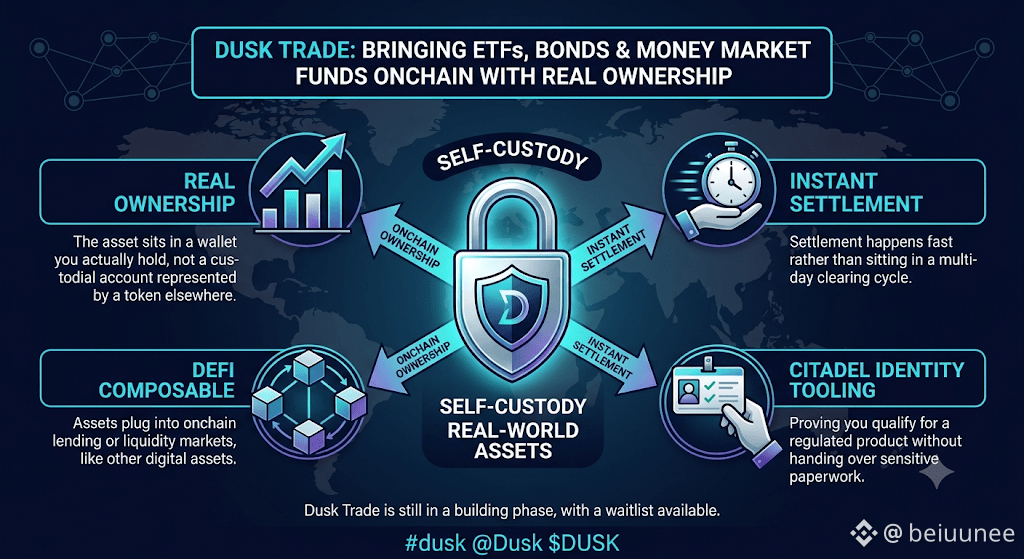
Dusk Trade is positioning itself differently. Built as a neobroker style platform on top of Dusk Network, it's designed to bring money market funds, ETFs, bonds, and broader real-world assets onchain with what the project calls real ownership, meaning the asset sits in a wallet you actually hold, not a custodial account represented by a token elsewhere. Settlement happens fast rather than sitting in a multi-day clearing cycle, and the resulting assets are meant to be composable with DeFi rather than locked inside one closed platform.
That last part is the interesting one. An ETF share or a bond position that can actually plug into onchain lending or liquidity markets, the way any other digital asset can, is a meaningfully different product than a static tokenized certificate sitting in an app doing nothing between statements.
The onboarding side leans on Citadel, Dusk's identity and credential tooling, to verify things like residency or accreditation without exposing the underlying personal documents to the platform itself. It's a small architectural choice that says something bigger: proving you qualify for a regulated product doesn't have to mean handing over a folder of sensitive paperwork to yet another company.
I'd hold the enthusiasm a little in check though. Dusk Trade is still in a building phase, with a waitlist rather than live trading for most users right now. Real ownership and instant settlement are the design goals. Whether the product delivers a smooth, genuinely self-custodied experience once real money and real regulation get involved is the part nobody can promise in advance, only build toward.
#dusk $DUSK @Dusk
Dusk Trade is positioning itself differently. Built as a neobroker style platform on top of Dusk Network, it's designed to bring money market funds, ETFs, bonds, and broader real-world assets onchain with what the project calls real ownership, meaning the asset sits in a wallet you actually hold, not a custodial account represented by a token elsewhere. Settlement happens fast rather than sitting in a multi-day clearing cycle, and the resulting assets are meant to be composable with DeFi rather than locked inside one closed platform.
That last part is the interesting one. An ETF share or a bond position that can actually plug into onchain lending or liquidity markets, the way any other digital asset can, is a meaningfully different product than a static tokenized certificate sitting in an app doing nothing between statements.
The onboarding side leans on Citadel, Dusk's identity and credential tooling, to verify things like residency or accreditation without exposing the underlying personal documents to the platform itself. It's a small architectural choice that says something bigger: proving you qualify for a regulated product doesn't have to mean handing over a folder of sensitive paperwork to yet another company.
I'd hold the enthusiasm a little in check though. Dusk Trade is still in a building phase, with a waitlist rather than live trading for most users right now. Real ownership and instant settlement are the design goals. Whether the product delivers a smooth, genuinely self-custodied experience once real money and real regulation get involved is the part nobody can promise in advance, only build toward.
#dusk $DUSK @Dusk