Read enough summaries of DuskEVM and you will find a specific phrase repeated: developers deploy Solidity contracts and automatically benefit from the privacy and security of Dusk Network's underlying consensus. I want to slow down on the word automatically, because it is doing more work than it should.
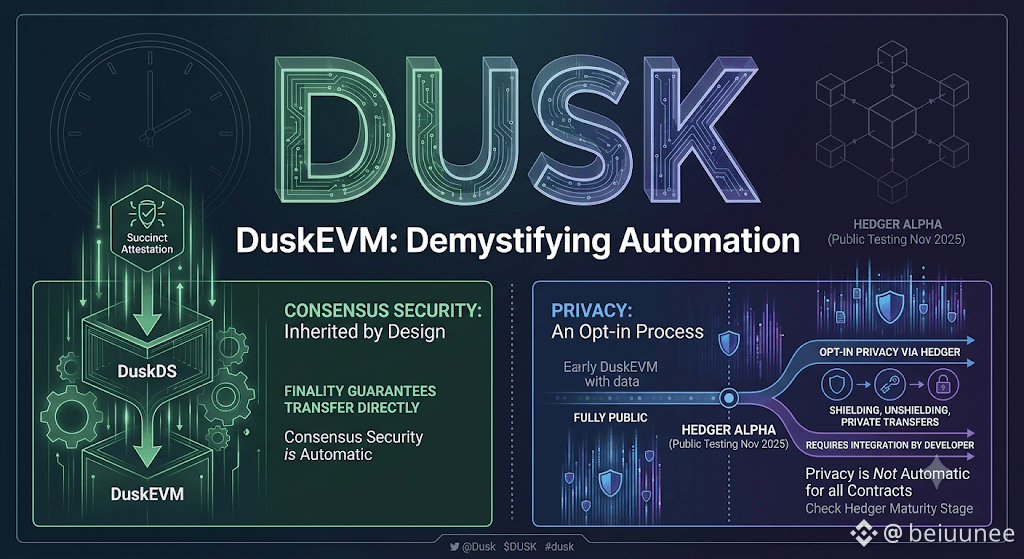
Consensus security genuinely does transfer. Succinct Attestation secures DuskDS, and DuskEVM settles back to that layer, so finality guarantees are inherited by design. Privacy is a different story entirely. The actual privacy mechanism for DuskEVM is Hedger, a module combining zero-knowledge proofs with homomorphic encryption, and it did not exist when DuskEVM was first announced. Public testing only opened in November 2025, running on a public test network, with the team explicitly calling it an early build and asking users to report problems. The alpha itself is narrow by design: it supports shielding, unshielding and private transfers, and Dusk's own researchers have walked through exactly how the private transfer flow works, down to the separate Hedger address each user needs alongside their normal EVM address.
That timeline matters. It means for a real stretch of DuskEVM's early life, contracts deployed on it were exactly as private as contracts on any other EVM chain: not at all, unless a team deliberately integrated Hedger once it matured past alpha. Privacy on DuskEVM is an opt-in feature a developer has to choose and build for, not a background property that shows up automatically because the chain happens to share infrastructure with a privacy-focused Layer 1.
I do not think this is dishonest marketing so much as marketing that is running ahead of shipping software, which happens constantly in this industry. But if privacy is the reason you are interested in Dusk Network at all, check what stage Hedger is actually at before assuming it is baked into every contract by default.
#dusk $DUSK @Dusk
Consensus security genuinely does transfer. Succinct Attestation secures DuskDS, and DuskEVM settles back to that layer, so finality guarantees are inherited by design. Privacy is a different story entirely. The actual privacy mechanism for DuskEVM is Hedger, a module combining zero-knowledge proofs with homomorphic encryption, and it did not exist when DuskEVM was first announced. Public testing only opened in November 2025, running on a public test network, with the team explicitly calling it an early build and asking users to report problems. The alpha itself is narrow by design: it supports shielding, unshielding and private transfers, and Dusk's own researchers have walked through exactly how the private transfer flow works, down to the separate Hedger address each user needs alongside their normal EVM address.
That timeline matters. It means for a real stretch of DuskEVM's early life, contracts deployed on it were exactly as private as contracts on any other EVM chain: not at all, unless a team deliberately integrated Hedger once it matured past alpha. Privacy on DuskEVM is an opt-in feature a developer has to choose and build for, not a background property that shows up automatically because the chain happens to share infrastructure with a privacy-focused Layer 1.
I do not think this is dishonest marketing so much as marketing that is running ahead of shipping software, which happens constantly in this industry. But if privacy is the reason you are interested in Dusk Network at all, check what stage Hedger is actually at before assuming it is baked into every contract by default.
#dusk $DUSK @Dusk