#termmax @TermMax
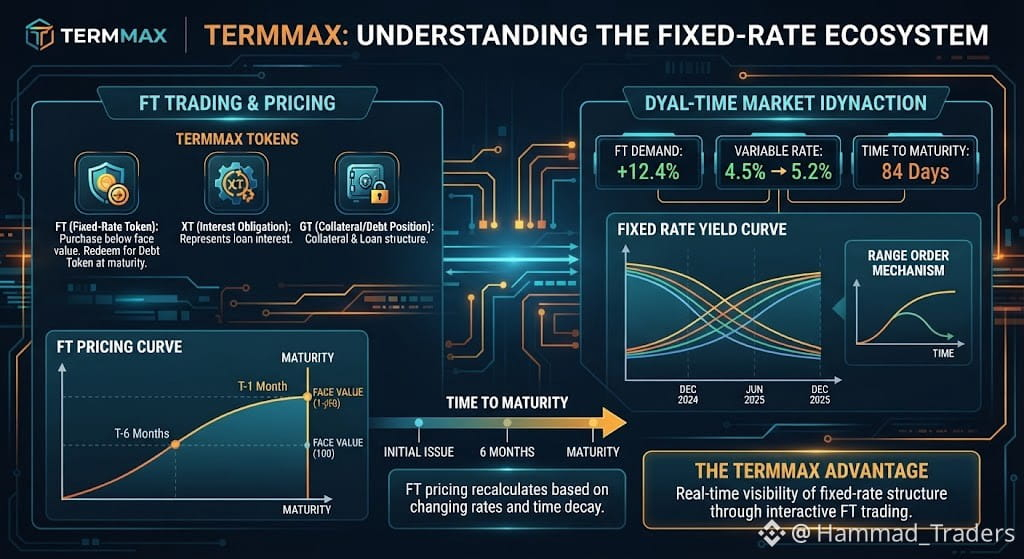
One thing I wanted to understand about @TermMax was why its fixed-rate market uses three different tokens.
The docs describe FT as a fixed-rate token that can be purchased below face value and redeemed for the debt token at maturity. XT represents the interest obligation associated with the loan, while GT represents the collateral and debt position.
That made me look at TermMax differently. The fixed rate is not just a number displayed on a lending screen; it is reflected through the structure of the position itself.
Another detail matters here: FT can be traded before maturity, and its pricing changes as the remaining time to maturity changes. TermMax’s range-order mechanism also recalculates its pricing curve as that time changes.
What I’m genuinely curious about is how these mechanics behave when real market activity, changing rates, and different maturity dates interact at the same time.
I want to watch this in practice.