

Crypto in 2026 looks increasingly different from the markets of previous cycles. Capital is becoming more selective, and simply attaching a popular narrative to a token is no longer enough to guarantee attention.
Recent market research points toward a broader shift from hype toward real usage, revenue, institutional integration and infrastructure. CoinGecko notes that the first half of 2026 did not produce one narrative dominating the entire market. Instead, capital and attention have been distributed across several sectors showing clearer product-market fit.
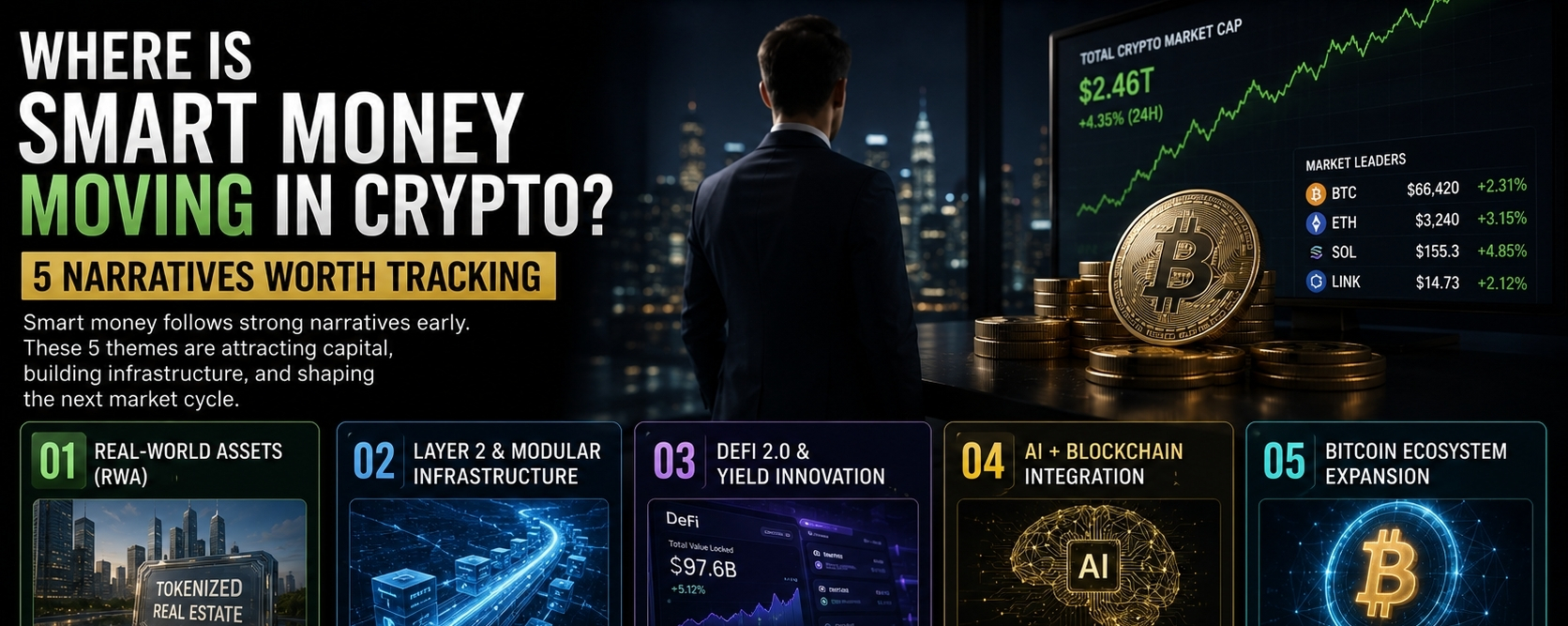
So where should investors look when trying to understand where sophisticated capital may be concentrating? Five narratives stand out.
1. Real-World Assets Are Moving Beyond the Narrative Stage
Real-world asset tokenization remains one of the strongest structural trends in crypto.
RWA technology allows assets such as government securities, funds, private credit, commodities and equities to be represented on blockchain networks.
The important development is that this sector is no longer based only on future promises.
DefiLlama reported that active RWA market capitalization increased from roughly $4.1 billion in early 2025 to about $25.2 billion by March 2026. Tokenized funds accounted for more than half of that market, while commodities, private credit and tokenized equities also expanded.
Momentum continued later in the year. In July, RWAs recorded their first day with more than $1 billion in net inflows, helped by a large addition to Franklin Templeton's iBENJI fund on BNB Chain.
That is why RWA deserves attention. The story is increasingly about traditional financial infrastructure moving onchain rather than another speculative crypto category.
2. Stablecoins Are Becoming Financial Infrastructure
Stablecoins may not generate the same excitement as rapidly moving altcoins, but their importance to crypto continues to grow.
They provide liquidity for trading, DeFi, payments and transfers while also connecting different parts of the onchain economy.
CoinGecko identified stablecoins and stablecoin-focused blockchains as one of the major narratives of 2026. Its July analysis estimated that the stablecoin market had reached approximately $290 billion after peaking near $311 billion earlier in the year.
The bigger opportunity may come from what stablecoins enable.
Imagine businesses settling payments onchain, users transferring dollars internationally, financial institutions moving tokenized assets and automated applications paying for services without relying entirely on traditional payment networks.
Stablecoins can provide the settlement layer underneath many of these activities.
That makes them less of a standalone crypto trend and more like infrastructure connecting multiple narratives.
3. DeFi Is Shifting Toward Real Usage
DeFi remains another sector worth watching, but the market increasingly expects more than enormous yields and token incentives.
The next phase is becoming more focused on sustainable lending, decentralized trading, stablecoin liquidity and revenue-producing financial applications.
Recent DefiLlama data showed around $77 billion in total DeFi TVL and approximately $39.6 billion in seven-day decentralized exchange volume in late July.
Those numbers matter because they represent economic activity occurring directly on blockchain networks.
The bigger opportunity could emerge when DeFi begins connecting more deeply with other growing sectors.
Tokenized real-world assets could become collateral.
Stablecoins could provide liquidity.
Decentralized exchanges could provide markets.
Lending protocols could connect borrowers and capital.
Instead of existing as an isolated crypto ecosystem, DeFi could increasingly become infrastructure connecting different forms of onchain finance.
4. AI x Crypto Is Becoming More Practical
Artificial intelligence remains one of technology's biggest themes, but crypto's AI narrative is changing.
Earlier AI tokens often benefited simply from having an AI-related story.
The next phase appears more focused on actual infrastructure.
CoinGecko highlights areas such as AI payments, verifiable AI infrastructure and decentralized computing resources as important parts of the 2026 AI-crypto narrative.
One particularly interesting concept is machine-to-machine payments.
AI software may increasingly need to purchase computing resources, data or digital services automatically. Blockchain-based payment infrastructure and stablecoins could potentially provide a way for those transactions to happen without traditional payment processes.
This creates an interesting connection between two major narratives: AI and stablecoins.
The projects worth watching may therefore not be those simply carrying an AI label, but those building infrastructure that AI applications genuinely use.
5. Tokenized Markets Could Become a Major Bridge to Traditional Finance
The fifth narrative sits somewhere between RWA, DeFi and institutional adoption: the broader tokenization of financial markets.
Tokenized equities have already demonstrated significant growth.
DefiLlama reported that tokenized stocks and equities expanded from roughly $200 million to about $1.2 billion by March 2026.
CoinGecko's July analysis estimated the category at roughly $1.3 billion and highlighted growing institutional infrastructure around tokenized securities.
The long-term opportunity is much larger than tokenized stocks alone.
Funds, bonds, commodities and other financial products could increasingly interact with blockchain infrastructure.
If that continues, the distinction between "crypto markets" and "traditional markets" could gradually become less obvious.
The Bigger Trend Connecting All Five
The most interesting part is that these narratives are not developing independently.
They are beginning to connect.
RWA brings traditional assets onchain.
Stablecoins provide digital settlement.
DeFi provides financial applications.
AI could automate interactions with those applications.
Tokenization connects more traditional markets with blockchain infrastructure.
This could explain why the market is becoming increasingly interested in infrastructure rather than simply searching for the next speculative token.
CoinGecko's recent research describes 2026 as a market increasingly focused on finding genuine product-market fit, with projects that attract real users and produce real economic activity becoming more important.
Smart Money Doesn't Mean Guaranteed Returns
There is an important distinction between identifying a growing narrative and identifying a good investment.
A sector can attract billions of dollars while individual tokens inside that sector still perform poorly.
Some protocols may have strong usage without their tokens capturing much of that value. Others may become heavily valued before their actual adoption catches up.
That means narrative tracking should be combined with fundamentals such as users, fees, liquidity, revenue, developer activity and actual onchain adoption.
The Bottom Line
The strongest crypto narratives for the rest of 2026 may increasingly revolve around RWA, stablecoins, sustainable DeFi, AI infrastructure and tokenized financial markets.
But the bigger story is not simply where money is moving today.
It is where useful infrastructure is being built.
Previous crypto cycles often rewarded whichever narrative generated the most excitement. The current market appears more selective, with growing attention on projects capable of demonstrating actual demand.
That could make one question especially important when evaluating the next big crypto narrative:
Is capital chasing the story—or is real adoption following it?