
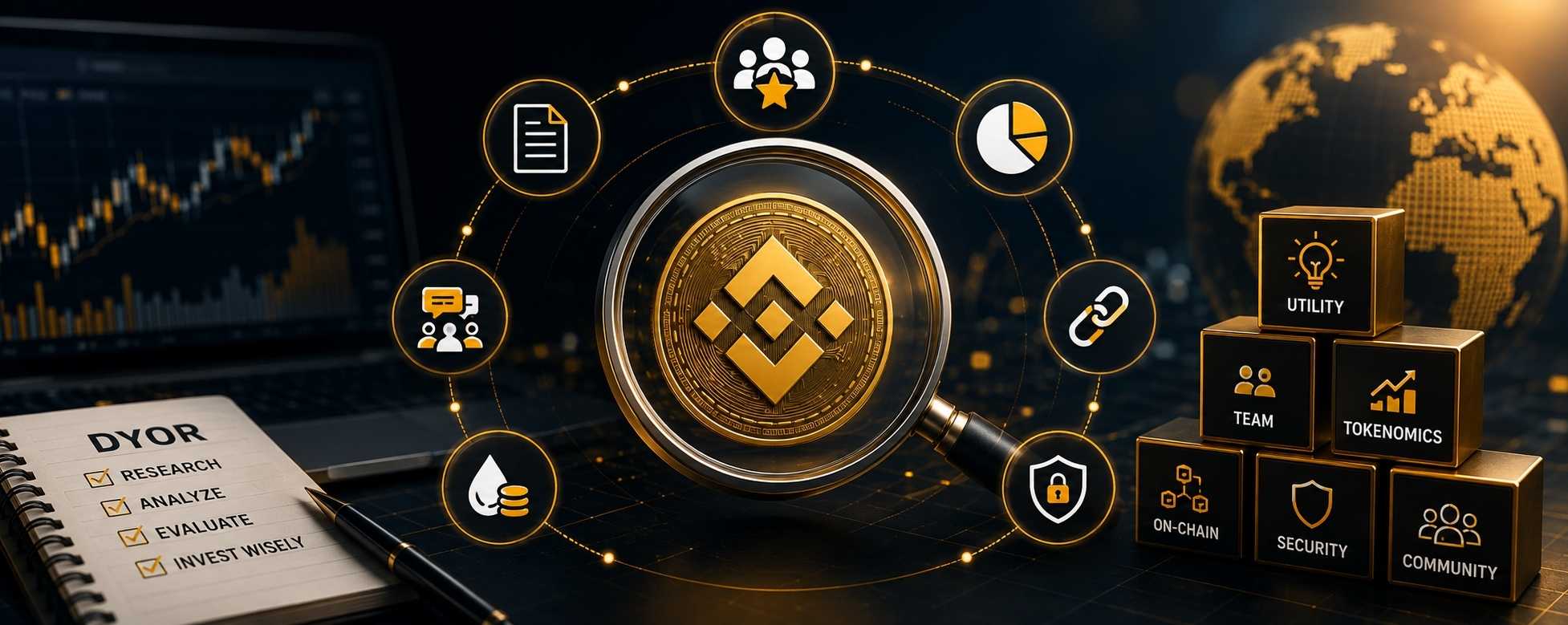
In crypto, “DYOR” — Do Your Own Research — isn’t just a slogan. It’s a risk-management habit.
With thousands of tokens competing for attention, a strong-looking website, huge community, or viral X post doesn't automatically mean a project is fundamentally strong.
Before buying any token, take a step back and investigate the product, team, tokenomics, on-chain activity, security, liquidity, and risks.
Here’s a practical 7-step framework you can use to research a crypto token like a pro. 👇
1️⃣ Understand the Project & Its Utility 📄
Start with the basics.
Read the project's official documentation and whitepaper and answer:
• What problem is the project actually solving?
• Does the product already exist?
• Who is the target user?
• Why does this project need a token?
• What makes it different from competitors?
• Is there genuine demand for the product?
Be careful with projects that rely heavily on buzzwords such as “AI,” “DeFi,” “Web3,” or “next-generation blockchain” without explaining how the technology creates real value.
A token having a use case doesn't automatically make it a good investment.
2️⃣ Research the Team, Investors & Partnerships 👥
Look beyond the project's social-media followers.
Check:
• Are the founders publicly identifiable?
• Do they have verifiable experience?
• What have they built before?
• Are the claimed investors and partners actually confirmed?
• Does the development team remain active?
An anonymous team isn't automatically a scam, but lack of transparency can increase the risk and make accountability harder.
Also remember: a famous VC backing a project does not guarantee the token will perform well.
3️⃣ Analyze Tokenomics & Future Supply 📊
This is one of the most important parts of DYOR.
Look at:
Circulating Supply → Tokens currently available in the market.
Total Supply → Tokens currently issued, including locked tokens.
Max Supply → The maximum number of tokens that can potentially exist, if a maximum is defined.
Market Cap → Price × circulating supply.
FDV (Fully Diluted Valuation) → Price × maximum supply.
Then ask:
• What percentage of the supply is currently circulating?
• How many tokens are held by the team and investors?
• When are the next unlocks?
• How large are those unlocks compared with current trading liquidity?
• Is the token inflationary or deflationary?
• Are there burn or emission mechanisms?
This matters because a low circulating supply can make a token's current market cap look relatively small while a much larger amount of supply may enter the market later.
In fact, CoinGecko reported in April 2026 that 21.3% of the top 300 cryptocurrencies were low-float assets, meaning more than half of their supply had yet to be unlocked.
👉 Never look at market cap alone. Always check FDV and the unlock schedule.
4️⃣ Check On-Chain Activity 🔗
Don't rely only on price charts and social-media hype.
For blockchain projects, investigate actual network activity:
• Active addresses
• Transaction activity
• Holder growth
• Token distribution
• Whale concentration
• Protocol fees/revenue
• TVL for DeFi projects
• Developer activity
A growing community is useful, but real usage is more important than follower counts.
For example, 100,000 followers don't mean much if only a tiny number of users actually interact with the protocol.
5️⃣ Check Smart-Contract Security 🛡️
If you're researching a token or DeFi protocol, don't ignore the contract itself.
Look for:
• Independent security audits
• Known vulnerabilities
• Contract ownership/admin controls
• Minting permissions
• Ability to pause or blacklist transfers
• Ability to change transaction fees
• Upgradeable contracts
• Multisig or centralized admin control
And remember:
An audit is not a guarantee that a project is safe.
A smart contract can still contain vulnerabilities, economic risks, or dangerous permissions even after an audit.
6️⃣ Examine Liquidity & Market Structure 💧
A token can have a large market cap but still have poor liquidity.
Check:
• 24-hour trading volume
• CEX and DEX liquidity
• Bid/ask spreads
• Liquidity depth
• Major trading pairs
• Number of exchanges
• Liquidity-lock information where relevant
Low liquidity can create high slippage, making it difficult to enter or exit a position at the price you expect.
Also watch for extremely concentrated ownership.
If a small number of wallets control a huge percentage of the supply, a few large transactions could have a significant impact on the market.
7️⃣ Research the Community — But Don't Trust the Hype 🌐
Check the project's:
• X
• Discord
• Telegram
• GitHub
• Official announcements
But don't measure a project purely by follower count.
Look for:
✅ Genuine technical discussions
✅ Developers responding to users
✅ Regular product updates
✅ Organic community activity
✅ Transparent communication
Be cautious when the majority of posts are simply:
🚀 “100x soon!”
🌕 “To the moon!”
💎 “Never sell!”
🔥 “Guaranteed profit!”
Hype is not fundamental analysis.
⚠️ Major Red Flags to Watch
🚫 Unrealistic guaranteed-return promises
🚫 Fake or unverifiable partnerships
🚫 Extremely concentrated token ownership
🚫 Very low liquidity
🚫 Large upcoming token unlocks
🚫 Unclear token utility
🚫 No working product or development activity
🚫 Suspicious smart-contract permissions
🚫 Anonymous team with no verifiable track record
🚫 Heavy marketing with little evidence of real usage
🧠 The DYOR Checklist
Before investing, ask yourself:
Product: Does it solve a real problem?
Team: Who is building it, and can I verify their history?
Tokenomics: How much supply is circulating?
FDV: What valuation does the token imply if the full supply is unlocked?
Unlocks: How much new supply is coming, and when?
Usage: Are people actually using the product?
Security: Has the code been reviewed, and what permissions exist?
Liquidity: Can I realistically exit without significant slippage?
Distribution: Are a few wallets controlling too much supply?
Community: Is the activity organic or mostly hype?
If you can't answer these questions, you probably haven't finished your research yet.
💡 Final Thoughts
DYOR doesn't mean finding a token that is guaranteed to go up.
There is no guaranteed investment in crypto.
The goal of research is to understand what you're buying, why it might have value, and what could go wrong.
Don't buy a token simply because an influencer mentioned it, because it's trending, or because the price is moving quickly.
Research first. Risk-manage second. Invest only when you understand the risks. 🔍
💬 What's the FIRST thing you check when researching a new crypto token?
👇 Share your DYOR checklist in the comments!
#DYOR #CryptoEducation #BinanceSquare #CryptoResearch #Tokenomics