Introduction
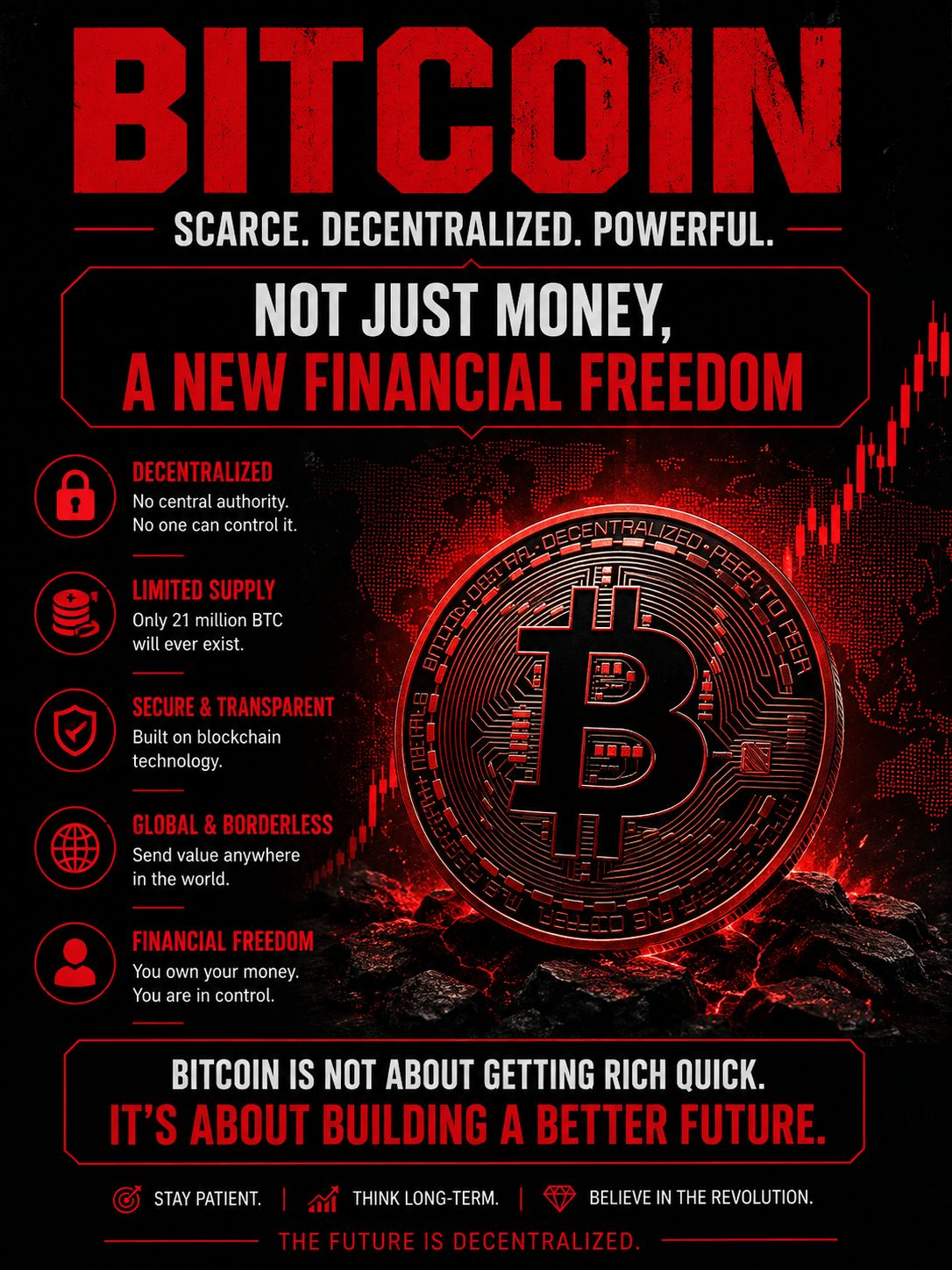
Bitcoin began as an unusual idea: a form of digital money that could operate without a central bank, government, or traditional financial institution controlling the network. Today, it has developed into something much larger—a global financial technology, a digital asset, and for many people, a new way of thinking about ownership and monetary freedom.
Unlike conventional currencies, Bitcoin does not exist as physical notes or coins. Its value is represented through a decentralized network secured by cryptography and maintained by thousands of computers around the world. No single company owns Bitcoin, and no central authority can simply create unlimited quantities of it.
This makes Bitcoin fundamentally different from traditional financial systems.
A New Kind of Digital Scarcity
One of Bitcoin's most important innovations is digital scarcity.
For decades, digital information could be copied almost instantly. A photograph, document, or song could be duplicated without destroying the original. Money, however, cannot work that way. If digital money could simply be copied, the financial system would become meaningless.
Bitcoin introduced a mechanism for creating scarce digital assets without relying on a central organization to maintain the records.
The Bitcoin protocol limits the total eventual supply to 21 million BTC. New bitcoins enter circulation through the network's mining process, and the issuance rate decreases over time through programmed halvings.
This predictable monetary policy is one of Bitcoin's defining characteristics.
Bitcoin as a Global Network
Bitcoin is more than an asset displayed on an exchange screen. It is a worldwide network that operates continuously.
Transactions can be broadcast to the network from almost anywhere with an internet connection. Miners process transactions and compete to add new blocks to the blockchain. Nodes independently verify that the rules of the Bitcoin protocol are being followed.
This architecture creates an unusual combination of transparency and independence.
Anyone can examine the public blockchain. At the same time, users do not need permission from a central bank to hold or transfer bitcoin.
That distinction has become increasingly important in a world where financial systems are becoming more digital.
The Meaning of Self-Custody
Bitcoin also introduced a powerful concept: self-custody.
With traditional banking, ownership and access to money generally depend on an account maintained by a financial institution. Bitcoin can instead be held directly by the person controlling the private keys.
The phrase "not your keys, not your coins" reflects this principle.
Self-custody can provide greater control, but it also creates responsibility. Losing private keys can mean permanently losing access to funds. Poor security practices can expose assets to theft or fraud.
Therefore, Bitcoin's freedom comes with an important requirement: users must understand how to protect what they own.
Bitcoin and the Future of Payments
Bitcoin was originally presented as a peer-to-peer electronic cash system. Although its role today extends beyond everyday payments, the underlying goal remains relevant.
Bitcoin can function as a settlement network for transferring value across borders without requiring the traditional chain of correspondent banks.
Second-layer technologies such as the Lightning Network attempt to make Bitcoin transactions faster and potentially more suitable for smaller payments.
The long-term question is not simply whether Bitcoin will replace cash or bank accounts. A more interesting possibility is that Bitcoin becomes one layer within a broader global financial infrastructure.
Bitcoin as Digital Gold
Another way to understand Bitcoin is to compare it with gold.
Gold has historically been valued because it is scarce, durable, difficult to produce, and independent of any single government's monetary policy. Bitcoin shares some of these characteristics while adding qualities that are native to the digital world.
Bitcoin can be transmitted electronically, divided into extremely small units, and verified through a public network.
However, the comparison should not hide the differences.
Gold has thousands of years of history as a store of value. Bitcoin is comparatively young and remains subject to significant price volatility, technological risks, regulatory uncertainty, and changing market conditions.
Bitcoin's future therefore cannot simply be assumed. It must be evaluated on its own merits.
The Investment Debate
Bitcoin has become one of the most closely watched assets in the world because of its extraordinary historical price movements.
Supporters argue that limited supply combined with growing adoption could create long-term scarcity. They point to institutional participation, expanding infrastructure, and increasing public awareness as potential drivers of demand.
Critics focus on volatility, speculative behavior, regulatory risks, technological competition, and the possibility that market enthusiasm can push prices far beyond reasonable valuations.
Both perspectives contain important lessons.
Bitcoin should not be treated as a guaranteed path to wealth. Its price can rise dramatically, but it can also experience severe declines. Anyone considering exposure should understand that possibility before investing.
Bitcoin and Institutions
The Bitcoin market has changed substantially as professional investors and financial institutions have become more involved.
Institutional participation can increase liquidity, accessibility, and legitimacy. Financial products can also make Bitcoin easier for traditional investors to gain exposure to.
At the same time, institutionalization creates an interesting contradiction.
Bitcoin was designed to allow individuals to control their assets without intermediaries. Yet much of the modern investment ecosystem surrounding Bitcoin involves exchanges, custodians, funds, and other intermediaries.
The future may therefore involve two parallel forms of Bitcoin ownership: institutional exposure through traditional financial products and direct ownership through personal wallets.
Regulation: Challenge and Opportunity
Bitcoin exists in a complicated relationship with governments.
Governments have legitimate concerns involving taxation, consumer protection, money laundering, financial stability, and market manipulation. Bitcoin advocates, meanwhile, often emphasize financial privacy, individual ownership, and freedom from excessive centralized control.
Regulation will likely continue to evolve.
Clear rules can encourage responsible businesses and reduce uncertainty. Excessive restrictions, however, could discourage innovation or push activity into less transparent markets.
The challenge for policymakers is finding a balance between protecting people and allowing technological innovation to develop.
The Environmental Question
Bitcoin mining has also generated substantial debate because proof-of-work mining requires electricity.
Critics argue that Bitcoin's energy consumption creates environmental concerns. Supporters respond that the industry can use renewable energy, stranded energy, and energy sources that might otherwise be wasted.
The environmental discussion is more complicated than simply asking how much electricity Bitcoin uses.
Important questions include where the energy comes from, what alternatives exist, how efficiently mining hardware operates, and whether mining can help stabilize or monetize energy systems.
As the industry develops, the environmental impact of Bitcoin will remain an important area of research and debate.
Bitcoin's Greatest Innovation May Not Be the Coin
Perhaps the most important contribution of Bitcoin is not bitcoin itself.
Bitcoin demonstrated that a decentralized network could maintain a shared financial ledger without a central administrator.
That idea influenced an entire generation of blockchain and cryptocurrency projects.
Many subsequent systems attempted to build decentralized applications, digital assets, smart contracts, decentralized finance, and new forms of online ownership.
Bitcoin remains different from many of these projects because its design is intentionally conservative. Its core protocol prioritizes security, decentralization, and monetary reliability over rapidly adding features.
A Different Vision of the Internet
The internet transformed information.
Bitcoin has the potential to transform ownership.
Traditional internet users can easily copy information, but ownership of digital assets has historically depended heavily on centralized databases. Bitcoin demonstrated that digital ownership could instead be represented through cryptographic control and a decentralized ledger.
This concept could become increasingly significant as economies move further into digital environments.
People may increasingly own digital currencies, digital securities, digital collectibles, virtual property, and other online assets.
Bitcoin is one of the earliest major experiments in this broader transformation.
The Risks That Should Not Be Ignored
A serious Bitcoin discussion must include its risks.
Bitcoin can experience extreme volatility. Regulatory environments can change. Exchanges can fail. Users can lose access to wallets. Cybersecurity threats remain real. Scams and fraudulent investment schemes can exploit Bitcoin's popularity.
There is also technological and competitive uncertainty.
No investor can know with certainty what the global financial system will look like decades from now.
For these reasons, Bitcoin should be approached as an emerging technology and financial asset—not as a guaranteed investment.
What Could Bitcoin Become?
The most interesting Bitcoin question is not simply, "How high can the price go?"
A better question is:
What role could Bitcoin play in the global economy?
It could remain primarily a speculative asset. It could become a widely recognized digital store of value. It could serve as a neutral settlement asset between countries and institutions. It could become an important reserve asset for some organizations. Or it could develop in ways that are difficult to predict today.
Several of these possibilities could exist simultaneously.
Bitcoin does not necessarily need to replace traditional money to be significant. A technology can change a system simply by becoming an alternative within it.
The Long-Term Perspective
Bitcoin's development is still relatively young when compared with established financial institutions.
The internet itself provides a useful reminder: early technologies are often difficult to understand because their eventual applications are not immediately obvious.
Bitcoin's future will depend on adoption, security, regulation, infrastructure, economics, competition, and public trust.
Its greatest strength may be the simplicity of its central proposition: a scarce digital asset governed by transparent rules rather than by a single institution.
Whether that proposition ultimately becomes a foundation of the global financial system or remains a major experiment in digital money is still an open question.
Conclusion
Bitcoin represents one of the most ambitious financial experiments of the digital era.
It combines cryptography, computer networking, economics, game theory, and monetary ideas into a system designed to operate without a central controller.
Its limited supply challenges conventional assumptions about money. Its decentralized structure challenges traditional ideas about financial intermediaries. Its global accessibility challenges the boundaries of national financial systems.
But Bitcoin is not without weaknesses. Volatility, security responsibilities, regulatory uncertainty, environmental concerns, and technological risks remain significant.
The most reasonable way to understand Bitcoin is neither as a guaranteed revolution nor as a meaningless speculative bubble.
It is a technology and financial network whose long-term importance is still being determined.
The Bitcoin story is ultimately a story about a larger transformation: the movement of money from the physical world into the digital world, and the search for a way to make digital value scarce, transferable, verifiable, and independent.
Whatever Bitcoin's final destination may be, its experiment has already changed the conversation about what money can be in the digital age.#BTC走势分析 #BTC突破7万大关