
There is one sentence about Babylon that sounds simple until you follow it all the way through:
You keep custody of your BTC.
Correct.
But that does not mean the person you delegate to becomes irrelevant.
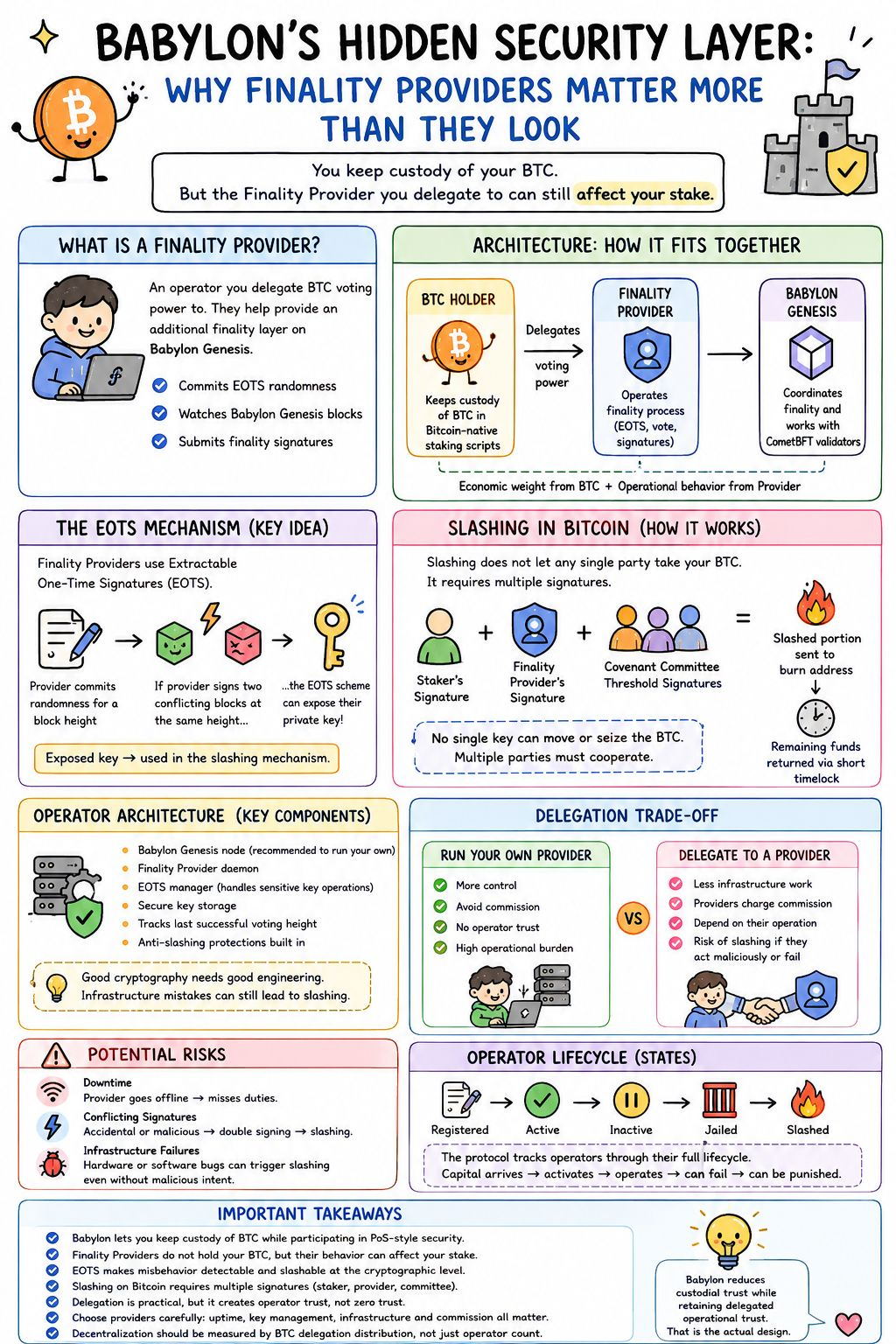
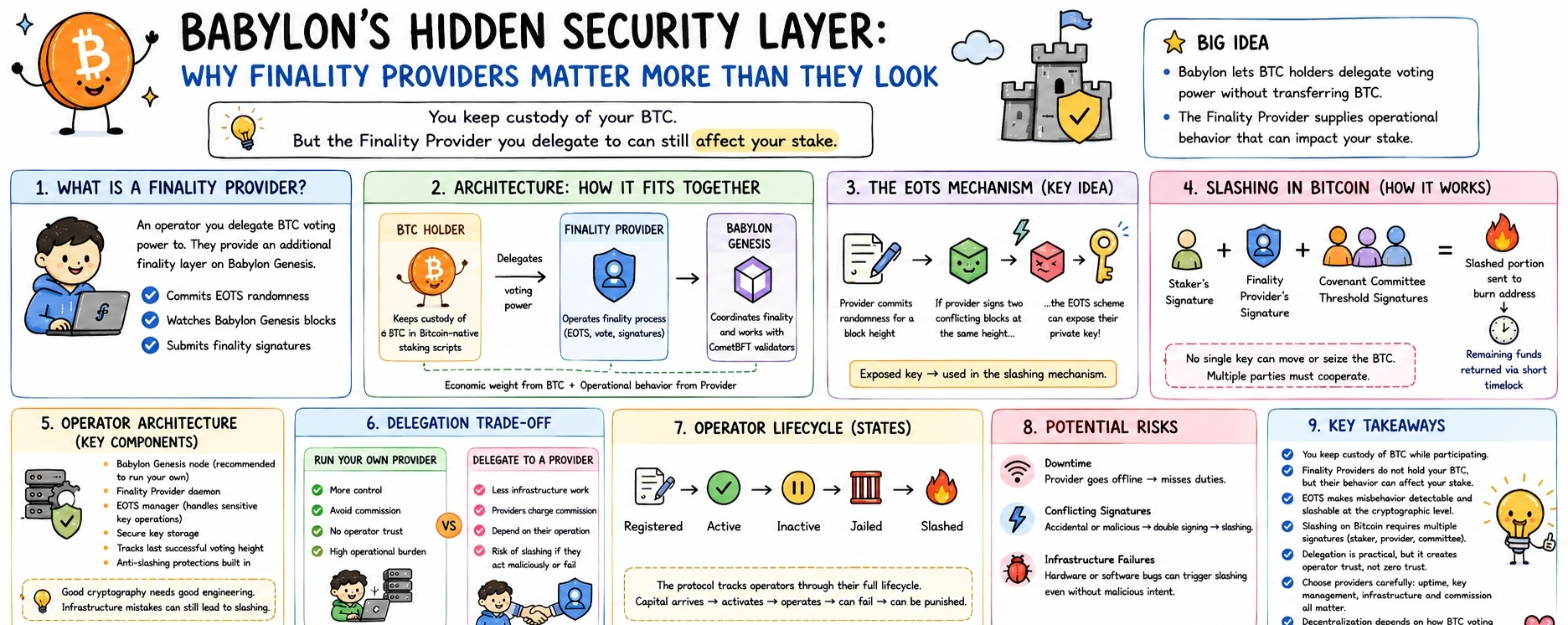
In Babylon, a BTC holder can delegate voting power to a Finality Provider without transferring the BTC itself. The coins remain locked through Bitcoin-native staking scripts, while the Finality Provider participates in the finality process on Babylon Genesis.
That distinction changes how I think about the risk.
The Finality Provider doesn't have custody of my BTC.
But its behavior can still affect my stake.
That is a very different trust model from a centralized custodian, yet it is still a trust model worth understanding.
A Finality Provider is basically the operator sitting between a BTC delegation and Babylon's finality mechanism.
It commits EOTS randomness, watches Babylon Genesis blocks and submits finality signatures. Its job isn't to produce the normal Babylon Genesis blocks. That belongs to the chain's CometBFT validators.
The Finality Provider is doing something narrower: providing an additional finality layer backed by delegated Bitcoin.
This separation is one of Babylon's more interesting architectural decisions.
The BTC holder supplies economic weight.
The Finality Provider supplies operational behavior.
Babylon Genesis coordinates the relationship.
If the operator performs correctly, those pieces fit together.
If the operator behaves incorrectly, the economic consequences can reach the delegator.
And that last part is where the design gets serious.
Babylon uses Extractable One-Time Signatures, or EOTS.
The basic idea is clever.
A Finality Provider commits randomness for a block height before submitting its finality vote. If it signs two conflicting blocks at the same height using the same underlying EOTS secret randomness, the cryptographic construction can expose the provider's private key. That exposed key can then be used as part of the slashing mechanism.
So the protocol isn't relying only on someone watching a validator and saying, “that operator misbehaved.”
The signature scheme itself is part of the punishment mechanism.
That matters because the whole point of Bitcoin staking is to turn BTC into something economically slashable without moving it into a conventional smart contract environment.
The Bitcoin side therefore has to understand more than just “locked” and “unlocked.”
It needs a way to express what happens when the Finality Provider violates the rules.
Babylon does that through specific Bitcoin spending paths.
The documented slashing path requires the staker's signature, the Finality Provider's signature and a threshold of covenant committee signatures. The resulting transaction sends the slashed portion to a burn address and returns the remaining funds through a short timelock.
That is an important detail.
The Finality Provider doesn't have a private key that lets it simply take the delegator's BTC.
And the covenant committee doesn't independently get unrestricted control over the stake either.
The slashing path requires multiple parties to cooperate.
But the Finality Provider still matters because its cryptographic key becomes part of the mechanism that enables slashing after double signing.
This is why I wouldn't describe Finality Provider selection as just a yield comparison.
Commission matters.
Uptime matters.
Infrastructure matters.
But key management practices matter too.
Babylon's operator architecture separates the Finality Provider's EOTS key from its Babylon Genesis account key. The EOTS key is tied to the provider's identity in the Bitcoin security model, while the Babylon Genesis key is used for transactions and rewards.
That is a pretty consequential operational constraint.
A normal user might look at a provider and see a commission rate, a name and an amount of delegated BTC.
Underneath that interface is a more complicated security stack.
The provider needs a Babylon Genesis node or trusted RPC access.
It needs the Finality Provider daemon.
It needs the EOTS manager.
It needs secure key storage.
And those components have to coordinate correctly.
Babylon's documentation recommends running your own Babylon Genesis node rather than relying on third party RPC infrastructure for security. The EOTS manager is also designed to handle sensitive key operations separately from the Finality Provider daemon.
This is where the phrase “non custodial staking” can become misleading if we aren't careful.
Non custodial describes control over the asset.
It does not mean operational independence from the delegated operator.
A user can maintain direct control over the BTC while still accepting the consequences of a Finality Provider's behavior.
That is normal in PoS systems.
The interesting part is that Babylon carries this model into Bitcoin without wrapping the BTC.
And that creates a slightly different risk boundary.
Consider a simple scenario.
I stake BTC and delegate to Provider A.
Provider A goes offline.
That is one kind of problem.
Now suppose Provider A's infrastructure accidentally signs conflicting blocks at the same height.
That's much more serious.
The EOTS design is intended to make that behavior detectable and slashable, and Babylon explicitly acknowledges that honest operators can face slashing risks from hardware failures or software bugs, not just malicious behavior.
That sentence is more important than it looks.
It means operator security isn't merely about preventing an attacker from stealing keys.
It's also about preventing ordinary infrastructure mistakes from becoming protocol level economic mistakes.
This is why Babylon has anti slashing protection built into the operator stack.
The Finality Provider daemon tracks the last successful voting height and avoids requesting another signature for a height it has already voted on. The EOTS manager has complementary protection around the signing process.
I read this as an admission of something healthy: cryptography can make bad behavior punishable, but it doesn't automatically make infrastructure reliable.
You still need engineering around the cryptography.
And then there is the delegator's side of the equation.
Babylon's documentation makes clear that a BTC staker does not have to run a Finality Provider themselves. Delegation is supported, but the provider generally charges commission, and if the delegated provider acts maliciously, the staker's stake can also be slashed.
Running your own provider avoids that operator trust and commission, but obviously creates a much larger operational burden.
That is probably the cleanest way to describe the trade off.
Run it yourself:
more control, more responsibility.
Delegate:
less infrastructure work, more dependence on someone else's operation.
There isn't a magical third option.
And I don't think this is a weakness unique to Babylon.
It's simply more visible because Babylon is trying to combine Bitcoin's asset properties with PoS style delegation.
The system needs a way for ordinary BTC holders to participate without asking every user to run infrastructure.
Delegation is the practical answer.
But delegation necessarily creates operator relationships.
What Babylon changes is the custody layer.
The operator doesn't receive the BTC.
The user's coins remain in Bitcoin based staking conditions, while the operator receives voting power and earns commission from delegated stake.
That is a meaningful reduction in trust.
It just isn't zero trust.
And I think that distinction matters especially as Babylon grows.
A Finality Provider with a small amount of delegated BTC represents one operational dependency.
A provider with a very large delegation represents a much more significant concentration of economic influence.
Babylon's current configuration allows a limited active Finality Provider set, so I wouldn't judge decentralization simply by counting registered operators.
I'd want to know how the actual BTC delegation is distributed.
If a handful of providers control a large share of active BTC voting power, then the practical security picture is different from what the raw operator count suggests.
That is an observable metric worth following.
There is another detail I find useful here: a Finality Provider can move through several states such as registered, active, inactive, jailed and slashed.
That means Babylon isn't treating “validator” as a binary identity.
The protocol is tracking an operator lifecycle.
That sounds mundane, but these state transitions are exactly where staking systems become real rather than theoretical.
Capital arrives.
Delegation activates.
Votes are produced.
Operators can fail.
They can be jailed.
They can be slashed.
Delegation can disappear.
And the system has to keep the Bitcoin side state and Babylon side state consistent throughout all of it.
Babylon's architecture therefore includes more than Bitcoin scripts and a Cosmos based chain. It also includes staking monitors, indexers, checkpointing, Finality Providers, EOTS infrastructure, covenant enforcement and monitoring mechanisms.
That broader architecture changes how I interpret the phrase “Bitcoin security.”
Bitcoin is providing the asset and the settlement environment.
It is not independently running the entire Babylon security protocol.
Babylon is building the coordination machinery around Bitcoin.
And the more I look at that distinction, the more I think Finality Providers deserve to be treated as first class parts of the security model rather than just a delegation UI choice.
The architecture is strong in one important way: the user doesn't have to surrender custody of BTC to obtain delegated security participation.
The trade off is that the user still has to care who receives the voting power.
That's not a contradiction.
It's the actual design.
Babylon reduces custodial trust while retaining delegated operational trust.
The question isn't whether that trust exists.
The useful question is how narrow it can remain, how well the cryptography constrains it, how reliable the operator infrastructure becomes, and how decentralized the delegated voting power actually is.
For me, that is the part of Babylon worth watching beneath the headline.
Not just how much BTC is staked.
Not just how many Finality Providers exist.
But how much security ultimately depends on each one.