@BabylonLabs_io ki TBV architecture ko dekhte hue mujhe ek interesting cheez samajh aayi.
Whitepaper mein cryptographic guarantees bohat strong lagti hain, lekin real-world security sirf mathematics se nahi, edge cases se bhi test hoti hai.
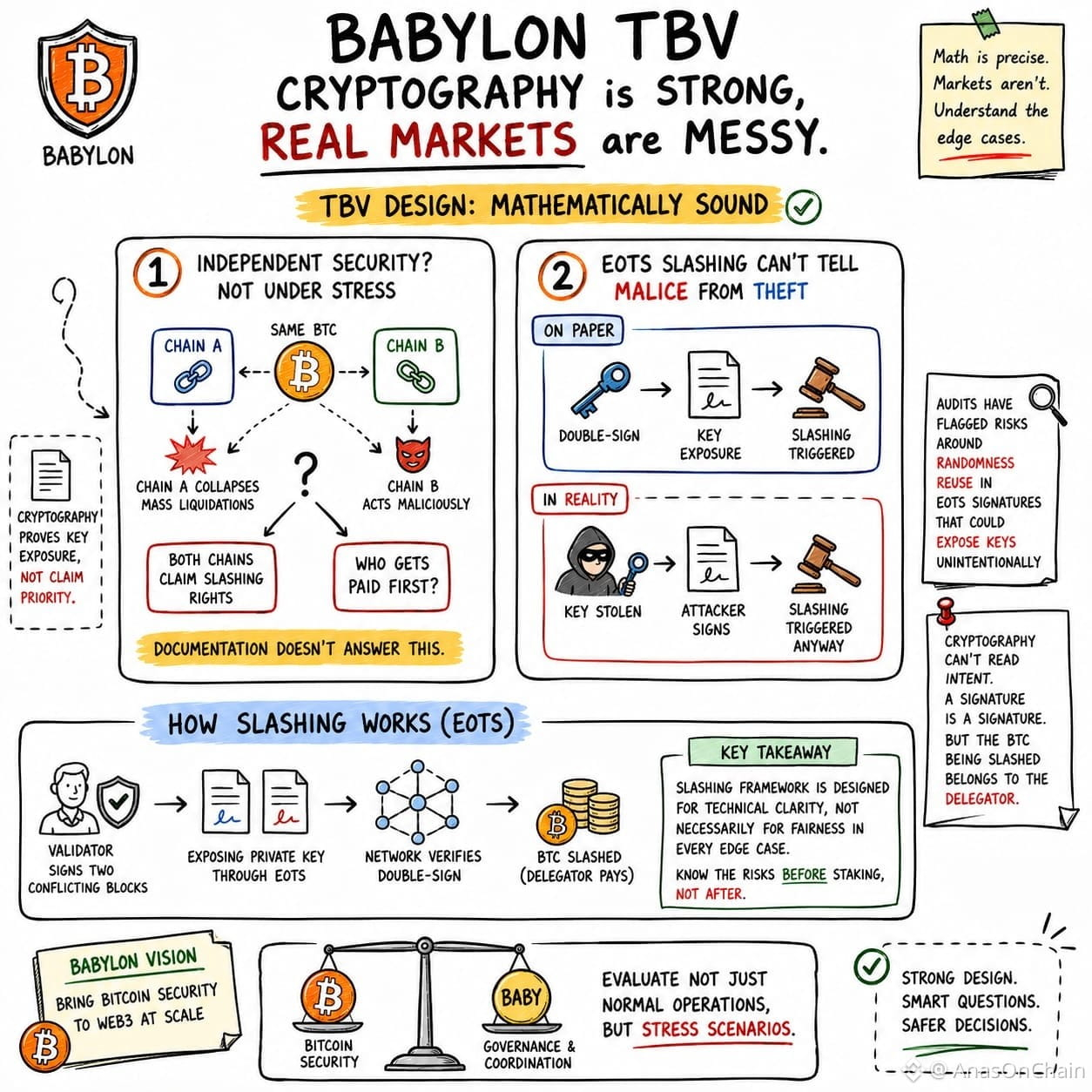
TBV ka model allow karta hai ke ek hi BTC multiple Bitcoin Secured Networks ko economic security provide kare. Ye capital efficiency ke liye powerful design hai. Lekin agar do chains extreme market stress ke dauran ek hi validator ke against slashing claim generate kar dein, to priority kis basis par decide hogi? Ye scenario documentation mein clearly define nahi hota.
Dusri observation EOTS slashing mechanism par thi.
EOTS validator honesty enforce karta hai kyun ke double-signing private key expose kar deti hai aur slashing trigger hoti hai. Lekin blockchain sirf signature dekh sakta hai, intention nahi. Agar key compromise ho jaye aur attacker usi key se sign kare, on-chain result phir bhi double-signing hi nazar aata hai.
Isi liye independent security reviews bhi randomness handling aur key management ko critical area mante hain, kyun ke technical implementation security ka utna hi important hissa hai jitna cryptographic design.
Mere liye ye protocol ki weakness nahi...
Balke trust model ko samajhne ka point hai.
Delegators sirf yield ya rewards choose nahi kar rahe. Wo us slashing framework par bhi trust kar rahe hote hain jo technical clarity provide karta hai, chahe har edge case mein intent ko identify na kar sake.
Babylon Bitcoin ki security ko Web3 tak extend kar raha hai, lekin us security model ko evaluate karte waqt sirf normal operation nahi, stress scenarios ko bhi dekhna zaroori hai.
@BabylonLabs_io $BABY #baby
Whitepaper mein cryptographic guarantees bohat strong lagti hain, lekin real-world security sirf mathematics se nahi, edge cases se bhi test hoti hai.
TBV ka model allow karta hai ke ek hi BTC multiple Bitcoin Secured Networks ko economic security provide kare. Ye capital efficiency ke liye powerful design hai. Lekin agar do chains extreme market stress ke dauran ek hi validator ke against slashing claim generate kar dein, to priority kis basis par decide hogi? Ye scenario documentation mein clearly define nahi hota.
Dusri observation EOTS slashing mechanism par thi.
EOTS validator honesty enforce karta hai kyun ke double-signing private key expose kar deti hai aur slashing trigger hoti hai. Lekin blockchain sirf signature dekh sakta hai, intention nahi. Agar key compromise ho jaye aur attacker usi key se sign kare, on-chain result phir bhi double-signing hi nazar aata hai.
Isi liye independent security reviews bhi randomness handling aur key management ko critical area mante hain, kyun ke technical implementation security ka utna hi important hissa hai jitna cryptographic design.
Mere liye ye protocol ki weakness nahi...
Balke trust model ko samajhne ka point hai.
Delegators sirf yield ya rewards choose nahi kar rahe. Wo us slashing framework par bhi trust kar rahe hote hain jo technical clarity provide karta hai, chahe har edge case mein intent ko identify na kar sake.
Babylon Bitcoin ki security ko Web3 tak extend kar raha hai, lekin us security model ko evaluate karte waqt sirf normal operation nahi, stress scenarios ko bhi dekhna zaroori hai.
@BabylonLabs_io $BABY #baby