


Spent the morning doing something unrelated — cleaning up a spreadsheet of my own trades from Q2, honestly boring work, the kind where your brain starts wandering. And somewhere in between rows I started thinking about all the "moving toward real adoption" language I keep seeing around AI-crypto projects lately. Newton Protocol specifically, since I've been circling it for weeks now.
So I opened their transparency report again, mostly to see what they're actually counting as adoption these days. Last time I skimmed it I didn't look closely at the metrics section. This time I did.
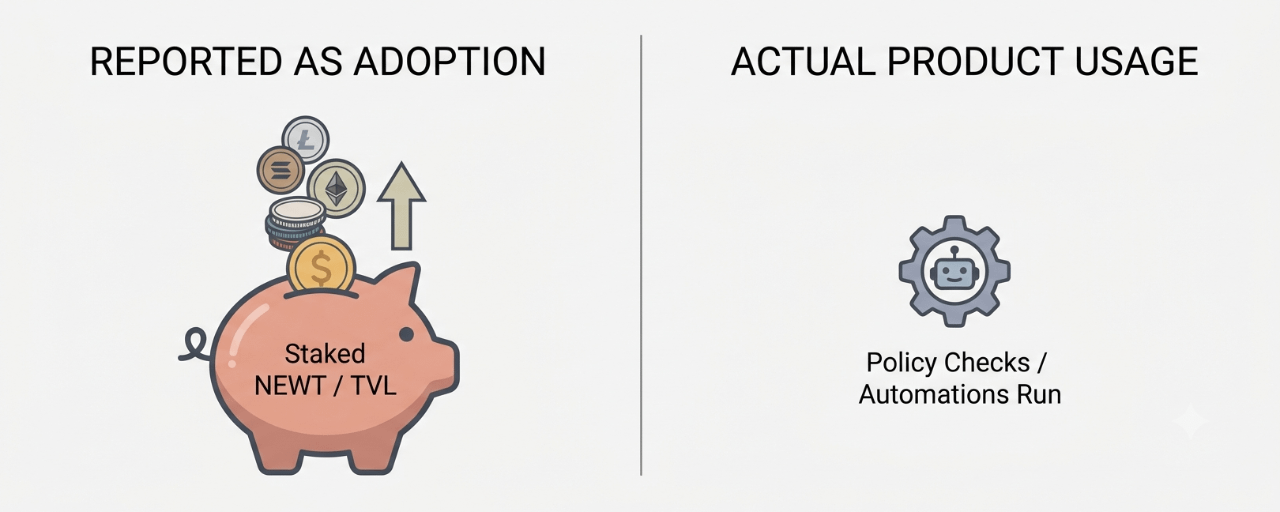
And here's the thing that got me — the adoption numbers they lead with are wallet connections, staked NEWT, and TVL-adjacent figures. Not agent executions. Not policy checks triggered. Not "X automations ran this week." The headline adoption metric is capital sitting in the system, not the system being used for what it's supposed to do.
I thought that was just me misreading it at first, so I went back and checked — is there anywhere they report actual automation volume, like number of policy evaluations processed on-chain? There's a technical explanation of how the AVS and policy engine works, sure, but the adoption-facing numbers are staking and deposit-shaped. Which, okay, staking is real, it's on-chain, it's verifiable. But staking isn't adoption of the automation product. Staking is people parking tokens for yield. Those are two completely different behaviors getting reported under one word.
This bugs me a little because "moving beyond hype toward real adoption" implies the next phase is usage-driven — people actually running agents, actually delegating tasks, actually needing the policy layer. But if the adoption metric being publicized is still deposit-based, then what's "beyond hype" here isn't the behavior, it's just the packaging. Same capital-seeking-yield pattern, described with more mature language.
I'm not fully convinced this is dishonest, to be clear — every early-stage protocol leans on TVL because it's the easiest number to show growth in, and usage metrics take longer to build up naturally. But it does mean when you read "adoption is growing," you should ask growing by what measure, because right now the measure and the product aren't quite the same thing.
This matters more for anyone using these adoption reports to time an entry, honestly, not just holders. If you're reading "adoption up" and picturing more agents doing more work, you're picturing something that isn't actually reflected in the number you're looking at. The gap only really shows up when yield incentives taper — that's when you find out whether the deposited capital was there for the product or just for the APR, and whether "adoption" holds once the reward rate stops doing the talking.
I caught myself almost writing "this proves the project is hollow" in my notes and had to walk that back — that's too strong, honestly. TEE/ZK infrastructure being built is real work, and the policy engine functions. It's specifically the adoption narrative that's ahead of the adoption metric, not the tech itself. Small distinction but it matters.
Anyway, went back to my spreadsheet after that, still not done reconciling Q2. Market's doing its usual afternoon nothing. I'll probably check Newton's next transparency report just to see if the metric definition changes, or if staking numbers keep getting called adoption either way.