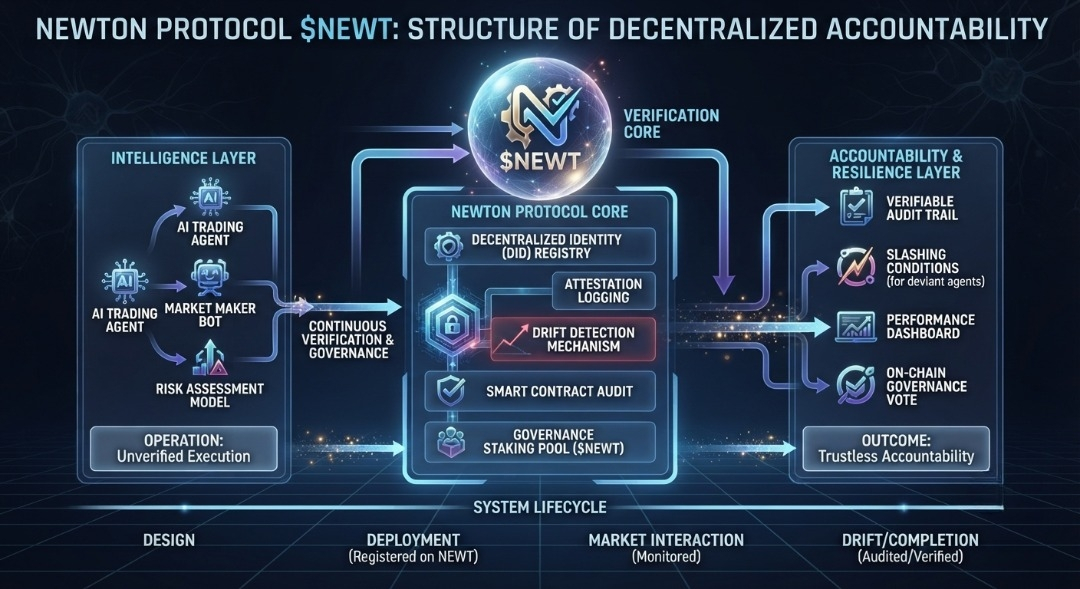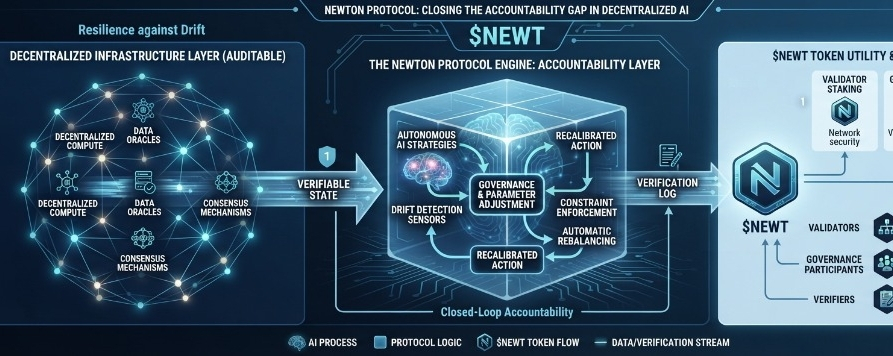

I caught myself reading about Newton Protocol for the third time before realizing I wasn't actually looking for features anymore. That usually means one of two things. Either I'm genuinely interested, or I'm trying to figure out whether an idea is quietly avoiding the hard questions.
After enough years in crypto those questions start sounding familiar.
It's rarely about whether something can be built. People build remarkable things every cycle. The harder part is watching them six months later, after the excitement has faded and the system has to deal with reality instead of diagrams.
AI seems to be heading toward the same point.
There's an assumption floating around that better models naturally lead to better decisions. I don't know if that's true in markets. Markets have a strange habit of punishing confidence more than ignorance. Sometimes the worst trades aren't emotional ones. They're the ones that look perfectly rational because every available signal agreed right until they didn't.
That's where Newton keeps pulling my attention.
Not because it talks about AI strategies. Plenty of projects do that now. It's more that once you imagine autonomous systems operating continuously on decentralized infrastructure the conversation shifts. Suddenly the interesting part isn't intelligence. It's accountability.
Who notices when an automated strategy slowly drifts away from the conditions it was designed for?
Nobody wakes up expecting infrastructure to fail. It usually deteriorates in quieter ways. Small assumptions stack together. Incentives change almost invisibly. One participant behaves slightly differently, another adapts then another follows. Months later everyone wonders why outcomes feel different even though nothing obvious changed.
I've seen that pattern enough times to stop treating it as an exception.
People like discussing execution because execution is visible. Transactions settle. Orders fill. Numbers move.
Trust is much less visible.
Verification is even less exciting.
Yet those are usually the parts that matter after the headlines disappear. They determine whether automation remains predictable once thousands of independent actors begin interacting with it in ways nobody anticipated.
Sometimes I think decentralized systems are less like software and more like ecosystems. You don't fully understand them by reading documentation. You understand them after enough unexpected behavior accumulates that the original assumptions no longer fit.
Now place AI inside that environment.
Not in a controlled benchmark or a carefully isolated simulation but inside a network where incentives compete liquidity shifts participants disappear governance changes direction and every optimization creates another unintended consequence somewhere else.
I'm not convinced intelligence alone solves any of that.
Maybe it even magnifies it.
Then again, perhaps that's why I haven't dismissed Newton Protocol outright. It seems to sit close to a problem that feels unavoidable rather than fashionable. If autonomous systems are going to exist in crypto, eventually they need somewhere dependable to operate. The infrastructure itself becomes part of the decision making process, whether anyone intended that or not.
I keep returning to that thought more than the protocol itself.
Not because I think I've found an answer.
Mostly because every cycle reminds me how often this industry mistakes successful demonstrations for lasting resilience. and I'm still not sure anyone knows where that line actually is.