

@PositiveMindsGlobalResults - ThinkPositiveGlobal - @Binance Square Official
Middle East War: Is the World Entering a New Era of Global Instability?
A New Geopolitical Reality: Energy, Economy, Technology, and the Future of Global Stability
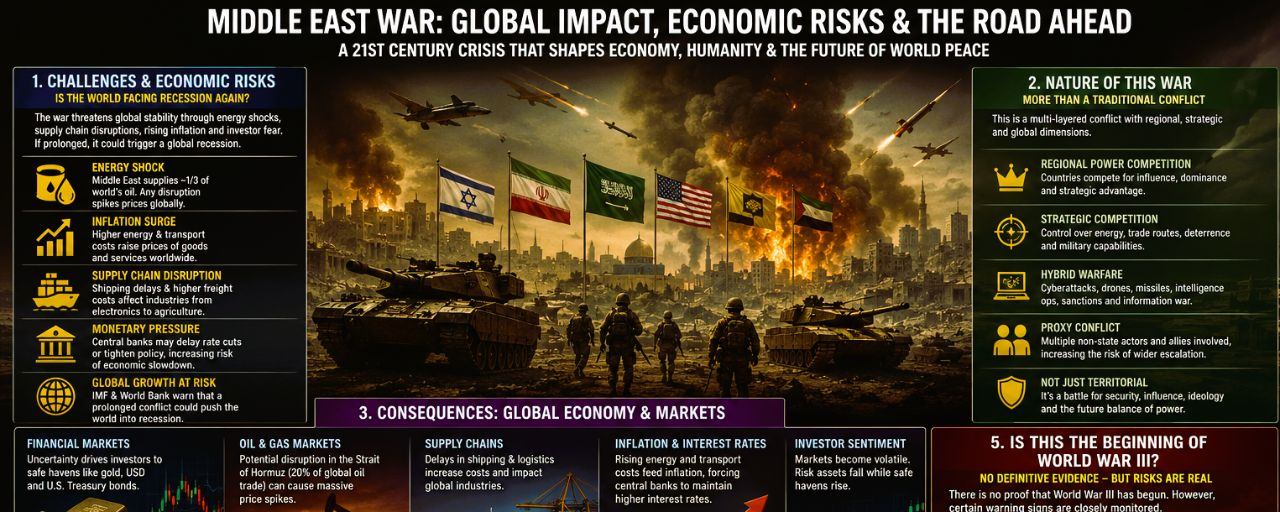
The Middle East has always been one of the world’s most strategically important regions. Located at the crossroads of Asia, Europe, and Africa, the region holds some of the world’s largest proven oil and natural gas reserves, controls vital maritime trade routes, and remains central to global energy security.
For centuries, the Middle East has been shaped by complex political, religious, territorial, and economic rivalries. However, in today’s interconnected world, conflicts in this region rarely remain local. Every major escalation has the potential to influence global energy markets, financial systems, international diplomacy, and economic stability.
The latest wave of conflict has once again forced governments, businesses, investors, and ordinary citizens to confront several critical questions:
Is the global economy entering another period of instability?
Could prolonged conflict increase the risk of a worldwide recession?
Are we witnessing the beginning of a new geopolitical era?
Is the world becoming more vulnerable to a larger international confrontation?
While dramatic headlines often dominate public attention, the reality is more complex. The world is not facing a single crisis but rather a combination of interconnected challenges involving geopolitics, economics, technology, climate, energy, and security.
Is the Middle East Conflict Creating a New Global Economic Shock?
Yes, the risk exists. However, whether the world experiences a major economic downturn depends on several factors:
How long the conflict continues
Whether it expands into neighboring regions
The impact on global energy supplies
The response of governments and central banks
The resilience of global financial markets
Unlike the 2008 Global Financial Crisis, which originated from failures within the banking and financial systems, today’s risks are primarily driven by geopolitical uncertainty.
The biggest concern is not necessarily a sudden economic collapse, but rather a prolonged period of:
Slower economic growth
Higher inflation
Rising energy costs
Weak consumer confidence
Increased market volatility
The Global Energy Challenge
The Middle East remains the foundation of the global energy system.
The region supplies a significant share of the world’s crude oil and natural gas, while several critical shipping routes connect energy producers with major consumer markets in Asia, Europe, and North America.
Among the world’s most important strategic waterways are:
The Strait of Hormuz
One of the world’s most critical energy chokepoints. A significant portion of global oil shipments passes through this narrow waterway connecting the Persian Gulf with international markets.
The Bab el-Mandeb Strait
A key maritime passage linking the Red Sea with the Gulf of Aden. Any disruption affects trade routes between Asia, Europe, and Africa.
The Suez Canal
One of the world’s busiest commercial shipping routes, connecting the Mediterranean Sea with the Red Sea and reducing travel time between major global markets.
Any disruption to these routes can immediately affect:
Oil prices
Shipping costs
Insurance premiums
Global supply chains
Consumer prices
The Inflation Domino Effect
A major geopolitical crisis can create a chain reaction across the global economy:
Energy disruption ↓ Higher oil and natural gas prices ↓ Increased transportation and shipping costs ↓ Higher production expenses ↓ More expensive food and consumer goods ↓ Persistent inflation ↓ Central banks delay interest-rate reductions ↓ Slower economic growth
If inflation remains high while economic growth weakens, the global economy could face a difficult scenario known as stagflation — a combination of slow growth, high inflation, and weak employment conditions.
The Changing Nature of Modern Warfare
The conflicts of the 21st century are fundamentally different from traditional wars of previous generations.
Modern conflicts are no longer limited to armies fighting on battlefields. They increasingly involve multiple dimensions:
Military operations
Cyber warfare
Economic pressure
Artificial intelligence
Information campaigns
Technological competition
Proxy Warfare: Conflict Without Direct Confrontation
Major powers often compete indirectly by supporting allied governments or non-state groups through:
Military equipment
Intelligence sharing
Financial assistance
Diplomatic support
This allows countries to pursue strategic interests while avoiding direct military confrontation with other major powers.
Hybrid Warfare: The New Battlefield
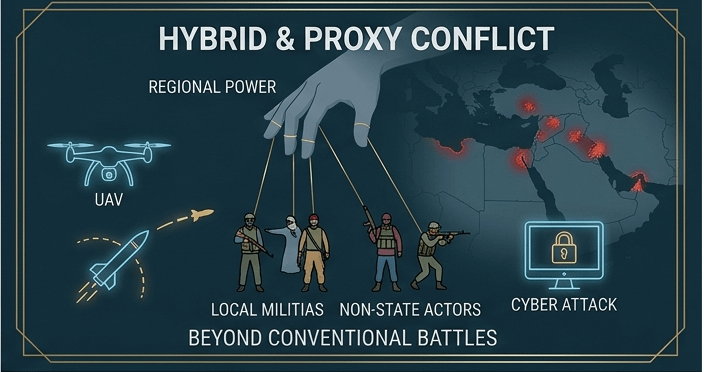
Today’s battlefield extends far beyond physical territory.
Modern conflicts increasingly involve:
Cyberattacks against governments and companies
Digital surveillance
Drone warfare
Artificial intelligence systems
Satellite intelligence
Electronic warfare
Economic sanctions
Information operations
Information has become a powerful strategic weapon.
Control over narratives, public opinion, and digital communication can influence conflicts almost as significantly as traditional military power.
Global Economic and Financial Consequences
Financial markets generally dislike uncertainty.
When geopolitical tensions rise, investors often become more cautious and shift capital toward assets considered safer.
Financial Markets
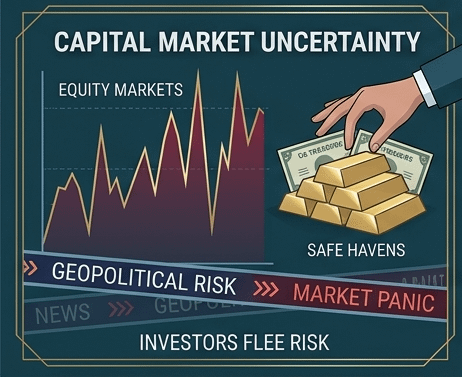
Periods of conflict usually create:
Increased stock market volatility
Lower investor confidence
Reduced risk-taking
Greater demand for defensive assets
Traditional safe-haven assets often include:
Gold
U.S. Treasury securities
Major reserve currencies
Energy Markets
Oil and natural gas markets typically react immediately to geopolitical tensions.
Higher energy costs affect almost every sector:
Manufacturing
Aviation
Transportation
Agriculture
Electricity production
Consumer goods
Global Supply Chains
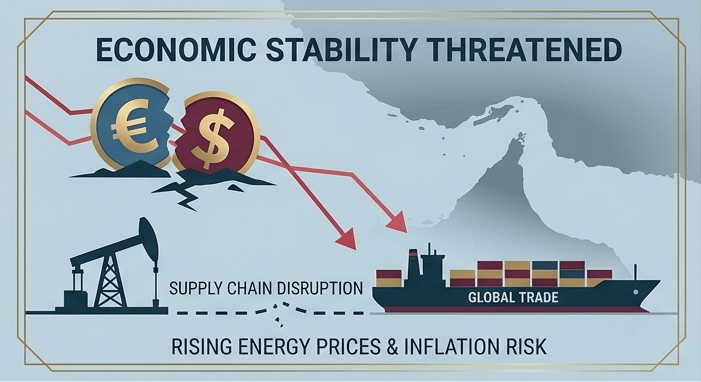
Modern economies depend on highly connected international supply networks.
Conflict-related disruptions can create:
Shipping delays
Higher freight costs
Increased insurance expenses
Industrial shortages
Higher consumer prices
Corporate Investment and Economic Growth
Businesses often delay expansion and investment decisions during periods of uncertainty.
Reduced investment can lead to:
Slower job creation
Lower productivity growth
Reduced economic confidence
3.1 The Impact on Cryptocurrency Markets
As digital assets become increasingly connected to the global financial system, cryptocurrency markets are also influenced by major geopolitical events.
Although cryptocurrencies were originally designed as decentralized financial alternatives, they are now increasingly affected by global economic conditions, liquidity cycles, interest rates, and investor sentiment.
Short-Term Crypto Market Volatility
During periods of geopolitical uncertainty, investors often reduce exposure to high-risk assets.
This can lead to:
Sharp price movements in Bitcoin and major cryptocurrencies
Liquidation of leveraged trading positions
Lower trading activity
Increased market uncertainty
Unlike gold and government bonds, cryptocurrencies remain a relatively young asset class and are still viewed by many investors as higher risk during periods of crisis.
Bitcoin: Digital Gold or Risk Asset?
Bitcoin is often described as “digital gold,” but its performance during geopolitical crises has been mixed.
In the early stages of global uncertainty, Bitcoin often behaves similarly to technology stocks, with investors selling risk assets to protect liquidity.
However, if concerns shift toward:
Currency depreciation
Inflation protection
Banking instability
Loss of confidence in traditional financial systems
some investors may view Bitcoin as a long-term alternative store of value.
Bitcoin’s future role will depend on market maturity, institutional adoption, regulation, and investor confidence.
Stablecoins and Capital Protection
During periods of uncertainty, demand for dollar-backed stablecoins such as USDT and USDC often increases.
Many traders temporarily move funds into stablecoins to:
Reduce volatility exposure
Preserve capital
Maintain liquidity within digital markets
This does not necessarily represent an exit from crypto markets but rather a risk-management strategy.
Institutional Investors and Digital Assets
Institutional participation has become a major force in cryptocurrency markets.
However, geopolitical instability may influence investment decisions.
Factors that could reduce short-term institutional appetite include:
Higher inflation
Delayed interest-rate cuts
Economic slowdown
Rising energy costs
Market uncertainty
At the same time, long-term trends such as:
Blockchain adoption
Tokenization of real-world assets
Digital payment systems
Regulated investment products
continue to support the broader development of the digital economy.
Crypto Mining and Infrastructure Risks
The cryptocurrency industry also depends on global infrastructure.
Geopolitical disruptions can affect:
Electricity prices
Semiconductor supply
Data centers
Internet networks
Mining profitability
For proof-of-work cryptocurrencies such as Bitcoin, rising energy costs can significantly impact mining operations.
The Human Cost of Modern Conflict
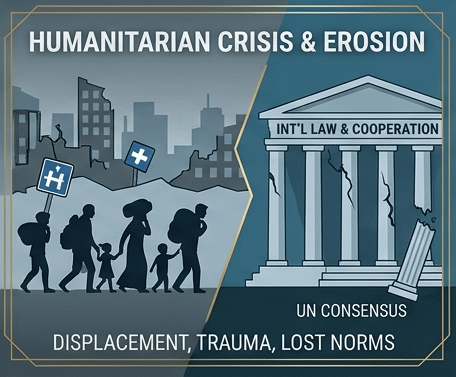
The Human Cost of Modern Conflict - ThinkPositiveGlobal
Behind every economic indicator are millions of human lives.
War affects not only soldiers but entire societies.
The consequences include:
Civilian casualties
Displacement of populations
Refugee crises
Damage to hospitals and schools
Economic destruction
Food insecurity
The effects of war often continue for generations.
The Psychological Impact
Unlike conflicts of previous centuries, modern wars are experienced globally through:
Television
Smartphones
Social media platforms
Constant exposure to violence can contribute to:
Anxiety
Trauma
Social division
Misinformation
Political polarization
Children growing up in conflict zones often face long-term educational and emotional challenges.
Is This the Beginning of World War III?
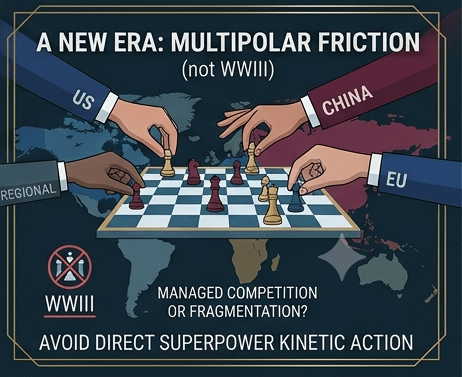
Is This the Beginning of World War III? - ThinkPositiveGlobal
At present, there is no confirmed evidence that the world has entered World War III.
A global war would require direct military confrontation between multiple major powers across several regions.
The current environment is better described as:
A period of increasing geopolitical competition in a multipolar world.
Major powers remain involved through:
Diplomacy
Economic sanctions
Intelligence cooperation
Military assistance
However, they continue to avoid direct large-scale confrontation with each other.
Warning Signs the World Must Watch
Analysts continue monitoring risks such as:
Direct conflict between nuclear powers
Large-scale military mobilization
Closure of major international shipping routes
Massive cyberattacks
Breakdown of diplomatic communication
Use of weapons of mass destruction
Any combination of these events would significantly increase global risks.
What Is the World Facing Today?
The Middle East conflict is only one part of a much larger global transformation.
Humanity is simultaneously facing several major challenges:
Geopolitical Fragmentation
The world is moving away from decades of relative stability toward stronger competition among major powers.
Economic Uncertainty
High debt levels, inflation pressures, slower productivity growth, and supply-chain weaknesses continue to challenge economies.
Energy Security
Countries are balancing traditional energy sources with renewable energy, nuclear power, and new technologies.
Climate Change
Extreme weather events, rising temperatures, floods, droughts, and resource pressures are creating new economic and humanitarian challenges.
Food and Water Security
Population growth, climate pressures, and political instability are increasing concerns about future resources.
Artificial Intelligence Revolution
AI is transforming industries worldwide while creating new challenges involving cybersecurity, employment, misinformation, and regulation.
Cybersecurity Threats
Cyberattacks targeting governments, companies, hospitals, and financial institutions are becoming increasingly sophisticated.
Demographic Change
Aging populations in developed economies and rapid population growth in developing regions are creating new social and economic pressures.
Final Assessment: A World Entering a More Uncertain Era
The Middle East conflict represents one of the most significant geopolitical challenges of the 21st century. Its impact extends beyond the battlefield, affecting global energy security, financial markets, inflation trends, and international relations.
Although current evidence does not indicate that the world has entered a third world war, the international environment is becoming increasingly fragile.
The greatest danger may not come from one sudden global conflict, but from the gradual accumulation of:
Regional wars
Economic fragmentation
Cyber conflicts
Strategic rivalry
Declining international cooperation
The future will depend on whether global leaders can strengthen diplomacy, maintain communication channels, and manage competition responsibly.
The decisions made today will shape not only global markets and national security, but also the future direction of human civilization.
Disclaimer: This article is for informational and educational purposes only and does not constitute financial or investment advice. Always conduct your own research (DYOR) and assess your risk tolerance before making financial commitments in volatile global climates.
ThinkPositiveGlobal — Understanding Global Change, Markets, and the Future

