while scanning the unlock schedule last night
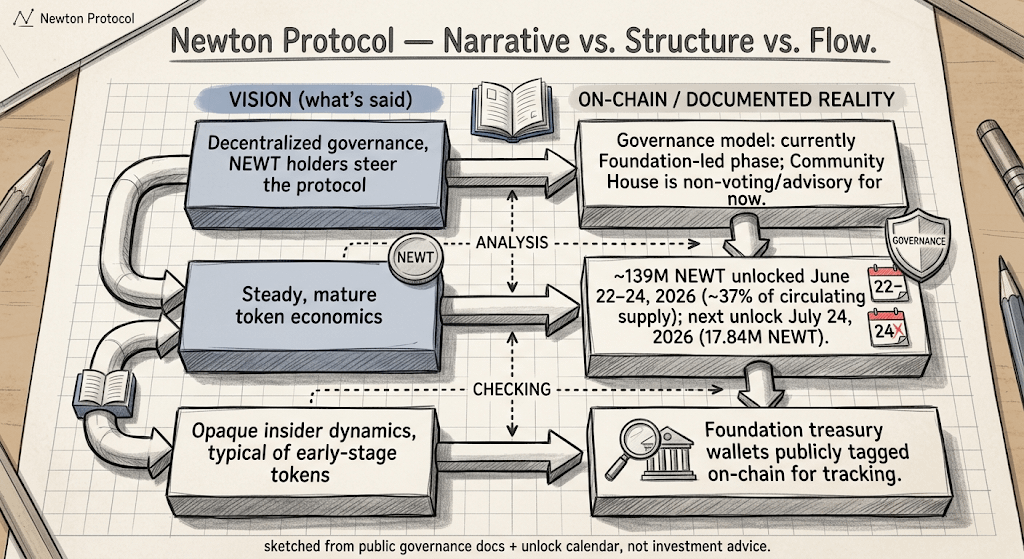
While I was cross-checking Newton Protocol's public unlock calendar against what's actually moved on-chain, something small snagged my attention and wouldn't let go. $NEWT had just processed a release of roughly 139 million tokens on June 22–24 — about 37% of its circulating supply at that moment, a genuinely large proportional unlock by any project's standard. Right next to it sat the July 24 entry: another 17.84 million NEWT, close to $880K at the time, 1.8% of total supply, quietly scheduled.
I wasn't hunting for drama. I was just trying to understand #NewtonProtocol's actual token flow versus the "verifiable automation layer" narrative I'd absorbed from @NewtonProtocol timeline over the past few weeks. Token flows tend to say more than governance decks do.
Two actionable things surfaced fast. First: if you're evaluating NEWT's supply dynamics, the unlock calendar matters more right now than the roadmap. Second: the protocol's own governance documentation — not a third-party take, their published governance model — openly states it's currently in a Foundation-led phase, with community sentiment polling layered on top, not binding votes.
That second point is the one that stuck with me.
the contrast that stuck with me
Here's the framework I kept circling back to, almost involuntarily: three layers to any protocol like this. There's the Vision layer — what gets said in threads and litepapers. There's the Structure layer — what the governance docs actually specify. And there's the Flow layer — what the chain itself shows moving.
Newton's Vision layer talks about staked NEWT holders eventually running the show — protocol upgrades, treasury allocation, fee parameters, all decentralized. Reasonable, standard stuff for 2026. But the Structure layer, in their own governance framework, is explicit that this is a phased rollout — proposals originate with the Foundation right now, and a "Community House" is described as a future, initially non-voting advisory body. Not hidden, to be fair. Just... undersold in how the project gets talked about day to day.
Then the Flow layer. A large unlock landing in one week is the kind of event that actually moves who holds leverage over a token — vesting cliffs concentrate supply in a handful of wallets (contributors, early backers, the Foundation treasury) well before "governance" in the fullest sense is live. I found myself doing the obvious math: decentralized governance without decentralized supply is a promise with a due date, not a current state.
I'll admit — I went into this expecting to write about the TEE and zero-knowledge verification mechanics, the Rego policy layer, the usual technical meat. Honestly, the unlock-versus-governance-phase contrast pulled harder.
still pondering who actually holds the wheel
A brief personal note, because it's relevant here: I used to skim tokenomics pages and governance pages as two separate categories in my head. Wrong instinct. The moment I started reading them together — unlock schedule next to voting-rights schedule — the picture of who governs this thing, and when, got a lot clearer, and a little less flattering than the marketing copy.
Two market-facing examples made this concrete for me. NEWT's price sat roughly flat-to-slightly-down through the June unlock window, which read to me as the market already pricing in dilution rather than reacting fresh — a sign the unlock wasn't a surprise, just a known cost. Second, Newton's Foundation treasury wallets are publicly tagged, per their own transparency reporting, meaning anyone can watch where that concentrated allocation actually moves. That's a genuinely good design choice, and it deserves credit — not every project tags its treasury wallets for public tracking.
So — not everything here is contrast for contrast's sake. Actually, let me back up a bit; the tagging piece is closer to Newton delivering on a promise than falling short of one.
Where I land, after sitting with the docs and the on-chain numbers for a while, is somewhere between skeptical and cautiously convinced. The compliance-as-code idea — policies as rules, evaluated by restaked operators, producing verifiable attestations before a transaction even lands — is a real technical contribution to a real problem. It's the governance-timeline gap between that vision and today's Foundation-led reality that I think gets glossed over in most of the content I've seen about this project.
What I'll be watching, without trying to predict anything: whether the Community House actually gets voting rights on the timeline implied, whether unlock events keep tracking calmly against price the way June's did, and whether validator decentralization — mentioned as a near-term goal — shows measurable movement rather than staying a bullet point.
I'd be curious whether others tracking $NEWT are weighing the unlock calendar as heavily as the governance-phase language, or whether I'm overindexing on one document. If you've dug into the Community House timeline specifically, I'd like to hear what you found — because I'm still not sure how "decentralized governance" and "Foundation-led phase" are supposed to sit together for the next few quarters, and I haven't settled that for myself yet.