
Why I’m Paying More Attention to What Happens Before a Blockchain Transaction
I used to think the hardest part of finance was moving money. Now I think the harder part is deciding whether money should move in the first place.
That one idea changed the way I look at blockchain.
For years, the focus has been on making transactions faster, cheaper, and more efficient. Those improvements are important, but the more I learned about how financial systems work, the more I realized that sending money is usually the easy part.
The difficult part happens before the transaction.
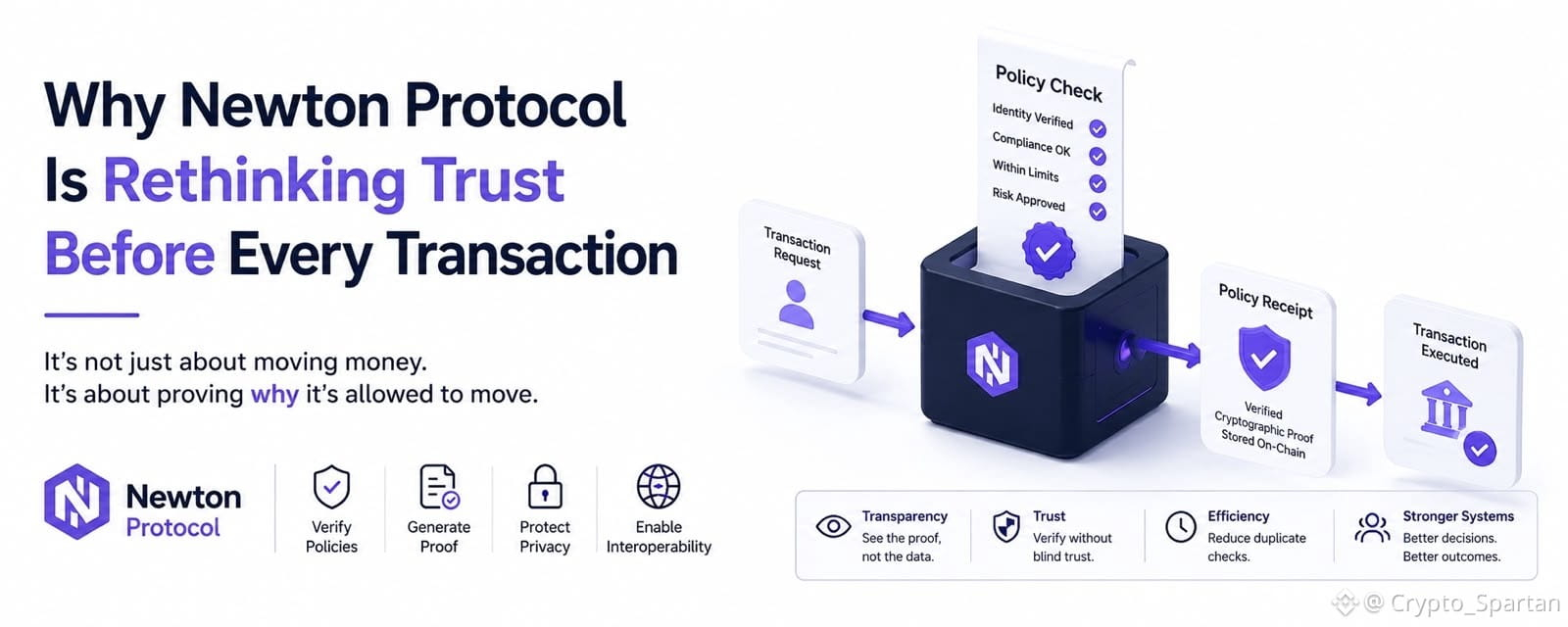
Before money moves, someone has to check a lot of things. Is the customer verified? Does the payment follow regulations? Is it within the company’s spending limits? Does it meet the organization’s risk rules?
These checks happen every day in banks, exchanges, and businesses around the world. They often take place in different systems that don’t work well together. Because of that, many organizations repeat almost the same checks again and again.
That’s why Newton Protocol caught my attention.
Most people talk about it as an authorization layer, but I think there’s another idea that’s even more interesting.
Instead of only proving that a transaction happened, Newton wants to create proof that the required rules were checked before the transaction happened.
Think about a normal blockchain transaction.
It tells you that money moved from one wallet to another.
But it doesn’t tell you why that transaction was allowed.
Did it pass compliance checks?
Did it meet the company’s internal rules?
Was the customer approved?
The blockchain usually doesn’t know.
Newton Protocol tries to solve that by creating what you can think of as a policy receipt. This is cryptographic proof that certain rules were checked before the transaction was approved.
I think that’s a powerful idea.
Not because it removes compliance work, but because it creates better proof that the work was actually done.
That could make audits easier, improve transparency, and help different systems trust verified results without sharing private information.
Of course, I don’t think this will solve everything.
Banks and financial companies are still responsible for making their own decisions. Even if another organization has already checked a customer, they may still need to perform their own review.
Technology doesn’t remove legal responsibility.
The biggest challenge may not be building the protocol.
It may be getting enough organizations to use the same standards.
Without shared standards, every system creates its own way of verifying policies, and many of the benefits disappear.
That’s why I also think we should pay attention to different success metrics.
Transaction numbers can grow because of incentives.
Wallet numbers can be misleading.
Even total value locked doesn’t always show real adoption.
What I’d rather see is more businesses using policy verification as part of their daily operations.
That would be much harder to fake.
I’m not saying Newton Protocol will definitely become the standard.
There are still many challenges ahead.
But I do believe it’s asking an important question.
Maybe blockchain shouldn’t only prove that a transaction happened.
Maybe it should also prove why it was allowed to happen.
As blockchain moves into regulated industries, that difference could become more important than many people realize.