Spending some time with Newton’s EigenLayer AVS design and i started to see the operator network differently.
At first it looks like a familiar restaking setup: operators, signatures, quorum, slashing, and an onchain proof. Clean enough. but Newton is not asking operators to simply validate blocks or repeat a deterministic computation. It is asking them to agree on whether a transaction should be allowed based on policy logic and, sometimes, messy offchain context.
that small difference changes the whole mood of the design.
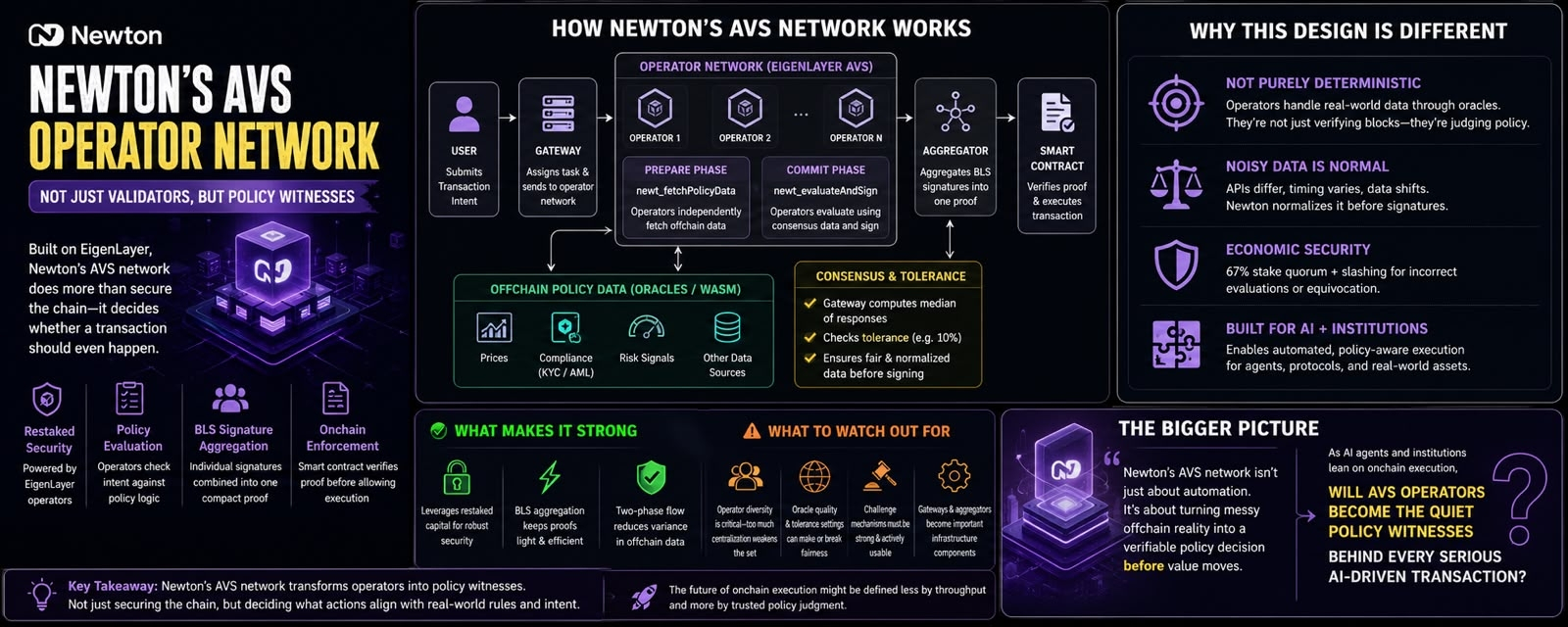
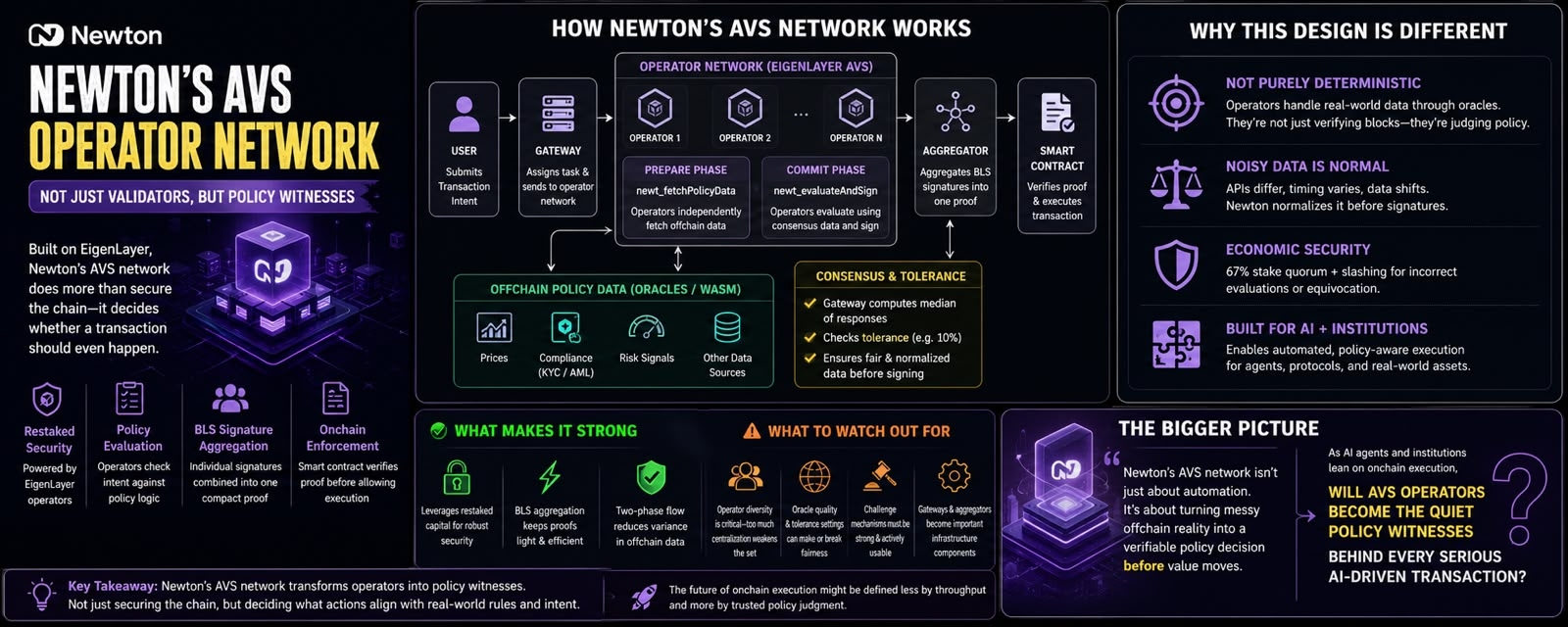
Newton’s operators evaluate transaction intents before execution. A Gateway sends policy tasks to the operator set, operators run the required checks and their individual BLS signatures are aggregated into one compact proof. The contract then verifies that proof before letting the transaction move forward.
So, EigenLayer gives Newton an economic security base. But the more interesting part is what sits on top of that base: a distributed policy judgment layer.
Th technical detail i find most worth noticing is Newton’s prepare-commit style flow for PolicyData. In the prepare phase, operators independently fetch external data through newt_fetchPolicyData. This could involve price feeds, compliance signals, risk data, or other policy inputs. Then the Gateway compares responses, computes a median where needed, and checks tolerance before moving into newt_evaluateAndSign.
That is not just a nice engineering detail. It is Newton admitting that real-world data is not always neat. One API may update a second earlier. One operator may see a slightly different market value. Another may hit a temporary delay. The system has to turn this noisy outside world into something operators can sign together.
I like that part. It feels practical, almost like Newton is building a referee room before the transaction reaches the chain.
But there is a tradeoff here too. The AVS network is only as strong as the operator diversity, the oracle quality, the tolerance settings, and the ability to challenge bad behavior. A 67% stake quorum and BLS aggregation help create a strong verification layer, but they do not magically remove every gray area around external data.
That is where Newton becomes more interesting than a normal “AI agents onchain” story.
Its real challenge is not only automation. It is whether an operator network can make policy decisions reliable enough for wallets, agents, and institutions to trust before value moves.
So the open question that reminds for me is this:-if onchain execution becomes more automated, will AVS operators become the quiet policy witnesses behind every serious AI-driven transaction??