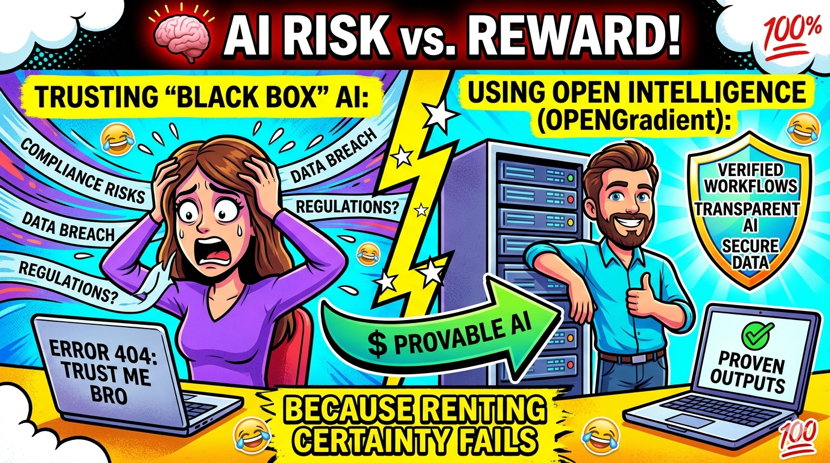


🧠 OPEN INTELLIGENCE: Because Apparently Trusting AI Blindly Wasn’t Risky Enough
I used to hear “decentralized AI infrastructure” and immediately file it next to other crypto buzzwords like “revolutionary ecosystem” and “community-driven innovation”—interesting phrases that somehow never explain why normal people should care. 😏
Then I realized something.
AI is fun when it’s generating memes and writing emails. But once businesses start relying on it for compliance, finance, settlements, legal workflows, and decisions involving actual money, suddenly “trust me, bro” becomes a less convincing security model.
At that point, AI isn’t a feature anymore.
It’s a dependency.
And dependencies have a funny habit of becoming problems.
🔒 Providers change policies.
🌍 Regions get restricted.
📜 Regulators start asking annoying questions like:
“Where did this output come from?”
“Which model produced it?”
“Can you prove it?”
Awkward.
Most solutions still force the same old choices:
⚡ Speed or control.
👀 Convenience or transparency.
🚀 Innovation or accountability.
Apparently we’re supposed to accept that tradeoff forever.
That’s where OpenGradient enters the conversation, essentially asking:
“What if AI infrastructure wasn’t built on crossing your fingers and hoping the gatekeeper stays friendly?”
The idea isn’t that decentralization magically solves every problem. Crypto has already taught us enough lessons about magical solutions. 😂
The idea is simply creating a system where using AI doesn’t automatically mean placing blind faith in a single provider, policy change, or black-box process.
⚖️ And that’s the real test.
Not whether the technology sounds impressive.
But whether verification stays affordable, access stays easy, and users choose it over the comfortable closed systems they’re already using.
Because let’s be honest—the first thing that breaks AI trust probably won’t be the model.
It’ll be the moment people realize they were renting certainty from someone else’s server all along.
🤔 So what fails first: access, privacy, or verification?