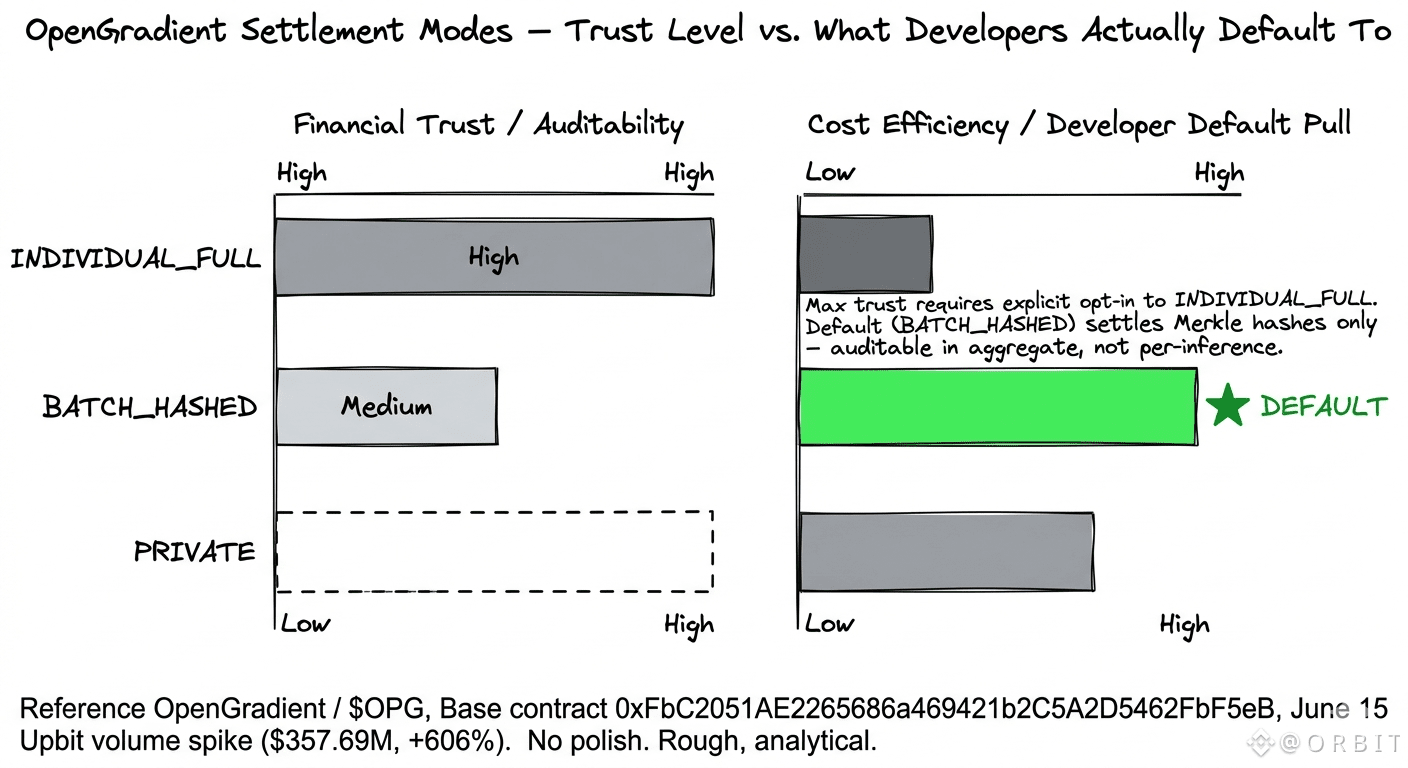
The thing that caught me off guard during this task wasn't the verifiable inference pitch — it was the settlement mode architecture sitting quietly in OpenGradient's SDK docs. Three modes: PRIVATE (payment only, nothing on-chain), BATCH_HASHED (Merkle-aggregated hashes, default), and INDIVIDUAL_FULL (every input, output, timestamp fully recorded). $OPG , @OpenGradient , #OPG . The default — BATCH_HASHED — is cost-efficient but not fully transparent. Maximum financial trust requires INDIVIDUAL_FULL. Nobody ships that by default.
That contrast landed harder when I looked back at the Upbit listing on June 15. OPG on Base (0xFbC2051AE2265686a469421b2C5A2D5462FbF5eB), volume exploding 606% to $357.69M, price swinging $0.3064 to $0.1815 intraday. The network was processing thousands of daily transactions through all of this. But what settlement mode were they using? Most likely batch. Cheaper, faster, less exposed. Not the version that reshapes financial trust at its core.
I sat with that for a while. The infrastructure to rebuild financial trust genuinely exists here — every model call auditable, every input and output immutably recorded, no black box. But the default behavior optimizes for cost, not transparency. Which means trust is an opt-in, not the baseline.
…and if trust requires an active choice to unlock, who actually makes that choice in practice — and who never thinks to ask?
That contrast landed harder when I looked back at the Upbit listing on June 15. OPG on Base (0xFbC2051AE2265686a469421b2C5A2D5462FbF5eB), volume exploding 606% to $357.69M, price swinging $0.3064 to $0.1815 intraday. The network was processing thousands of daily transactions through all of this. But what settlement mode were they using? Most likely batch. Cheaper, faster, less exposed. Not the version that reshapes financial trust at its core.
I sat with that for a while. The infrastructure to rebuild financial trust genuinely exists here — every model call auditable, every input and output immutably recorded, no black box. But the default behavior optimizes for cost, not transparency. Which means trust is an opt-in, not the baseline.
…and if trust requires an active choice to unlock, who actually makes that choice in practice — and who never thinks to ask?