

@PositiveMindsGlobalResults - @Binance Square Official
 BNB711.47+1.04%
For over half a century, the geopolitical friction between the United States and Iran has acted as a persistent fault line under the global economy. When tensions flare, the script is predictable: oil prices spike, inflation rears its head; investors retreat to safe havens, and financial markets brace for impact.
But what happens if the script flips?
If Washington and Tehran successfully cement a lasting peace agreement, the world could witness one of the most explosive economic relief rallies of the decade. Wall Street is already paying attention. Recent whispers of diplomatic breakthroughs have sent Brent crude tumbling from its recent highs while global equities edge upward. Markets are eagerly pricing out geopolitical peril and pricing in a new era of growth.
Here is how a historic US-Iran accord would reshape the global financial landscape from Main Street to the blockchain.
The Macro Shockwave: Energy Deflation & Growth
A Massive Relief Valve for Energy Markets
The most immediate, visceral impact of peace would be felt at the pump and on the high seas. The Strait of Hormuz is the world’s most critical energy chokepoint, a maritime highway responsible for a massive chunk of global oil transit. In times of conflict, the mere threat of its closure tacks on a heavy "geopolitical risk premium" to every barrel traded.
A permanent peace treaty would effectively dismantle this risk premium:
Crude Stabilization: Global oil prices would likely settle into a comfortable, predictable $75–$85 range.
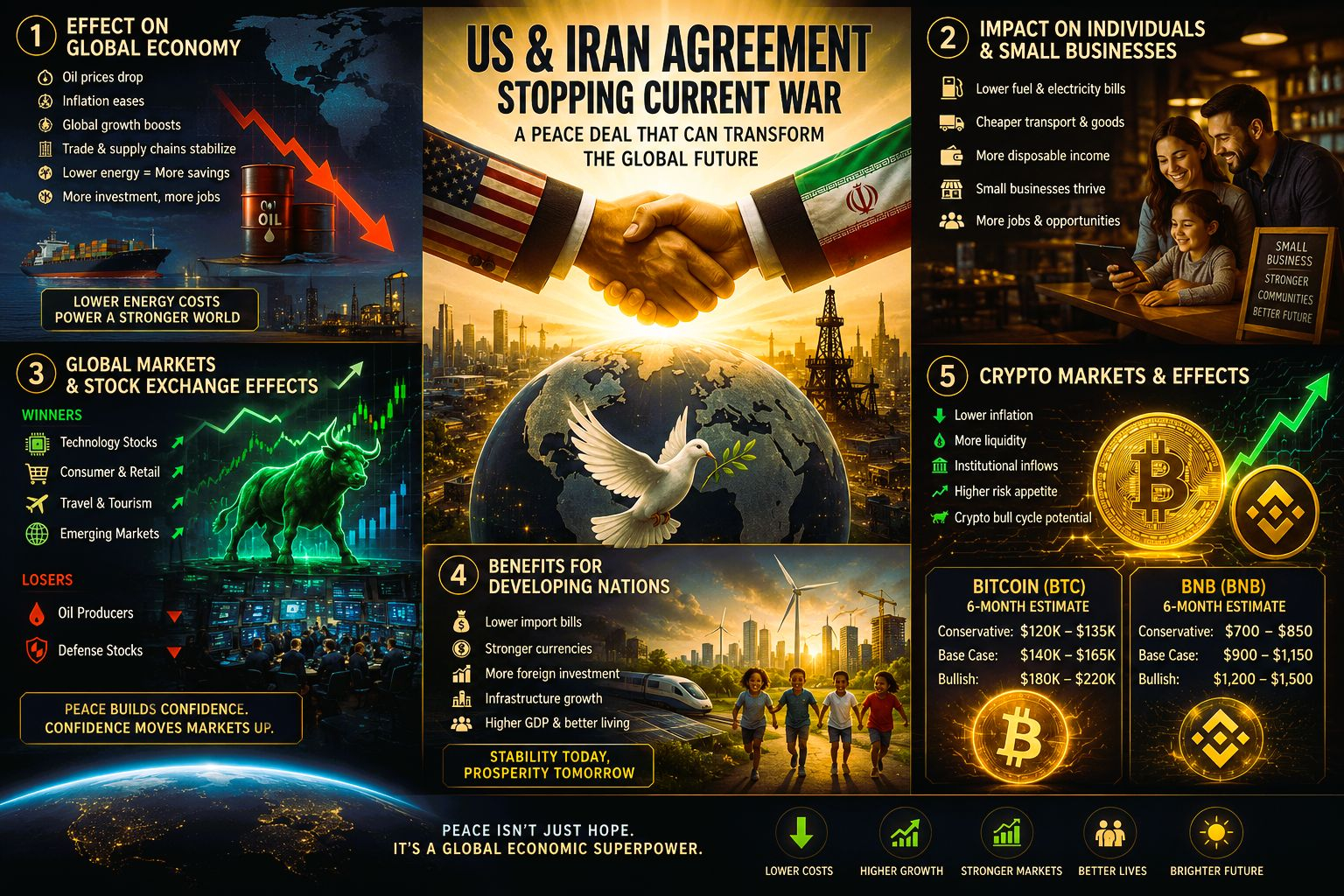
Slashed Overhead: Shipping insurance premiums for maritime freight would collapse.
The "Global Tax Cut": Lower fuel prices act like an immediate stimulus injection, putting capital directly back into the pockets of consumers and corporations alike.
Igniting Global GDP
Cheap energy is the lifeblood of economic expansion. By curbing inflation, a peace deal would give central banks the green light to aggressively cut interest rates. This macroeconomic breathing room would supercharge high-exposure sectors:
[Industrial Production] ➔ [Aviation & Logistics] ➔ [Global Tourism] ➔ [Consumer Spending]
Main Street Realities: Individuals & Small Businesses
While institutional traders watch tickers, ordinary citizens and small businesses would feel the peace dividend in their daily lives.
For the Everyday Consumer
The crushing weight of the cost-of-living crisis would finally ease. A stable Middle East translates to:
Cheaper Commutes: Noticeably lower gasoline and diesel prices.
Cooling Utility Bills: Reduced heating, cooling, and electricity costs.
Grocery Relief: Slower food inflation as agricultural supply chains become cheaper to operate.
For Small Businesses
Small businesses are typically the collateral damage of geopolitical chaos, lacking the hedging tools of multinational conglomerates. A de-escalation of conflict risk opens up a new playbook:
The Small Biz Boost: Falling freight costs and stabilized supply chains mean predictable inventory pricing. As central banks lower interest rates, small businesses will gain easier, cheaper access to lines of credit to expand operations, hire workers, and innovate.
Prime Beneficiaries: Retail, restaurants, local logistics, and e-commerce platforms.
Wall Street Reimagined: Winners & Losers
Historically, equity markets celebrate peace with aggressive capital deployment. If a deal is signed, expect a sharp rotation of capital across the stock market.
🟢 The Winners
Big Tech (NVIDIA, Microsoft, Apple): Technology giants are highly sensitive to interest rates. When inflation drops and rates fall, the future growth valuations of tech companies soar, making them prime targets for massive institutional inflows.
Consumer Discretionary: Travel, hospitality, luxury retail, and entertainment stocks will thrive as consumers find themselves with newfound disposable income.
Energy-Importing Emerging Markets: Nations that rely heavily on foreign oil will see their import bills slashed, immediately strengthening their domestic currencies and fiscal health.
🔴 The Losers
Legacy Oil & Gas Producers: Substantially lower crude prices mean squeezed profit margins for oil majors and exploration firms.
Defense Contractors: The defense sector often loses its near-term speculative momentum when long-standing geopolitical flashpoints cool down.
The Lifeline for Developing Nations
While developed economies enjoy a boost, for developing nations, a US-Iran peace agreement is a economic lifeline.
Nations like India, Bangladesh, Pakistan, and Sri Lanka collectively spend billions of dollars annually just to keep the lights on and vehicles moving. High oil prices bleed their foreign exchange reserves and trigger brutal currency devaluations.
Lower Oil Prices ➔ Improved Trade Balances ➔ Stronger Domestic Currencies ➔ Enhanced Sovereign Credit Risk
As the global risk index drops, foreign direct investment (FDI) will flood back into these emerging markets, unlocking funding for massive infrastructure, tech, and sustainability projects that were previously deemed too risky.
The Crypto Catalyst: Unlocking Risk-On Liquidity
Cryptocurrency thrives in a specific environment: expanding liquidity, falling interest rates, and high risk appetite. A US-Iran peace agreement creates the absolute perfect storm for digital assets.
When geopolitical anxiety fades, investors happily ditch safe havens like cash and gold to hunt for alpha in high-growth ecosystems. Lower oil-driven inflation accelerates central bank rate cuts, flushing the global financial system with fresh liquidity.
What This Means for Digital Assets:
Accelerated institutional inflows into spot crypto ETFs.
A surge in retail participation as disposable income recovers.
Massive capital rotation into Decentralized Finance (DeFi) and Web3 infrastructure.
Six-Month Crypto Forecasts
Bitcoin (BTC) Price Targets
As the ultimate barometer of global liquidity, Bitcoin stands to gain the most from a macro shift toward peace.
Conservative Scenario ($120,000 – $135,000): Driven by steady ETF inflows and a standard post-halving macroeconomic lift.
Base Case ($140,000 – $165,000): Triggered by falling inflation, easing geopolitical tensions, and a soft landing for major economies.
Bullish Scenario ($180,000 – $220,000): A full-blown "risk-on" mania ignited by synchronized global rate cuts and massive institutional FOMO.
BNB Price Targets
BNB is positioned to aggressively outperform many large-cap altcoins due to its deeply entrenched utility and exchange ecosystem.
Conservative Scenario ($700 – $850): Healthy ecosystem recovery aligned with broader market growth.
Base Case ($900 – $1,150): Driven by an explosion of retail traders returning to the market, boosting trading volumes.
Bullish Scenario ($1,200 – $1,500): Fueled by skyrocketing Total Value Locked (TVL) on the BNB Chain, a flurry of high-yield Launchpool events, and a manic altcoin season.
The Bottom Line
A lasting US-Iran peace agreement would easily define the economic narrative of 2026. By removing one of the oldest risk premiums in modern history, the normalization of energy markets would spark a domino effect of prosperity.
If diplomacy wins the day, the latter half of 2026 will not just see a market correction—it will usher in a synchronized, cross-asset global recovery, creating one of the most lucrative windows for both traditional equities and digital assets since the post-pandemic boom.
Includes third-party opinions. No advice. Binance AI may be used without guarantee. See T&Cs.
@PositiveMindsGlobalResults - Positive Minds. Global Results - 13062026-1100HS