

@PositiveMindsGlobalResults - $BNB
 BNB706.35-0.15%
The Ripple Effect: How the Upcoming U.S. Midterm Elections Could Reshape Global Markets, ETFs, and Cryptocurrency
Why the World Is Watching Washington
As the world's largest economy and issuer of the global reserve currency, the United States occupies a unique position at the center of the international financial system. When political power shifts in Washington, the effects extend far beyond American borders, influencing capital flows, investment strategies, currencies, commodities, and financial markets worldwide.
This is why institutional investors, hedge funds, pension funds, sovereign wealth funds, and retail traders across the globe are closely monitoring the upcoming U.S. midterm elections. While these elections do not determine the presidency, they can dramatically alter the balance of power in Congress, shaping the future of taxation, government spending, regulation, trade policy, and economic growth.
Historically, the months leading up to midterm elections are characterized by heightened uncertainty and increased market volatility. However, once the political landscape becomes clear, markets often enter a new phase driven by renewed investor confidence and capital deployment.
The question facing global investors is simple yet critical:
Will the next Congress create a policy environment that encourages growth and investment, or will political divisions create obstacles that slow economic momentum?
Why U.S. Midterm Elections Matter to Global Markets
Control of Congress directly influences some of the most important economic decisions affecting global financial markets, including:
Fiscal Policy
Corporate and individual tax rates
Infrastructure spending programs
Defense budgets
Government borrowing and debt management
Regulatory Policy
Banking oversight
Artificial intelligence regulations
Energy policy
Cryptocurrency legislation
International Trade and Foreign Relations
Tariffs and trade agreements
Supply-chain policies
Relations with China and major trading partners
Global investment flows
Because these policies influence corporate earnings, economic growth, and investor confidence, financial markets worldwide often pause and reassess risk before major elections.
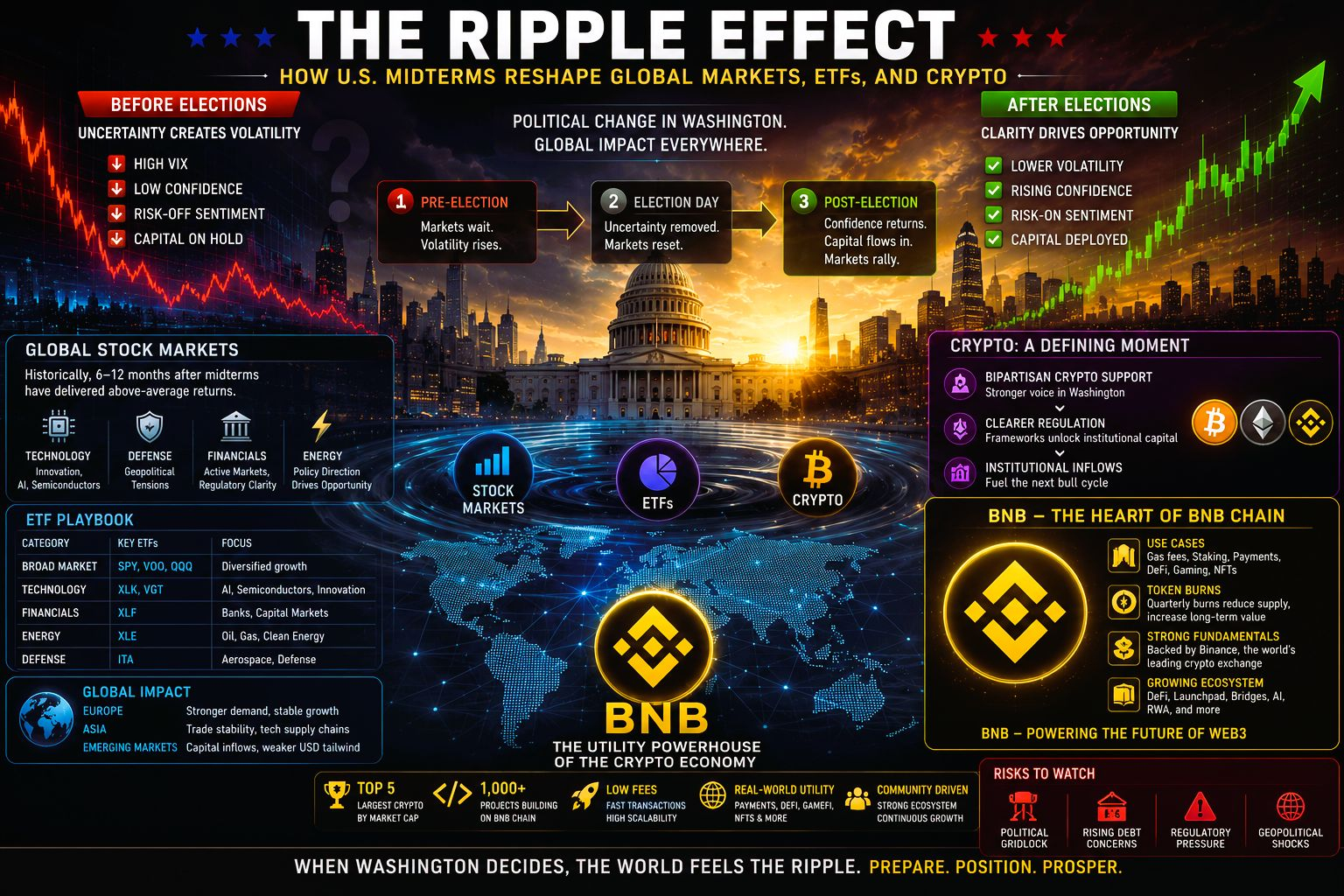
Global Stock Markets: From Election Uncertainty to Potential Relief Rally
Financial markets dislike uncertainty more than anything else.
As election day approaches, institutional investors often reduce risk exposure, delay major allocations, and maintain higher cash positions until political outcomes become clearer.
This typically creates:
Increased market volatility
Higher demand for defensive assets
Reduced trading volumes
Greater sensitivity to economic data and political headlines
The Historical Post-Election Pattern
One of the most consistent market observations over several decades is the tendency for equities to perform strongly following U.S. midterm elections.
Once election uncertainty disappears, investors gain greater visibility into the policy environment for the next two years. Markets generally prefer certainty—even when investors disagree with the political outcome.
As a result, sidelined capital frequently returns to the market, often supporting stronger stock performance during the following six to twelve months.
Key Sectors Positioned to Benefit - Technology
Technology remains one of the most influential sectors in global markets. Companies such as NVIDIA, Microsoft, Apple, and Amazon could benefit significantly if Congress supports innovation, artificial intelligence development, semiconductor manufacturing, and digital infrastructure investment. The AI revolution continues to attract enormous capital, making technology one of the primary beneficiaries of policy stability.
Defense
Defense spending remains one of the few areas that consistently receives bipartisan support. With geopolitical tensions persisting across multiple regions, defense contractors such as Lockheed Martin, Northrop Grumman, and RTX could continue benefiting from elevated military budgets and long-term procurement programs.
Financial Services
Major financial institutions including JPMorgan Chase, Goldman Sachs, and Morgan Stanley generally perform well when capital markets remain active, and regulatory frameworks become more predictable.
A stable policy environment often encourages mergers, acquisitions, public offerings, and investment activity.
Energy
Energy policy remains one of Washington's most politically sensitive battlegrounds. The composition of Congress could influence whether future legislation favors:
Traditional oil and natural gas production
LNG export expansion
Renewable energy development
Nuclear power investment
Carbon reduction initiatives
Consequently, both traditional and clean energy sectors may experience significant policy-driven opportunities depending on election outcomes.
The ETF Advantage: Where Institutional Capital May Flow
Exchange-Traded Funds (ETFs) are expected to remain among the preferred vehicles for institutional investors seeking efficient market exposure after election uncertainty fades.
Broad Market ETFs
SPY
VOO
QQQ
These funds provide diversified exposure to U.S. economic growth and often attract substantial inflows when investor confidence improves.
Technology ETFs
XLK
VGT
These vehicles offer targeted exposure to artificial intelligence, software, cloud computing, and semiconductor industries.
Financial ETFs
XLF
Financial sector ETFs may benefit from increased market activity, improving credit conditions, and regulatory clarity.
Defense and Energy ETFs
ITA (Defense)
XLE (Energy)
These funds provide focused exposure to sectors that are particularly sensitive to Congressional spending priorities and policy decisions.
International Impact: Why the Rest of the World Cares
The consequences of U.S. elections extend far beyond Wall Street.
Europe
European exporters, industrial firms, and financial institutions typically benefit from strong U.S. consumer demand and a stable American economic environment.
Political stability in Washington often supports global business confidence and cross- border investment.
Asia
Major Asian economies including Japan, South Korea, Taiwan, and Singapore closely monitor U.S. trade and technology policies.
Predictable U.S.-China relations can help reduce supply-chain disruptions and support global demand for semiconductors, electronics, and advanced manufacturing.
Emerging Markets
Emerging economies often perform best when:
The U.S. dollar stabilizes
Treasury yields remain contained
Global risk appetite improves
Such conditions can encourage foreign direct investment and increase capital flows into higher-growth markets.
Cryptocurrency: A Potential Turning Point for Digital Assets
Perhaps the most significant long-term implications of the upcoming midterms may emerge within the cryptocurrency sector.
Digital assets have evolved from a niche market into a major financial industry with growing influence in Washington.
As crypto adoption expands among institutions, policymakers are facing increasing pressure to establish clear regulatory frameworks.
Bitcoin and Ethereum: Institutional Adoption Accelerates
Bitcoin
Often referred to as "digital gold," Bitcoin has increasingly become viewed as a strategic asset within institutional portfolios.
Should Congress support a more favorable regulatory environment and encourage continued ETF growth, institutional analysts believe Bitcoin could enter a new phase of adoption-driven expansion.
Under highly bullish scenarios driven by sustained ETF inflows, broader corporate adoption, and favorable regulation, long-term projections ranging between $150,000 and $200,000+ remain within the realm of possibility.
Ethereum
Ethereum's investment thesis continues to strengthen through:
Stablecoin infrastructure
Real-world asset tokenization
Institutional DeFi adoption
Enterprise blockchain integration
As traditional finance increasingly adopts blockchain technology, Ethereum remains one of the primary beneficiaries.
Stablecoins and the Next Phase of Crypto Growth
One of the most anticipated regulatory developments involves comprehensive stablecoin legislation.
Clear regulatory frameworks for stablecoins such as USD Coin and Tether could become the bridge connecting traditional financial systems with blockchain infrastructure.
Regulatory clarity would likely encourage:
Greater institutional participation
Increased payment adoption
Expanded tokenization initiatives
Broader blockchain integration across financial markets
Beyond Bitcoin and Ethereum, institutional capital could increasingly flow toward high utility blockchain ecosystems such as Solana, BNB, Avalanche, and Chain-link.
The Bull Case: A New Expansion Cycle
The most optimistic scenario following the elections would involve:
Stable economic growth
Continued disinflation
Federal Reserve rate cuts
Pro-investment legislation
Clear cryptocurrency regulation
Under these conditions:
✔ U.S. equities could reach new all-time highs.
✔ ETF inflows could accelerate significantly.
✔ Institutional participation could drive the next major cryptocurrency bull market.
✔ Global risk assets could experience a synchronized expansion phase.
Risks Investors Should Not Ignore
Despite optimism, several risks remain.
Political Gridlock
A deeply divided Congress could create prolonged disputes over:
Federal budgets
Tax legislation
Government funding
Debt-ceiling negotiations
Rising Debt Concerns
America's growing national debt remains a structural challenge that could place upward pressure on Treasury yields and borrowing costs.
Regulatory Surprises
Unexpected regulatory actions targeting cryptocurrencies, artificial intelligence, banking, or large technology firms could generate sudden periods of market volatility.
Final Thoughts
The upcoming U.S. midterm elections are shaping up to be one of the most important macroeconomic events for global investors. While election-related uncertainty may create short-term volatility, history suggests that markets often respond positively once the political picture becomes clearer.
Ultimately, the key issue is not simply which political party wins control of Congress. What matters most is whether the next legislative environment can deliver stability, encourage innovation, attract institutional capital, and support sustainable economic growth.
For investors across stocks, ETFs, and cryptocurrencies, the post-election landscape may provide one of the most significant opportunities of the decade. In an interconnected global economy, the decisions made in Washington will continue to influence portfolios from New York to London, Frankfurt, Singapore, Dubai, and beyond.
(Disclaimer: This overview represents a compilation of market data and trend indicators for informational purposes and should not be taken as financial advice.
Includes third-party opinions. No advice. Binance AI may be used without guarantee. See T&Cs.
@PositiveMindsGlobalResults - Positive Minds. Global Results - 10062026-0800HS