


Most people still think AI infrastructure is mainly about models. Bigger models, faster models, cheaper inference. But after spending more time researching OpenLedger, I think the more important layer might actually be structured intelligence.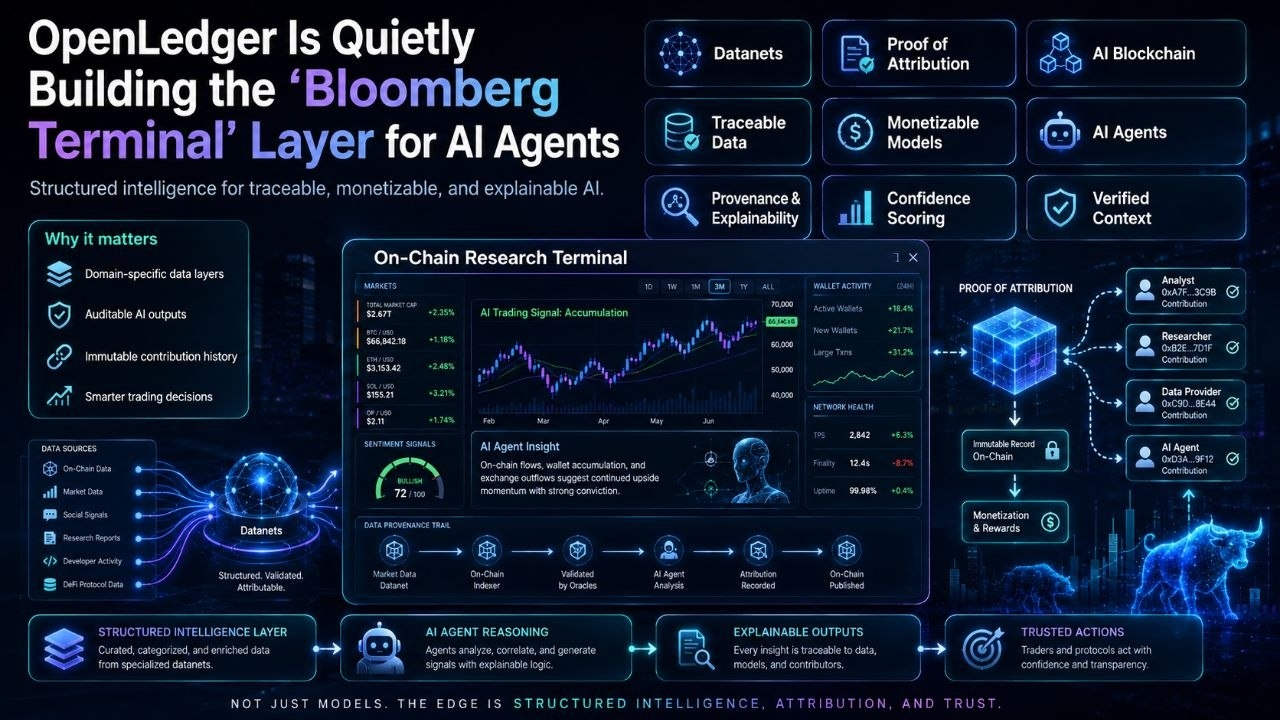
That’s the underrated part of OpenLedger’s vision.
OpenLedger positions itself as an AI blockchain where data, models, and agents become traceable and monetizable through systems like Datanets and Proof of Attribution. Instead of treating datasets like disposable fuel, OpenLedger treats them like economic assets that can continuously generate value when models or agents use them.
And honestly? That changes how I think about AI trading systems completely.
In traditional crypto trading, edge usually comes from information asymmetry. Some traders react faster to governance changes. Others monitor unlocks, liquidity shifts, whale wallets, validator activity, GitHub commits, or social rotations before the market fully prices them in.
But AI agents today mostly scrape generic internet data with weak attribution. That creates two problems:
1. The data quality is inconsistent.
2. Nobody really knows which data actually influenced the output.
OpenLedger’s Datanet structure feels designed to solve this exact issue. Specialized communities can create domain-specific data layers for areas like DeFi, governance, AI tooling, security exploits, or on-chain analytics. OpenLedger explains that contributors upload and validate data inside Datanets, while all contribution history is tracked on-chain.
That’s important because good AI agents are really just context engines.
A strong trading agent shouldn’t only answer:
> “What’s happening?”
It should answer:
> “Why is this happening, which datasets support it, and how reliable are those datasets?”
This is where OpenLedger’s Proof of Attribution becomes more interesting than people realize. Their attribution system links model outputs back to specific data contributions and keeps immutable records of influence and provenance.
For builders, that unlocks a completely different AI economy.
Imagine a DeFi analyst who consistently uploads high-signal governance summaries into a Datanet. If those summaries repeatedly influence successful agent outputs, the contributor can theoretically continue earning from future usage instead of getting paid once and forgotten. That’s closer to owning productive digital infrastructure than selling content.
And from a trader’s perspective, attribution creates something AI desperately lacks right now: confidence scoring with accountability.
Personally, I’d trust an OpenLedger-powered agent more if it showed:
which Datanets influenced the answer,
how recent the supporting data is,
whether the signal historically performed well,
and which contributors consistently produced high-quality insights.
That’s basically the beginning of an AI-native research terminal.
What makes this narrative stronger is that the broader market is moving in the same direction. Recent decentralized AI research is increasingly exploring blockchain-based inference verification and auditable AI execution systems instead of black-box generation alone. OpenLedger’s architecture fits naturally into that shift because it focuses on provenance, attribution, and explainability at the infrastructure layer.
I think people are still underestimating how valuable traceable intelligence will become.
The internet monetized attention. Crypto monetized coordination. AI may monetize verified context.
And if that happens, OpenLedger’s biggest product may not just be AI models. It could become the trust layer that AI agents rely on when money, automation, and decisions are all happening on-chain 🤝