

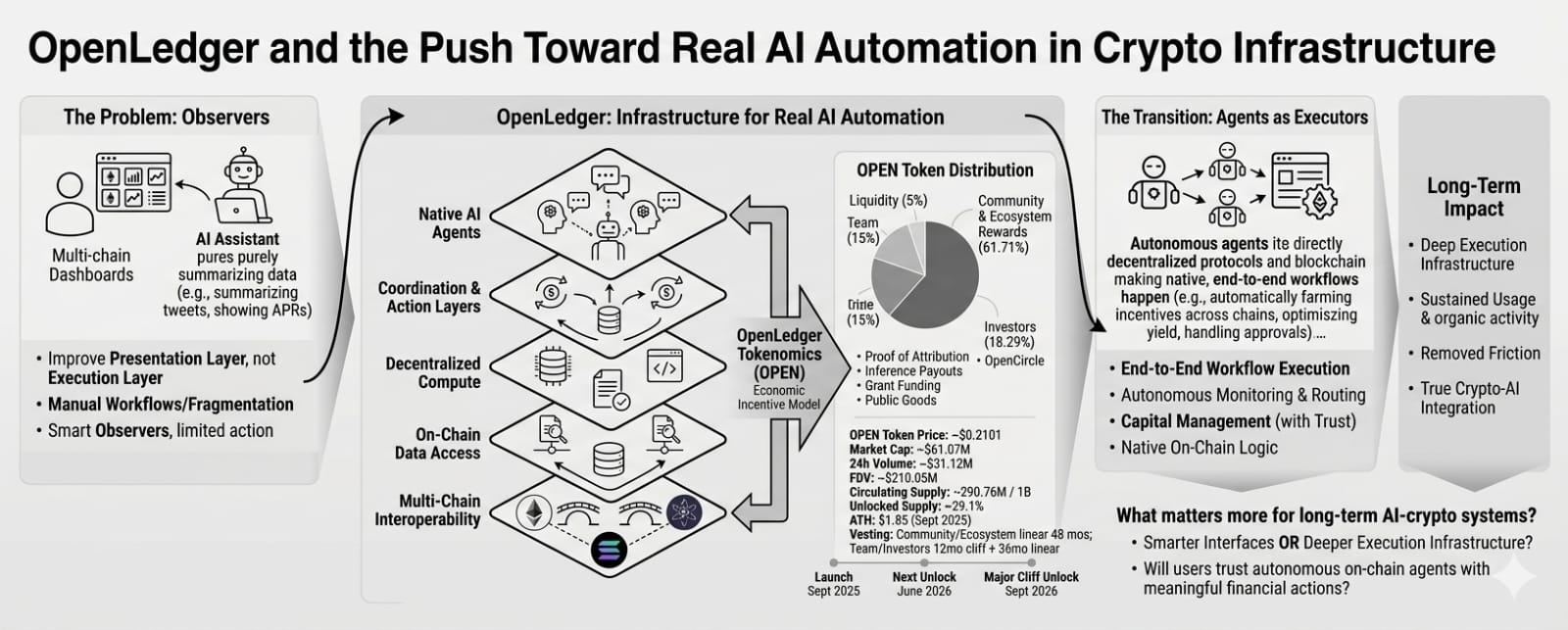

A few months ago, I watched a friend spend almost two hours moving assets between chains just to farm a new incentive program. First he bridged funds, then checked three dashboards to confirm liquidity depth, then opened another tab to track emissions, and finally sat in Discord asking whether the APR numbers were even real. The funny part was that he had an “AI crypto assistant” open the entire time. It summarized tweets perfectly, but it still couldn’t actually reduce the workload that mattered.
That moment stuck with me because it captures the biggest problem with the current AI narrative in crypto. Most tools are improving the presentation layer, not the execution layer. The dashboards look cleaner. The chatbots sound smarter. The summaries feel more personalized. But underneath all of that, users are still clicking through the same fragmented workflow manually.
I noticed this myself while rotating between ecosystems earlier this year. Even simple tasks became exhausting after a while. One wallet for staking, another for governance, multiple RPC endpoints failing randomly, reward trackers lagging behind on data, and bridge interfaces that still feel risky every time you approve a transaction. AI was supposed to simplify crypto, yet most implementations only added another interface between the user and the chaos.
That’s why OpenLedger started standing out to me.
Not because it marketed itself as “AI-powered,” since almost every project says that now, but because the focus appears to be lower in the stack. Instead of building another chatbot with a crypto personality, OpenLedger seems more interested in infrastructure that allows AI agents to coordinate actions, access data, use compute resources, and eventually operate across chains in a more native way.
That difference matters more than people realize.
Right now, many AI agents in crypto behave like smart observers. They can explain markets, summarize governance proposals, or monitor wallets, but they rarely execute end-to-end workflows autonomously. They sit beside the user instead of replacing repetitive behavior. Real automation would mean the system handles monitoring, routing, approvals, execution logic, and optimization without forcing the user to babysit every step.
The easiest way I explain it to friends is this: most crypto AI today feels like a GPS that talks beautifully but still makes you push the car uphill yourself.
OpenLedger appears to be targeting the engine instead.
From a structural perspective, the incentive model is also interesting. A lot of crypto projects can launch tokens quickly, but sustaining participation is the difficult part. OpenLedger’s tokenomics are clearly designed around maintaining an active ecosystem rather than creating a short-term hype cycle. Community rewards and ecosystem incentives make up 61.71% of allocation, while investors hold 18.29%, the team controls 15%, and liquidity accounts for 5%.
That ecosystem bucket is important because it funds Proof of Attribution rewards, inference payouts, datanet grants, hackathons, public goods, and OpenCircle incentives. In theory, that creates a loop where developers, data providers, and compute contributors all have economic reasons to keep participating instead of abandoning the network after launch speculation fades.
Still, token design alone does not guarantee adoption.
OPEN is currently trading around $0.2101 with a market cap near $61.07 million and a 24-hour trading volume of roughly $31.12 million. Fully diluted valuation sits around $210.05 million, while circulating supply is approximately 290.76 million OPEN out of a 1 billion total supply. About 29.1% of tokens are unlocked today, meaning the market has already absorbed significantly more supply since launch.
That detail matters because the chart already reflects a brutal reset. OPEN is nearly 88.63% below its September 2025 all-time high of $1.85. To me, that suggests the market has largely repriced the early “tiny float” premium that inflated many AI-related launches last year. The token now trades more like an infrastructure bet than a speculative AI narrative trade.
I think vesting schedules will become increasingly important going forward. Community and ecosystem allocations unlock linearly over 48 months, while both team and investor allocations follow a 12-month cliff with 36 months of gradual monthly unlocks afterward. Based on the September 8, 2025 launch timeline, the next recurring unlock cycle should arrive around June 8, 2026, with larger cliff-related unlock pressure likely appearing closer to September 2026.
Personally, I always watch unlock dynamics closely because they reveal whether network participation is organic or simply reward-driven. I learned this the hard way during earlier infrastructure cycles where token emissions looked sustainable until incentives slowed and activity collapsed almost overnight.
That’s the real test for OpenLedger too.
Can it create automation people genuinely rely on, or will it become another impressive demo environment that struggles under real usage conditions?
Infrastructure projects usually fail quietly. Not because the ideas are bad, but because real-world crypto environments expose weaknesses quickly: latency issues, poor coordination incentives, fragmented liquidity, unreliable data feeds, or users refusing to trust autonomous execution with capital.
At the same time, I think the broader direction makes sense. Crypto does not necessarily need louder AI branding anymore. It needs systems that remove friction so effectively that users barely notice the complexity underneath.
That is a much harder challenge than building another AI agent that posts market opinions on social media.
For now, I’m still watching cautiously. OpenLedger feels more grounded than many projects chasing the AI trend, but infrastructure narratives only prove themselves through sustained usage, not presentations.
What do you think actually matters more for AI-crypto systems long term: smarter interfaces, or deeper execution infrastructure beneath them? And do you believe users are ready to trust autonomous on-chain agents with meaningful financial actions yet?
$OPEN @OpenLedger #OpenLedger $PHB #SECPausesNewETFApplicationReview #OpenAIToConfidentiallyFileForIPO #AtlantaFedGDPNowForecastsQ2GrowthAt4.3% #CFTCNHLSignPredictionMarketMOU
