
Fogo is easiest to understand if you stop thinking about it as just another Layer 1 and instead look at it as infrastructure designed around one specific pressure point: trading execution.
At its core, Fogo runs on the Solana Virtual Machine. That choice immediately places it inside a familiar technical framework. Developers who already build for Solana do not need to relearn a new execution model. The programming assumptions, runtime logic, and account model feel recognizable. This matters because compatibility lowers friction. It allows existing tooling, libraries, and mental models to carry over with minimal adjustment.
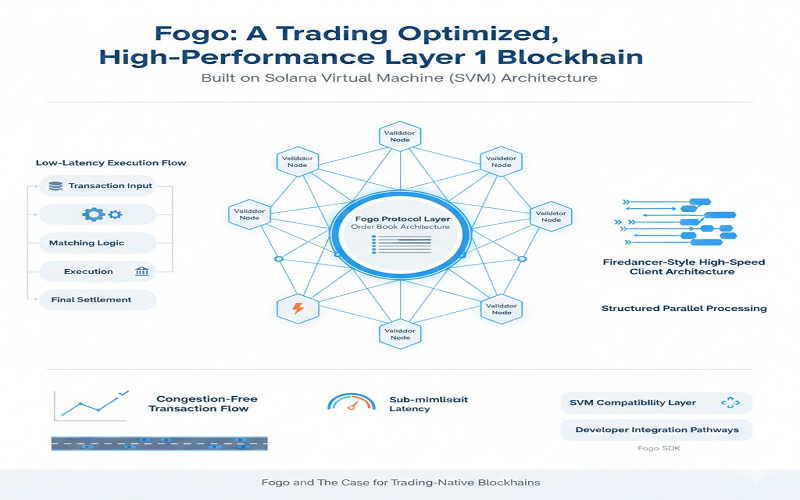
But Fogo is not trying to be a general-purpose chain in the usual sense. It is structured around trading activity as a primary workload. Most blockchains start with a broad design goal and then let applications compete for block space. Fogo takes a narrower view. It assumes that high-frequency, order book-based markets will be central, and it organizes execution around that assumption.
Think of execution layers like highways. On a typical chain, every type of vehicle shares the same lanes. NFTs, governance votes, DeFi swaps, games, everything competes for space. Congestion appears when traffic spikes. Fogo attempts to design the highway specifically for financial vehicles that need predictable speed and consistent throughput. It does not eliminate traffic, but it reduces variability for the type of activity it prioritizes.
One structural difference is the way order book mechanics are integrated into the chain’s design rather than treated purely as smart contract logic. On many networks, order books are implemented at the application layer. They work, but they inherit the limitations of general transaction ordering and latency. Fogo’s architecture leans toward tighter integration between execution and market structure. That does not magically remove complexity, but it aligns the system with the needs of price matching, cancellations, and rapid updates.
Performance discussions around Fogo often reference a Firedancer-style client architecture. Firedancer, originally developed to optimize Solana’s performance, focuses on efficient networking, parallel execution, and minimizing bottlenecks at the validator level. Fogo’s approach borrows from that philosophy. The idea is straightforward: if the base client can process transactions more consistently and with lower overhead, trading applications experience fewer execution surprises.
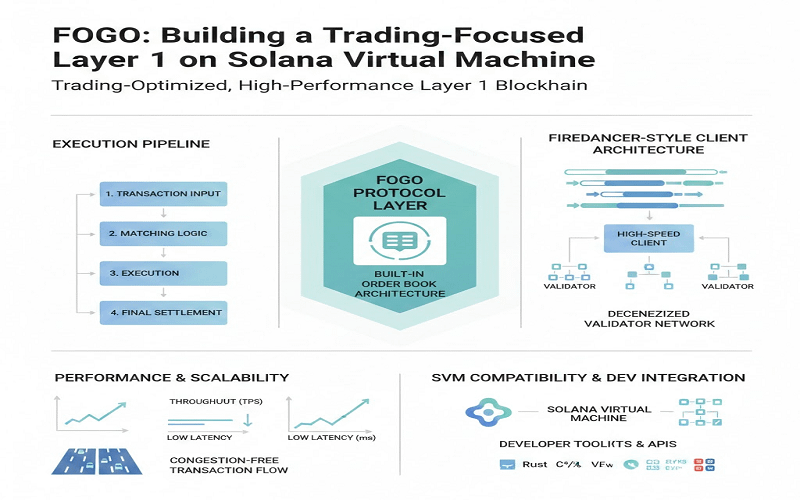
Consistency is the key word here. Peak throughput numbers are less interesting than how stable performance remains during bursts of activity. Traders care less about theoretical limits and more about whether the system behaves predictably under load. Fogo’s design attempts to address that by reducing jitter in execution and keeping validator performance tight.
From a developer perspective, the use of the Solana Virtual Machine lowers migration costs. Teams already building on Solana can port or adapt code with fewer structural changes. This also means ecosystem tools such as wallets and analytics platforms can integrate more easily. The project account, @Fogo Official , has positioned the chain within the broader SVM landscape rather than outside it. That framing is important. It signals that Fogo is not rejecting existing infrastructure but refining it for a specific purpose.
The token, $FOGO , fits into this architecture in a conventional way. It secures the network, aligns validator incentives, and coordinates economic activity. There is nothing structurally exotic about the token model from what is publicly discussed. The differentiation lies more in system design than in token mechanics.
Still, there are limitations worth acknowledging. The SVM ecosystem is growing quickly. Multiple chains now run variations of the same virtual machine. That creates competition not only for users but for developers and liquidity. Fogo must prove that its execution optimizations translate into real advantages for trading applications, not just technical diagrams.
Validator decentralization is another challenge. High-performance systems often demand stronger hardware and optimized clients. That can narrow the pool of participants who can realistically operate nodes. Balancing performance with broad participation is an ongoing tension across many modern Layer 1 designs, and Fogo is not exempt from it.
Ecosystem maturity also matters. General-purpose chains benefit from diverse applications that reinforce each other. A trading-focused chain needs sustained liquidity and active markets to justify its architecture. Without sufficient depth, even a well-designed execution layer does not fulfill its purpose.
The hashtags #Fogo and #fogo tend to circulate in discussions about SVM expansion, but the more relevant conversation is about specialization. As blockchain infrastructure evolves, some networks are moving away from trying to serve every use case equally. Fogo represents one expression of that shift. It treats trading not as an app on top, but as a design constraint from the beginning.
Whether that model becomes dominant is uncertain. What is clear is that Fogo approaches performance not as a marketing metric, but as a structural requirement tied to how markets function on-chain.
In the end, it is less about speed in isolation and more about whether a system can stay calm under pressure.
