
The peer-to-peer (P2P) digital currency Bitcoin (BTC) debuted in 2009 and introduced the concept of decentralized finance to the world. While tax authorities, police, governments, and regulators around the world are still debating how to control it, the legislative question regarding cryptocurrencies is still in its infancy. However, many people are asking whether using cryptocurrencies is legal and whether there could be a future ban on Bitcoin.
BAN ON BITCOIN
When it comes to the question of new technologies and legislation, regulations tend to lag behind changes and innovations. This is natural and common. Although BTC has been available for several years, many countries have still not introduced a clear legal framework that relates to it (and cryptocurrencies in general).
The cryptocurrency industry is changing so dynamically and there are so many new products and services that by the time regulations are prepared by legislators, they may already be outdated and irrelevant. Lawmakers have a really difficult task in this regard.
IS BITCOIN ACTUALLY LEGAL?
The question of whether Bitcoin is legal or illegal depends on where you are on the map. Although the technology is decentralized and transcends national legal frameworks, individual countries adopt local regulations on how to deal with cryptocurrencies.
As the ban on Bitcoin became a reality in some countries, there was more discussion about the possibility of elevating it to an officially recognized currency. Among the countries where Bitcoin is illegal are several African countries, as well as China, Iraq, and Qatar. Some have no regulations regarding cryptocurrencies, and some consider them fully legal, such as in the United States or the European Union.
In contrast to illegality, which was imposed on Bitcoin in some countries, there is also the opposite. There are countries where Bitcoin has become an official national currency. This situation first occurred in El Salvador, where you can now pay not only with local dollars but also with bitcoins. Last year, the Central African Republic decided to take the same step.
In the European Union, no regulations directly related to bitcoins have been introduced yet, except for those related to taxation and VAT. Companies operating in the digital asset industry must also comply with anti-money laundering and counter-terrorism financing regulations (AML/CFT).
Bitcoin has not gained legal status, but taxes are paid on its turnover. In the near future, however, EU regulations governing virtual asset providers will be adopted. The MiCA (Markets in Crypto-Assets) directive may be approved in April 2023, and its effectiveness may be possible in 2024.
On the other side of the globe - in China, the first steps to put Bitcoin outside the law were taken in 2013-2014. A complete ban on Bitcoin occurred in September 2021 when the country's central bank banned mining and trading in cryptocurrencies.
This, of course, does not mean that investors are completely cut off from BTC. Due to its decentralized nature, they have uninterrupted access to it. However, holding or mining BTC may lead to significant penalties for Chinese residents in the form of both financial penalties and even imprisonment.
WHICH COUNTRIES HAVE BANNED BITCOIN?
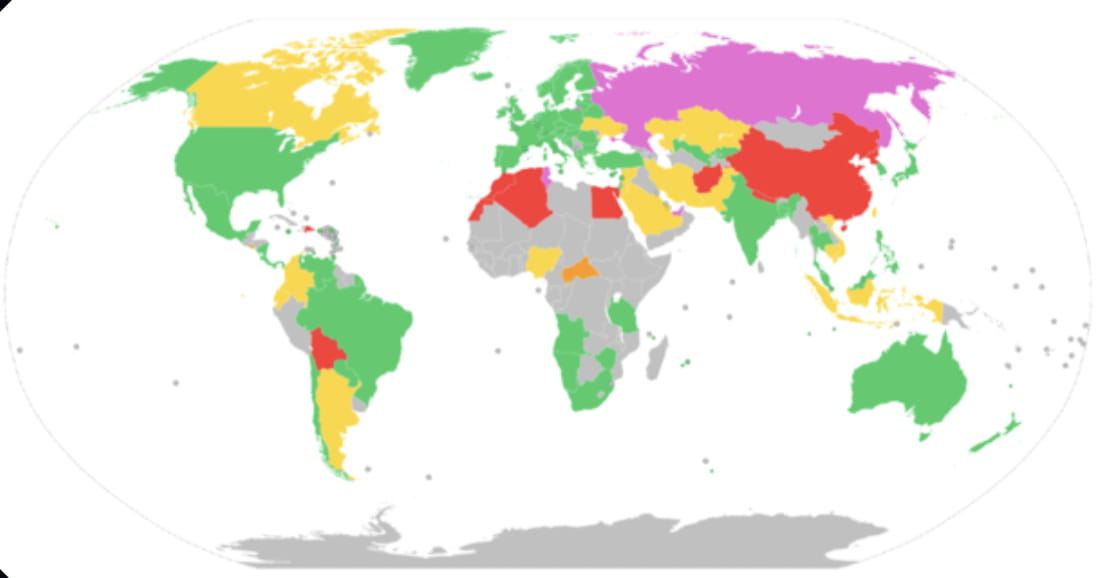
The map below shows the current status of the ban (or legalization) of Bitcoin in different countries around the world. Let's explain the meaning of each color.
Orange color
The orange color on the map shows countries where Bitcoin has become a legal tender.
Green color
Green color represents countries where the use of Bitcoin is not restricted in any way.
Yellow color
Yellow color denotes countries that have introduced certain legal restrictions on the use of BTC.
Pink color
Pink color represents the region of the world where Bitcoin is trying to fit into the interpretation of old regulations, but there are tendencies to ban it. However, there is currently no complete ban on its use.
Red color
Red color indicates regions with partial or complete bans on the use of Bitcoin and other cryptocurrencies.
Gray color
In states represented by the gray color, there is no official information or procedures regarding Bitcoin.
WHERE IS BITCOIN BANNED?
Among the countries where the ban on Bitcoin has become a 100% reality are Algeria, Bangladesh, China, Egypt, Iraq, Morocco, Nepal, Qatar, and Tunisia. In many cases, these are Muslim countries where BTC is believed to be in violation of religious rules.
WHERE IS BITCOIN RESTRICTED?
Countries where the use of cryptocurrencies, including Bitcoin, is partially banned or restricted to some extent, are Bahrain, Burundi, Cameroon, South Africa, Gabon, Georgia, Guyana, Kuwait, Lesotho, Libya, Macao, Maldives, Vietnam, and Zimbabwe.
WHERE IS BITCOIN AN OFFICIAL CURRENCY?
On the other side, El Salvador and the Central African Republic (CAR) have recognized BTC as a fully legal means of payment equivalent to local currencies.
El Salvador and CAR want to lower the cost of money transfers to the country. Salvadoran President Nayib Bukele expected to save $400 million from money transfers by switching the country to a Bitcoin infrastructure.
Using the Bitcoin Lightning network, payments could be cheaper than traditional transfer methods. At the macroeconomic level, the currencies of these countries generally have problems maintaining their value against the US dollar.
El Salvador switched to using the dollar as its currency, but quickly realized that most of its exports go to the USA, and a weakening dollar was causing more harm than good to its citizens. For countries with a weak local currency (or its lack), accepting decentralized Bitcoin could be seen as an alternative.
PRESSURE FOR THE LEGALIZATION OF CRYPTOCURRENCIES
The dynamic decline of the bitcoin market in 2022 (and the entire cryptocurrency ecosystem), combined with two major scandals – the collapse of the Terra LUNA cryptocurrency and the FTX crypto exchange – prompted regulators around the world to speak about the need to regulate this market.
Christine Lagarde, the president of the European Central Bank (ECB), stated in November 2022 that regulation of cryptocurrencies in the European Union (EU) is an "absolute necessity" after the collapse of the FTX exchange based in the Bahamas. The EU is currently working on the aforementioned MiCA regulation, which stands for "Markets in Crypto-assets".
"Europe has a head start on regulatory measures. But as I said earlier, it is a step in the right direction. That's not all – MiCA II will have to be created, which will cover more broadly what needs to be regulated and supervised, and that is very much needed," commented Christine Lagarde.
The view of the ECB is also held by the Federal Reserve System (Fed), the US central bank. Its chairman, Jerome Powell, reminded in September that "there is a real need" for better regulation of bitcoin in the country and around the world.
While a ban on bitcoin is not a topic of discussion according to his opinion – because the cryptocurrency industry should exist at the same level as other financial sectors – its freedom and lack of regulation face strong legal restrictions on other types of investments that should be ended.
Politicians and bureaucrats may be quite right. While the idea of cryptocurrencies is decentralization, without proper supervision tools, it will be difficult to avoid further situations such as the collapse of Terra Luna or FTX, which cost investors and cryptocurrency companies billions of dollars in losses.
If cryptocurrency entities were subject to the same regulations, restrictions, and reporting requirements as traditional exchanges or investment firms, then some of these significant collapses could certainly be avoided.
SUMMARY - WILL THE BAN ON BITCOIN BECOME A REALITY?
The risk when creating regulations for cryptocurrencies, especially without consulting with entities operating in the industry, may be the adverse effect of completely incompetent regulation and "over-tightening the screw."
While a ban on bitcoin should not be a threat in Western economies, it has long been a reality in some parts of the world. However, current voices suggest that neither the European Union nor the United States will put cryptocurrencies outside the law, but rather fully legalize them, i.e., dress them in the appropriate standards and laws.
Keep in mind that cryptocurrencies are many industries: investment, derivatives, decentralized finance, lending, passive investing, mining, necessary software and hardware supplies. Each of these issues can be regulated separately and according to different rules.
In the USA, as well as in the European Union, bitcoin is unlikely to be placed outside the law.