Let’s be honest. Most Layer 1 blockchains don’t know what they want to be.
They promise everything. Infinite scale. Total decentralization. A new internet. A new economy. A new world. It’s a lot. And most of it collapses under its own weight.
Plasma doesn’t try to do that. And that’s the first thing that caught my attention.
The way I see it, Plasma is making a very specific bet: stablecoins are the real product-market fit in crypto. Not governance tokens. Not yield farms. Not whatever narrative is trending this quarter. Stablecoins. Dollars on-chain. Settlement that actually works. That’s the focus.
And frankly, that’s refreshing.
If you’ve spent time in high-adoption markets—places where people actually rely on USDT or USDC to protect savings or move money across borders—you know this isn’t theoretical. This is daily life. People aren’t experimenting. They’re surviving. They don’t care about abstract decentralization debates. They care about whether the transfer lands instantly and whether fees eat into their margin.
That’s where Plasma’s design starts to make sense.
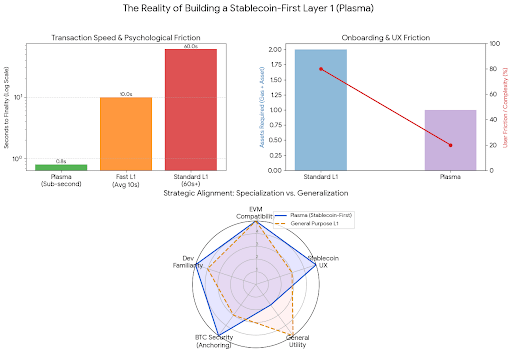
It keeps full EVM compatibility through Reth. That’s not flashy, but it’s critical. Developers don’t want to relearn everything. They won’t. Solidity is already the lingua franca of smart contracts. Tooling matters. Familiarity matters. If you make builders jump through hoops, they’ll just stay where they are. Plasma doesn’t force that fight. It says, bring your contracts, bring your infrastructure, let’s move.
Now here’s where it gets interesting.
Sub-second finality with PlasmaBFT.
That sounds like a spec sheet brag. But in payments, speed isn’t cosmetic. It’s psychological. If you’ve ever watched someone wait for a crypto transaction to confirm while standing at a counter, you know how awkward it gets. Ten seconds feels like a minute. A minute feels broken.
Sub-second finality changes the tone completely. It removes doubt. It makes crypto feel less like an experiment and more like a tool. That’s a big shift.
But speed alone won’t save you. Plenty of chains are fast on paper. The real clincher here is how Plasma handles fees.
Stablecoin-first gas. Gasless USDT transfers.
This is where they’re either very smart or walking into a minefield.
Paying gas in the same stablecoin you’re transferring? That’s obvious in hindsight. Users think in dollars. They don’t want to calculate fractions of a volatile native token just to send $20. That extra step kills adoption. I’ve seen it happen. People get confused. They run out of gas tokens. They give up.
Plasma tries to eliminate that friction.
And gasless USDT transfers? That’s bold. It lowers the barrier dramatically. New users don’t need to preload anything. They just send. Simple.
But let’s not pretend it’s magic. Someone is paying for that gas. Relayers, validators, subsidy models—whatever the mechanism is, it has to hold up under stress. Otherwise spam becomes a nightmare. Or fees spike behind the scenes. Or the economics fall apart. This isn’t a small detail. It’s a make-or-break moment for the network.
Then there’s the Bitcoin anchoring.
Look, anchoring to Bitcoin is a smart narrative move. But it’s more than that. Bitcoin is still the hardest network to mess with. Period. By committing state checkpoints there, Plasma borrows some of that security gravity. It adds an external reference point. That’s not trivial.
In regions where censorship risk is real, or where political pressure can distort infrastructure, that anchor matters. It sends a signal: this chain isn’t floating alone.
But here’s the ugly truth. Combining sub-second finality with periodic Bitcoin anchoring adds complexity. Fast local consensus is one thing. External settlement guarantees are another. The coordination between those layers has to be airtight. If there’s ambiguity about finality versus anchoring windows, institutions will hesitate. And institutions hate ambiguity.
Speaking of institutions, Plasma clearly wants them.
Payments companies. Financial rails. Cross-border operators.
They care about deterministic settlement. Audit trails. Risk modeling. They don’t care about hype cycles. EVM compatibility helps them plug into existing systems. Fast finality reduces counterparty exposure. Bitcoin anchoring strengthens the compliance narrative.
But institutions also look at governance. Validator distribution. Regulatory exposure of stablecoin issuers. And here’s the elephant in the room: stablecoin dependence.
If your entire network revolves around USDT or a handful of centralized issuers, you inherit their risk. Regulatory crackdowns. Blacklisting events. Policy shifts. That’s not theoretical. We’ve seen it happen.
So Plasma’s biggest strength is also its biggest vulnerability.
It’s all-in on stablecoins.
Now, that might be exactly the right call. Stablecoins already dominate on-chain volume. They’re the real liquidity layer. If you optimize for where value actually moves, you win relevance.
But you also concentrate exposure.
Retail users in high-adoption markets will love simplicity. They don’t want to think about gas markets or token economics. They want transfers that just work. Cheap. Instant. Predictable.
If Plasma nails UX, it could spread fast in those regions.
If it doesn’t? If wallets are clunky, bridges are risky, or fee models become opaque? Users will bounce. They don’t have patience for experimental friction.
And bridges. We have to talk about bridges.
No Layer 1 exists in isolation. Liquidity has to move in and out. Bridges are historically one of the weakest points in crypto architecture. Hacks. Custodial risks. Smart contract bugs. If Plasma becomes a stablecoin settlement hub, bridge security isn’t optional. It’s existential.
What I appreciate, though, is the restraint in the design philosophy.
Plasma isn’t trying to be the chain for everything. It’s trying to be the chain where stable value moves cleanly. That’s a narrower goal. But narrow goals are often more achievable.
Crypto is maturing. Slowly. Painfully. And part of that maturation is specialization. Not every chain needs to be a general-purpose world computer. Some can be infrastructure rails. Settlement layers. Payment highways.
Plasma feels like it understands that.
Will it succeed? That depends less on whitepapers and more on execution. Validator incentives. Fee sustainability. Real partnerships. Regulatory navigation. These are messy, human problems.
But the direction makes sense.
Stablecoins are already the backbone of crypto activity. Building a Layer 1 that treats them as first-class citizens instead of secondary assets isn’t radical it’s logical.
And sometimes logic wins.