

WLFI's Worst Day. A Reserve Sale, a Broken Peg, and a Fraud Accusation.
WLFI fell 51% in 24 hours and hit a record low of $0.01579 before bouncing 28% off the bottom. The bounce is not the story. The story is what happened off the chart: the project's own reserve sold its ETH at half price, its stablecoin lost its peg, and one of its earliest backers is now calling the whole venture a fraud and urging exchanges to delist it.
THE SALE: THE ONE FACT NOBODY DISPUTES
Using Arkham data, EmberCN tracked an address labelled World Liberty Financial: Strategic Reserve selling 12,121 ETH through CoW Swap for roughly $20.06 million in stablecoins ($17.58 million in USDC and $2.48 million in USD1). The average price was about $1,655 per ETH.
According to CoinDesk, World Liberty bought that same ETH last year at around $3,244. At that price, the position was worth about $39.32 million. The gap is a realised loss of roughly $19.26 million, which means the loss is locked in and will not come back.
A reserve exists to be a project's backstop. This one sold at the market price and absorbed the loss.
THE PEG: A DOLLAR STOPPED BEING A DOLLAR
USD1 is designed to trade at $1. Today it fell to $0.94 on Binance, 6% below its peg, before recovering to about $0.998. It still has not fully returned to $1.
There is no evidence that the reserves behind USD1 were empty. BitGo issues the token and holds the reserves, and redemptions remained open in principle. According to Lookonchain, Jump Crypto bought 43.26 million USD1 below $1 and redeemed it at par through BitGo. That is the arbitrage mechanism working as intended, but only for a firm large enough to use it.
A stablecoin is a promise that a dollar is always a dollar. One that relies on arbitrageurs to defend its peg is one the market is already doubting.
THE ACCUSER: JUSTIN SUN
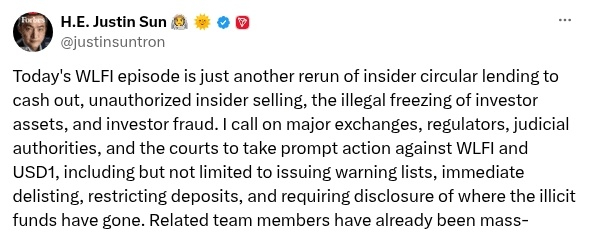
Sun invested $30 million in World Liberty beginning in late 2024 and was once among its largest backers. Today he accused the project of investor fraud, alleging insider circular lending to cash out, unauthorised insider selling, and the illegal freezing of investor assets. Circular lending here means borrowing against your own token to extract cash.
He called on exchanges, regulators and courts to act against WLFI and USD1, including warning lists, immediate delisting, deposit restrictions, and disclosure of where the funds went. He also claims team members have been mass-deleting posts.
Sun is not a neutral party, and that context matters:
- After WLFI began trading in September 2025, his wallet was blacklisted, freezing about 595 million unlocked tokens then worth around $107 million.
- He sued World Liberty in April 2026, alleging fraud and extortion.
- World Liberty countersued in May, accusing Sun of shorting WLFI to drive its price down.
That history does not make him wrong. It means his words should be read with his position in mind.
THE UNCONFIRMED THREAD
Chatter on X links the ETH sale to a $75 million stablecoin loan against roughly 5 billion WLFI tokens on Dolomite, with speculation that the team sold ETH to repay debt or add collateral. This is reported but unconfirmed, and World Liberty has not responded to CoinDesk's request for comment.
If the loan story is true, the sale looks like debt management. If it is not, it looks like a reserve giving up on its own project. Either way, the silence is part of the story.
WHAT TO WATCH
In my view, the next 48 hours will decide this.
- If USD1 holds at $1 and no exchange acts on Sun's call, today was a panic, and the project earns a second chance.
- If USD1 slips again, or even one exchange delists WLFI or USD1, the trust question answers itself.
Also watch whether BitGo or World Liberty explains the depeg at all, and whether anyone with access to the records confirms the Dolomite loan.
A token can bounce 28% in an afternoon. Trust cannot. It has to be rebuilt, and so far nobody at World Liberty has started.