Tesla’s European autonomy ambitions have reached an important regulatory moment. But the next milestone is not a product launch or a software update. It is a vote that may—or may not—take place in Brussels.
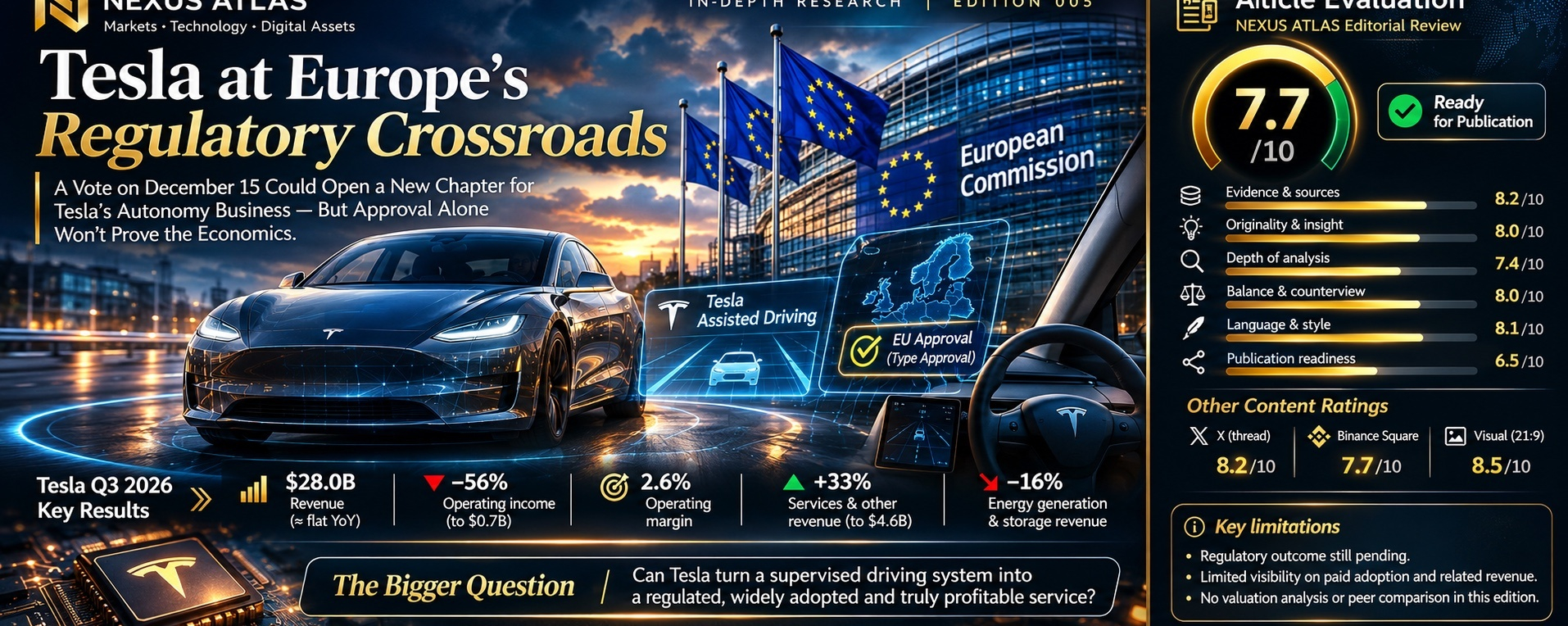
On November 26, Reuters reported that a draft European Commission agenda lists a possible vote on December 15 concerning EU-wide type approval for Tesla Assisted Driving.
That wording matters.
A possible vote is not a confirmed vote, and a vote is not an approval. The distinction is especially important because Tesla’s European expansion depends on clearing a regulatory process that has already experienced delays.
The European threshold
The proposed decision concerns the Dutch request for type approval of Tesla’s assisted-driving system across the European Union.
EU-wide approval requires support from at least 15 of the 27 member states, representing 65% of the bloc’s population.
Several countries have followed the Netherlands’ preliminary approval. Yet a negative EU-level decision could invalidate national approvals already granted.
The system itself must also be described accurately. It can steer, accelerate and brake, but drivers are still required to supervise it continuously.
This is not unrestricted autonomous driving.
Why the decision matters commercially
Europe represents more than another market for Tesla to enter. Regulatory approval could influence how widely the company can distribute its driver-assistance software and build recurring revenue around its vehicle fleet.
That opportunity is meaningful, but it should not be confused with proven economics.
Tesla’s third-quarter 2026 results show why the distinction matters.
The company reported revenue of approximately $28.0 billion, broadly unchanged from a year earlier. Operating income fell 56% year over year to roughly $0.7 billion, leaving an operating margin of 2.6%.
Cash and short-term investments stood at approximately $45.4 billion.
Services and other revenue increased 33% year over year to $4.6 billion, while energy generation and storage revenue declined 16% during the quarter.
These figures describe a company investing heavily in its next phase while its current operating profitability remains under pressure.
The question investors should ask
The debate around Tesla often becomes a contest between two narratives: a car manufacturer facing margin pressure, or an autonomy and robotics company preparing to reshape transportation.
Neither narrative is sufficient on its own.
The more useful question is whether Tesla can convert supervised driver-assistance technology into a legally deployable, trusted and commercially scalable service.
That requires more than technical capability.
It requires regulatory approval, customer adoption, reliable performance, manageable liability and recurring revenue that can be measured in financial statements.
A December vote could remove one important obstacle. It cannot, by itself, prove that the business model works.
What would change the assessment?
The evidence worth watching is straightforward:
1. Whether the December 15 meeting proceeds to a formal vote.
2. Whether the required EU member-state support is secured.
3. Whether approval expands actual availability across major European markets.
4. Whether paid adoption and software-related revenue become more visible in Tesla’s disclosures.
5. Whether operating margins improve as the company scales its software and autonomy investments.
A delay would not automatically invalidate Tesla’s long-term autonomy ambitions. Equally, approval would not automatically validate the financial expectations attached to them.
The regulatory milestone is important. The commercial proof still has to follow.
The real test for Tesla is not whether its software can drive a car. It is whether the company can turn that capability into a trusted, approved and profitable service at scale.
⸻
NEXUS ATLAS
We investigate companies and digital assets with the potential to shape future industry and infrastructure.
We distinguish technological progress from commercial adoption, and commercial adoption from shareholder value.
We don’t chase narratives. We investigate what the evidence reveals.
Research cut-off: November 26, 2026. This article is independent research for educational purposes and is not financial advice.
Sources
* Reuters, November 26, 2026 — EU may vote on authorising Tesla’s assisted-driving system at the December 15 meeting.
* Tesla Q3 2026 Form 10-Q, filed with the U.S. Securities and Exchange Commission.
* Tesla Q3 2026 Update Deck.