

Who Holds the Keys When a Bank Joins the Chain?
How are traditional banks approaching blockchain infrastructure, and who really controls the keys?
As a writer for @DAO Labs , I looked at @keybank's role in tokenized deposit projects alongside other US banking initiatives. Here is what the sources show about privacy, control and the trade-offs.
In crypto there is an old saying: not your keys, not your coins. Now picture a bank whose roots go back more than two centuries stepping onto a blockchain, with the keys split between the bank, a network operator, a regulator and maybe the customer.
That is why "does KeyBank sell Bitcoin?" misses the point. The better question is who holds which key. I found no sign that KeyBank sells crypto to retail customers. I did find three tokenized-deposit projects that name it.
How to read the labels: Confirmed = primary source. Reported = relayed by news outlets. Vendor claim = a company describing its own product. Not found = I couldn't find it, which doesn't mean it doesn't exist.
KeyBank on-chain
KeyBank is Cleveland-based, with about $191 billion in assets at June 30, 2026 (KeyCorp Q2 filing, Confirmed).
1. Cari Network. A permissioned Layer-2 built on ZKsync's Prividium stack, anchored to Ethereum and aimed at regional and mid-size banks. Former Comptroller of the Currency Gene Ludwig founded it in 2025.
- KeyBank has been one of six design partners since September 2025 (Confirmed, Cari's Business Wire release, September 2, 2026).
- Cari announced a $32.5 million first tranche on September 2, 2026, entirely from banks. The release says all six design partners, KeyBank included, took part (Confirmed).
- Status: Pilot, pre-production. Cari says the funding will move the network toward production (Confirmed). A November 6, 2026 GARP report says design partners are expected to go live by year-end (Reported).
2. FIS Project Keystone. A bank-administered network for regulated deposits in digital form, announced April 30, 2026 with Citizens, Fifth Third, Huntington, KeyBank and M&T, on FIS's Lyriq platform (Confirmed, FIS release). The release says six institutions but names five. That it is live: Not found.
3. The Clearing House On-Chain Money Initiative. The Clearing House is owned by 25 large US institutions. It announced the initiative on June 5, 2026, naming KeyBank (Confirmed), and selected Quant as technology partner on September 24, 2026. It targets availability in the first half of 2027, so this is a plan, not a production system.
Leadership. On CNBC in July 2025, CEO Chris Gorman called stablecoins promising and said deposit erosion is a threat, but not an immediate one (Reported). Earlier coverage noted his concerns about traceability and money laundering (Reported).
Bitcoin. A July 2025 report said KeyBank planned Bitcoin trading and custody through third parties (Reported). That it launched: Not found.
THE TECHNOLOGY
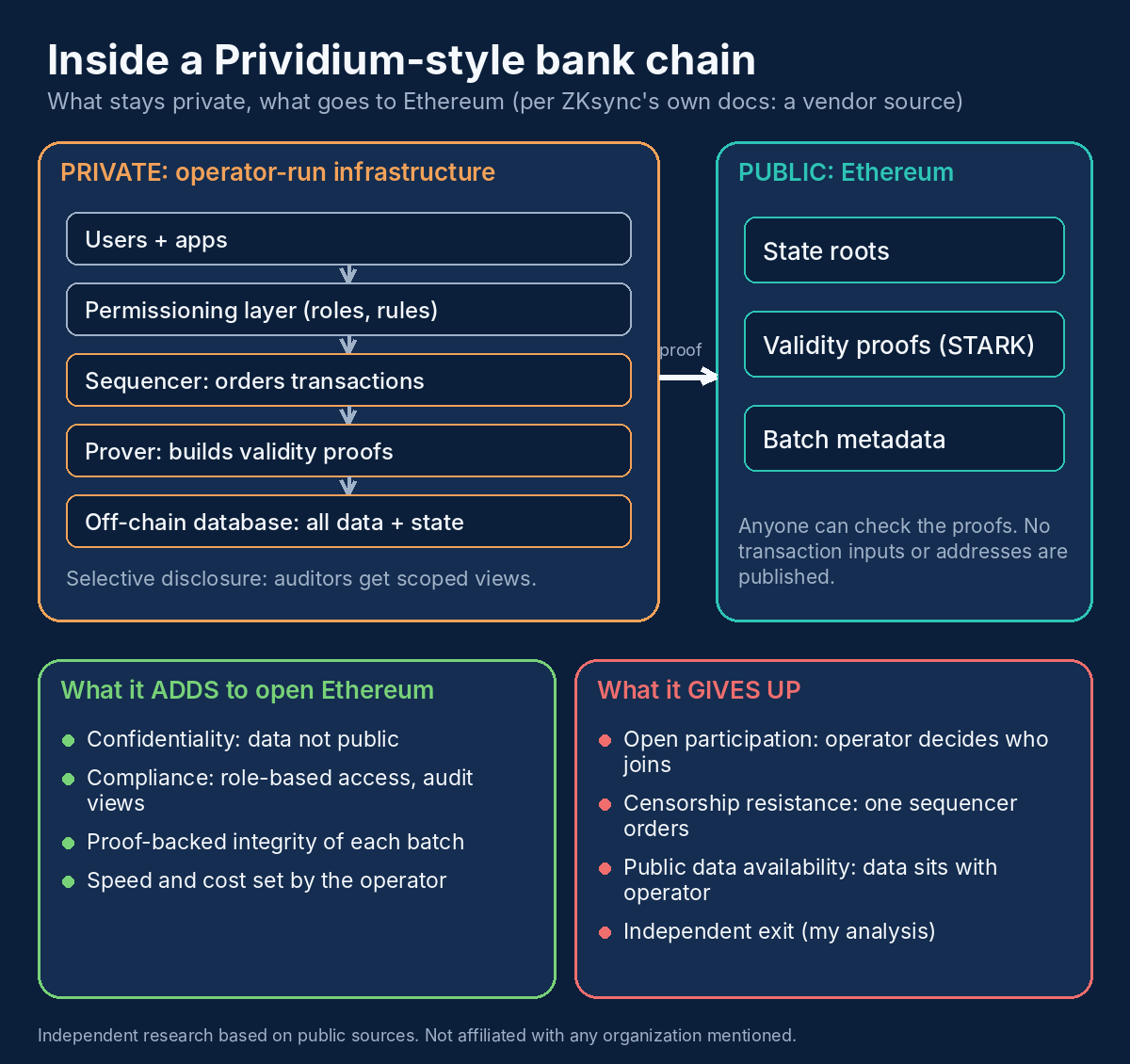
ZKsync's documentation (Vendor claim) describes Prividium as a permissioned validium. The operator runs its own sequencer, prover and database.
- Private: Transaction inputs, addresses and full state stay off-chain, behind role-based access rules.
- Public: State roots and zero-knowledge proofs go to Ethereum.
- Disclosure: Auditors can receive scoped views through selective disclosure.
It adds confidentiality, compliance controls and proof-backed batches. It gives up open participation, since the operator decides who joins, and censorship resistance, since one sequencer orders transactions.
It also gives up public data availability. In my analysis, because transaction data stays off-chain, users depend on the operator's data-access and recovery arrangements. Ethereum can verify validity proofs without necessarily having enough information to reconstruct the private ledger independently.
Who holds the keys? (Opinion)
I compared a Prividium-style bank chain with public Ethereum and a traditional bank ledger:
- Access: The bank and operator decide who joins.
- Visibility: The operator controls the private database; regulators and auditors can see information disclosed to them.
- Ordering: The operator's sequencer orders transactions.
- Verification: Ethereum validators can check the cryptographic proofs without seeing private transaction data. The operator controls the underlying database, while authorised auditors can inspect selectively disclosed information.
- Exit: A tokenized deposit is a claim on a bank, so redemption ultimately depends on the issuing bank. Whether customers can independently withdraw or transfer their on-chain assets depends on the network's withdrawal and interoperability arrangements. I found no published forced-withdrawal path (Not found).
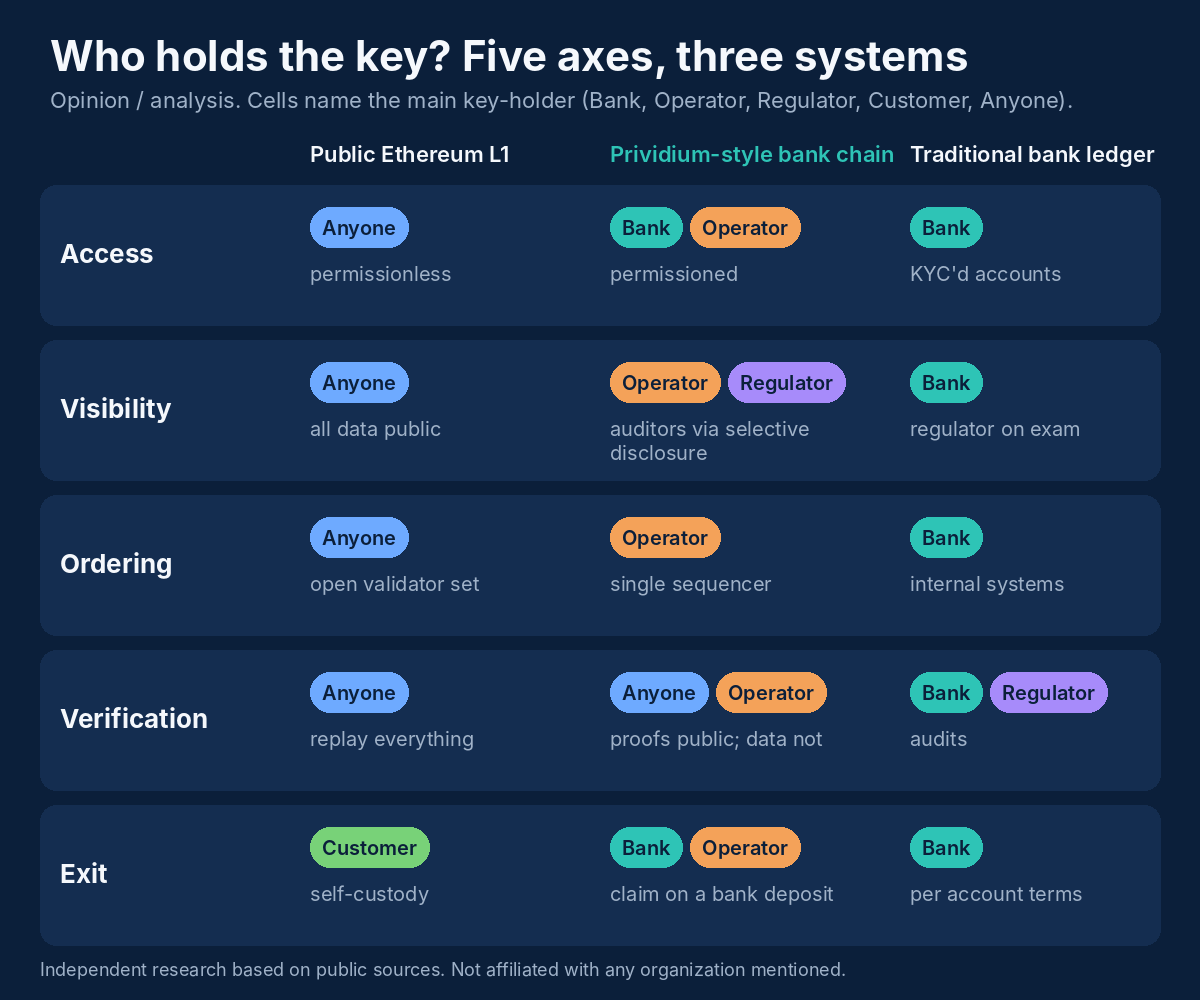
My verdict: This looks closer to a bank ledger with a cryptographic audit trail than to open crypto. If you want regulated, private, programmable deposits, that is a feature. If you want open participation, censorship resistance and independent exit, the trade-offs deserve serious attention.
Deutsche Bank's DAMA 2 also builds on ZKsync technology with a permissioned sequencer, but for tokenized funds. Its MVP was targeted for H2 2025 (Deutsche Bank, June 2025); production status: Not found. My read: a trend, not a standard.
Three questions I would ask KeyBank's team
1. Governance: Who runs the sequencer and prover, how are upgrades and disputes decided, and can a bank leave with its data?
2. Interoperability: KeyBank is named in Cari, Keystone and The Clearing House. How would a deposit move between them?
3. Verification: What can a customer check without trusting the operator, such as inclusion proofs or a published data backup?
I would be more optimistic if there were public governance rules, customer-side proofs, independent audits and dated production metrics.
Sources
- KeyCorp Q2 2026 earnings release (8-K): https://www.sec.gov/Archives/edgar/data/0000091576/000009157626000017/a2q26earningsrelease.htm
- Cari funding release, Business Wire, September 2, 2026 (republished copy): https://www.crypto-reporter.com/newsfeed/cari-raises-over-30-million-in-first-tranche-of-initial-funding-round-backed-entirely-by-banks-130847/
- Cari raises $32.5M, Pulse 2.0 (September 2026): https://pulse2.com/cari-raises-32-5-million-from-banks-to-scale-tokenized-deposit-network/
- Cari raises $32.5M, Ledger Insights (September 2, 2026): https://www.ledgerinsights.com/us-tokenized-deposit-network-cari-raises-32-5-million-from-banks/
- Cari lands $32.5M, Fintech Futures (September 2026): https://www.fintechfutures.com/venture-capital-funding/cari-lands-32-5m-for-blockchain-banking-network
- GARP report on Cari (November 6, 2026): https://www.garp.org/risk-intelligence/technology/ormer-regulator-rallies-261106
- FIS Project Keystone release, Business Wire (April 30, 2026): https://www.businesswire.com/news/home/20260430729662/en/FIS-and-Leading-Financial-Institutions-to-Build-Their-Own-Digital-Tokenized-Money-Network
- The Clearing House On-Chain Money Initiative, PR Newswire (June 2026): https://www.prnewswire.com/news-releases/major-financial-institutions-unveil-bank-led-on-chain-money-initiative-302792661.html
- The Clearing House selects Quant, PYMNTS (September 24, 2026): https://www.pymnts.com/blockchain/2026/the-clearing-house-taps-quant-to-power-tokenized-deposits-network/
- Gorman on stablecoins, CryptoNews (July 2025): https://cryptonews.com/news/keycorp-bank-ceo-bullish-on-crypto-says-stablecoin-has-a-lot-of-promise/
- KeyBank Bitcoin report, Crypto Times (July 24, 2025): https://www.cryptotimes.io/2025/07/24/keybank-to-launch-bitcoin-trading-and-custody-for-customers/
- ZKsync Prividium documentation: https://docs.zksync.io/zk-stack/prividium and https://docs.zksync.io/zk-stack/prividium/architecture
- Deutsche Bank DAMA 2 release (June 18, 2025): https://www.db.com/news/detail/20250618-dama-2-litepaper-institutional-blueprint-for-asset-tokenisation-and-servicing-on-ethereum-layer-2
X thread: [https://bit.ly/4jedrd9]