


TLDR
Brent crude traded near $92 a barrel Thursday after new attacks on ships and Saudi energy sites.
On Monday, Brent’s January contract had closed at its lowest level since late August.
The IEA expects a supply surplus of 3.8 million barrels a day in 2027.
ANZ says Hormuz traffic is at 49% of normal, with almost no spare capacity.
OPEC+ meets Sunday to set its 2027 output policy.
The oil market is trying to price two stories at once. One says the world faces a large supply glut next year. The other says the world’s most important oil shipping lane is running at around half its normal traffic, under attack, with little backup supply.
BREAKING: Oil surges above $85 following Houthi attacks on Middle Eastern infrastructures and maritime incidents in the Strait of Hormuz. pic.twitter.com/rllB16tE8L
— Bull Theory (@BullTheoryio) November 26, 2026
The lead story has flipped quickly. On Monday, Brent’s January contract closed at $89.37, its weakest finish since Aug. 28, after three straight weekly losses. By Thursday, Brent was trading at $91.86 in Europe, according to Investing.com, after a new wave of attacks across the Gulf.
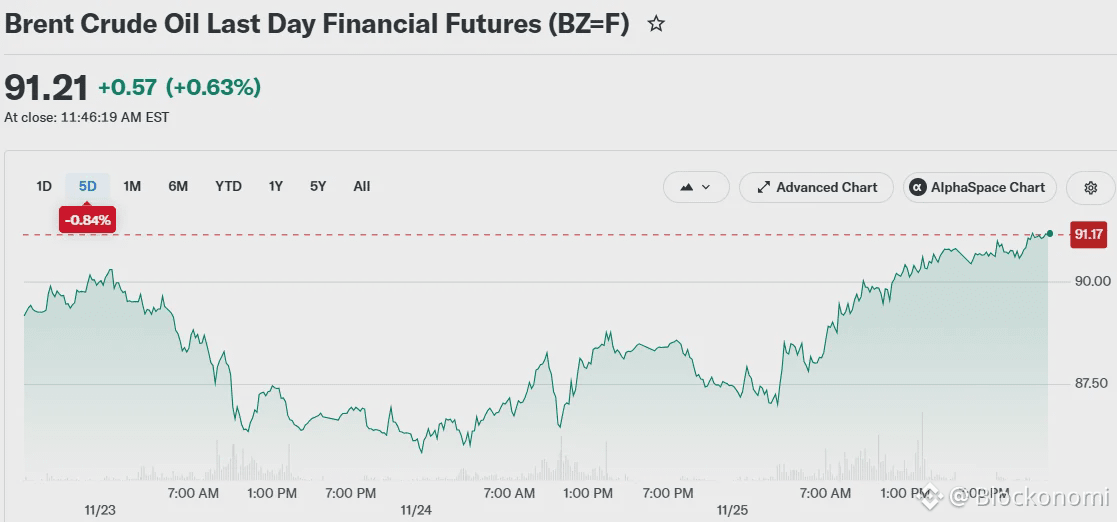 Brent Crude Oil Last Day Financial Futures (BZ=F)
The UK Maritime Trade Operations agency said three more ships were struck by projectiles heading east through the Strait of Hormuz. Iran’s Fars news agency reported that another tanker had hit a naval mine. Houthi militants aimed four drones at Saudi Arabia’s Ras Tanura refinery and two Red Sea ports. Bahrain reported an Iranian attack on a civilian industrial site, and Iran’s Revolutionary Guards claimed strikes on U.S. positions there.
The case for a glut
The International Energy Agency expects supply to exceed demand by 1.7 million barrels a day this quarter, widening to 3.8 million barrels a day in 2027.
U.S. crude stocks rose 1.1 million barrels in the week to Nov. 20, the third straight weekly build, the Energy Information Administration reported.
Dennis Kissler of BOK Financial wrote in a note on Monday that the attacks have not stopped oil from moving:
“Global crude oil exports remain ample… While attacks are still occurring…oil flows are reaching destinations.”
He called Iranian claims that more than 35 large tankers hit mines in 20 days “nearly impossible” given current flows.
The case for a squeeze
ANZ analysts estimate Hormuz throughput at 49% of normal. They warn that low global inventories and almost no spare production capacity leave the market exposed. UBS analyst Giovanni Staunovo has said prices underestimate the combined risk of depleted inventories, recovering Chinese demand and ongoing disruptions.
Even the basic numbers don’t line up. Preliminary Kpler data showed Hormuz transits 42% below prewar levels in the week to Nov. 21, which is closer to 58% of normal than ANZ’s 49%. The figures cover different periods and may measure different things. Demand signals are mixed too. Investing.com linked a drop in U.S. crude exports, which fell to their lowest since early August, partly to softer Asian demand.
A lesson from the 1980s
This is not the first time a Gulf shipping war has met a glut. During the Iran-Iraq “Tanker War,” which began in 1984, hundreds of merchant ships were attacked. Yet oil prices collapsed in 1986.
Spare capacity was a big reason. Saudi Arabia had cut its output deeply earlier in the decade, leaving it large volumes it could bring back.
ANZ says that cushion is missing now. If that is right, today’s glut forecasts depend heavily on one assumption: that Gulf oil keeps getting through the strait.
What to watch
OPEC+ ministers meet Sunday, Nov. 29, to set 2027 output policy, with Iraq pushing for more room to pump. But most Iraqi crude ships from terminals near Basra, inside the Gulf. Safe passage may matter more than higher quotas.
Vice President JD Vance met Qatar’s prime minister this week, but U.S. efforts to win nuclear concessions from Iran remain stalled. Tehran has threatened to tighten control of the strait unless Washington lifts its naval blockade, eases sanctions and frees Iranian assets.
Thin Thanksgiving trading could exaggerate price swings this week. After that, the next weekly count of Hormuz traffic may tell traders more than any annual forecast.
The post Oil Prices Rise as Hormuz Attacks Clash With Forecasts of a 2027 Supply Surplus appeared first on Blockonomi.