
Let me start with the part nobody likes to say out loud. Crypto has been promising to fix payments for over a decade, and for most ordinary people it still hasn't. Not because the idea is stupid, but because the experience has been terrible. You need one token to move another token. You copy a forty-character address and pray you didn't mistype it. You get a fee quote that looks fine until the network gets busy and suddenly it isn't. Somebody's cousin tries to send twenty dollars, the fee eats a big chunk of it, and that's the end of their crypto journey. I've heard versions of that story so many times it barely registers anymore.
So when people ask me about Celo ($CELO), I don't start with the token. I start with the question of whether the thing solves any of that. And honestly, the answer is "more than most, but not all of it," which is about the most generous thing I say about any project.
Here's the short history, because it explains a lot. Celo launched as its own chain around 2020 with a pretty narrow obsession: mobile-first payments, stablecoins, people in countries where banking is slow or expensive or both. While the rest of the industry chased whatever was hot, Celo kept talking about phones and dollars. In 2025 it moved over to become a layer 2 on top of Ethereum, built on the OP Stack. That was a big shift on paper. In practice, the idea was to keep the cheap, fast experience while borrowing the security and the huge developer pool of Ethereum. Does that matter to someone sending money to their family? Not directly. Nobody at a market stall in Nairobi is thinking about rollups. But it matters for whether the network sticks around and stays compatible with the tools people already use. That's plumbing, and plumbing is the whole game here.
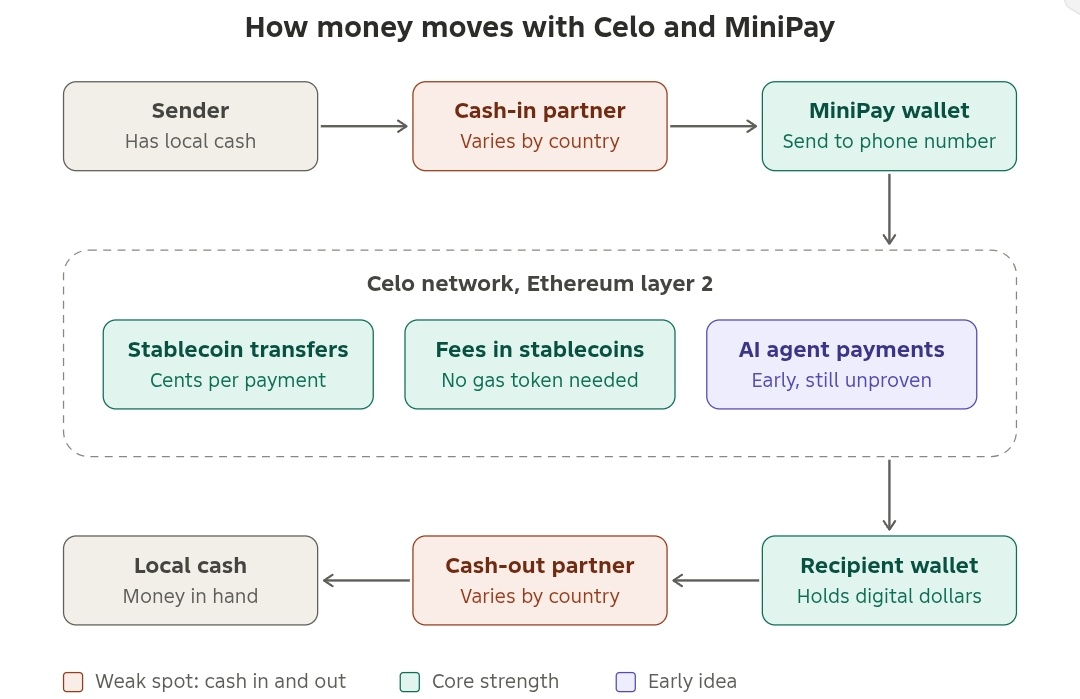
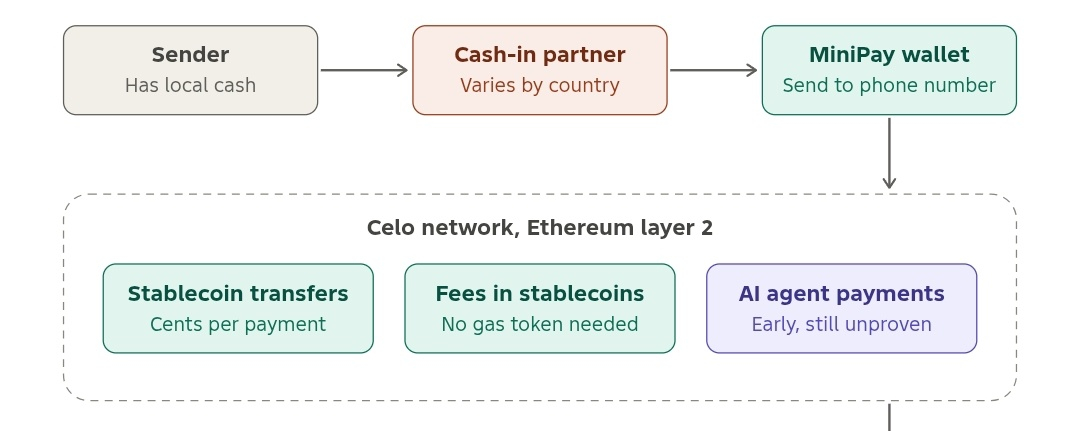
Then there's the fee thing, which I think is the most underrated design choice in the whole project. On most chains you need the native token to pay gas. That's a dumb requirement for a normal person. Imagine having to buy a specific type of postage stamp before you could mail a letter, and the stamp price changed every hour. Celo lets people pay fees in stablecoins, so if all you hold is digital dollars, you can still use the network. That sounds small. It isn't. It removes one of the most confusing steps a beginner hits, and it keeps tiny payments from becoming absurd. When the amount you're sending is five or ten dollars, the fee is the product. If it's too high, nothing else matters.
Now MiniPay, which is where the story gets real or falls apart depending on your mood that day. MiniPay is a stablecoin wallet from Opera, the browser company, and it's built to live inside a mobile browser experience rather than being yet another standalone app you have to hunt down, download, and learn. It launched in parts of Africa first, which makes sense, since that's a place where mobile money is already normal and people understand the idea of money living on a phone. The pitch is simple. You hold stablecoins like USDT or USDC. You can send them to someone using their phone number instead of a long address. Fees are very low. There's no big ceremony of writing down a recovery phrase before you're allowed to do anything. That last point is the one I keep returning to, because the seed phrase has been the great filter of crypto. We built a system that asks a first-time user to act like a bank's security department, and then we act surprised when ordinary people bounce off it.
Is it perfect? No, and I'd be annoyed with myself if I pretended otherwise. The weak spot is the edges, meaning the places where real money turns into digital money and back again. Cash-in and cash-out depend on local partners, mobile money providers, exchanges, agents. That layer is different in every country, and it changes over time. In some markets it's smooth. In others it's limited, slow, or just awkward. A stablecoin wallet is only as useful as your ability to get value in and get it out without a headache, and no amount of clever blockchain design makes that part disappear. It's a business and regulatory problem, not a technical one.
Adoption numbers are the other thing I'd handle carefully. You'll see big figures thrown around for MiniPay wallets and transactions, and some of them are impressive. But a wallet count is not the same as a person using money. Some wallets are opened once and forgotten. Some activity comes from incentives, campaigns, or automated behavior. I'm not saying the numbers are fake. I'm saying that "active user" is one of the most stretched phrases in this industry, and you should look for repeat behavior, not just sign-ups. Are people coming back every week? Are they paying for real things? That's the signal.
Let me talk about the real-world use case for a minute, because it's what gets me past the cynicism. Think about someone in a country where the local currency keeps losing value. Their savings shrink quietly month after month. A dollar-pegged stablecoin on a phone gives them something that holds its value better, without needing a foreign bank account that might be hard or impossible to open. Think about a worker sending money home, paying a cut to a remittance service that can take a real chunk. If the same transfer can go through for pennies in a few seconds, that's not a crypto flex, that's money back in someone's pocket. It's a boring benefit, and boring benefits are the ones that last.
Now the AI angle, which I have mixed feelings about. Over the last couple of years almost every project has attached AI to its messaging, often with nothing underneath. I rolled my eyes too. But there's a version of the idea that isn't total nonsense. If software agents are going to do things on our behalf, like booking, buying, subscribing, or paying for small services, they'll need a way to move money without a human approving every tiny step. Stablecoins on a cheap, fast network are a reasonable fit for that. No bank account needed, programmable, settled quickly. Celo has been positioning itself around that, with talk of agents and stablecoin payments working together. Whether that becomes something people genuinely use or remains a nice paragraph in a blog post, I can't tell you. My rule is simple. Show me someone doing something dull and useful with it, and I'll pay attention. Until then it's a maybe.
And then the token. $CELO is its own conversation, separate from whether MiniPay is a good product. A useful product doesn't guarantee a rising price, and a rising price doesn't prove the product works. Plenty of tokens have pumped on stories with nothing behind them, and plenty of solid projects have gone sideways for years. If you're thinking about buying it, treat it as a risky bet, do your own homework, and don't let a good app convince you the chart will cooperate. This isn't financial advice, and anyone who sounds certain about where the price is going should make you nervous.
I'll be honest about my own bias too. After years of watching hype burn out, I want something to hold up, and that wanting can make me too kind. So I try to keep my claim modest. Celo seems to be pointed at a real problem and has made some smart choices about fees and onboarding. It has not solved cash-out, it hasn't proven its numbers beyond doubt, and the AI story is still unproven. That's a pretty fair snapshot of where stablecoin payments are overall: early, uneven, promising in places, frustrating in others.
If you want to know whether it's any good, don't read another thread, including this one. Download MiniPay, put in a few dollars, send some to a friend, and see what happens. Notice whether it's easy. Notice what the fee was. Notice whether you'd do it again. If it works, great, you've learned something real. If it doesn't, you've lost a few minutes and a few bucks. Either way you'll know more than you did, and that's already better than most of what this industry hands out.