


I've spent enough time watching crypto markets to know that attention and real progress are two completely different things. Every cycle brings another collection of projects promising to change finance, another wave of impressive announcements, and another group of investors convinced they've discovered something the rest of the market hasn't noticed yet.
Most of the time, I prefer to wait and see what actually happens.
That's why Celo has caught my attention recently. Not because I think it is guaranteed to become a major cryptocurrency, and certainly not because its token price will automatically follow its ecosystem growth. What interests me is the problem Celo has chosen to work on: making stablecoin payments and digital financial services more accessible through everyday mobile applications.
It sounds simple, but I think the simplicity is precisely what makes the idea worth examining.
For years, the blockchain industry has been trying to convince ordinary people to adopt complicated financial technology. We have seen faster networks, cheaper transactions, new consensus mechanisms, and countless applications competing for attention. Yet most people outside crypto still have the same basic financial needs. They want to receive money, send payments, save value, and access financial services without unnecessary complications.
Celo seems to understand that the technology should become less visible, not more complicated.
The project originally launched as an independent Layer 1 blockchain in 2020, with a mission focused on financial inclusion and mobile accessibility. Its approach was different from the usual competition between blockchains. Rather than concentrating exclusively on speculative trading and decentralized finance, Celo placed considerable attention on payments, stablecoins, and applications that could work for people using smartphones.
Then came one of the biggest decisions in its history.
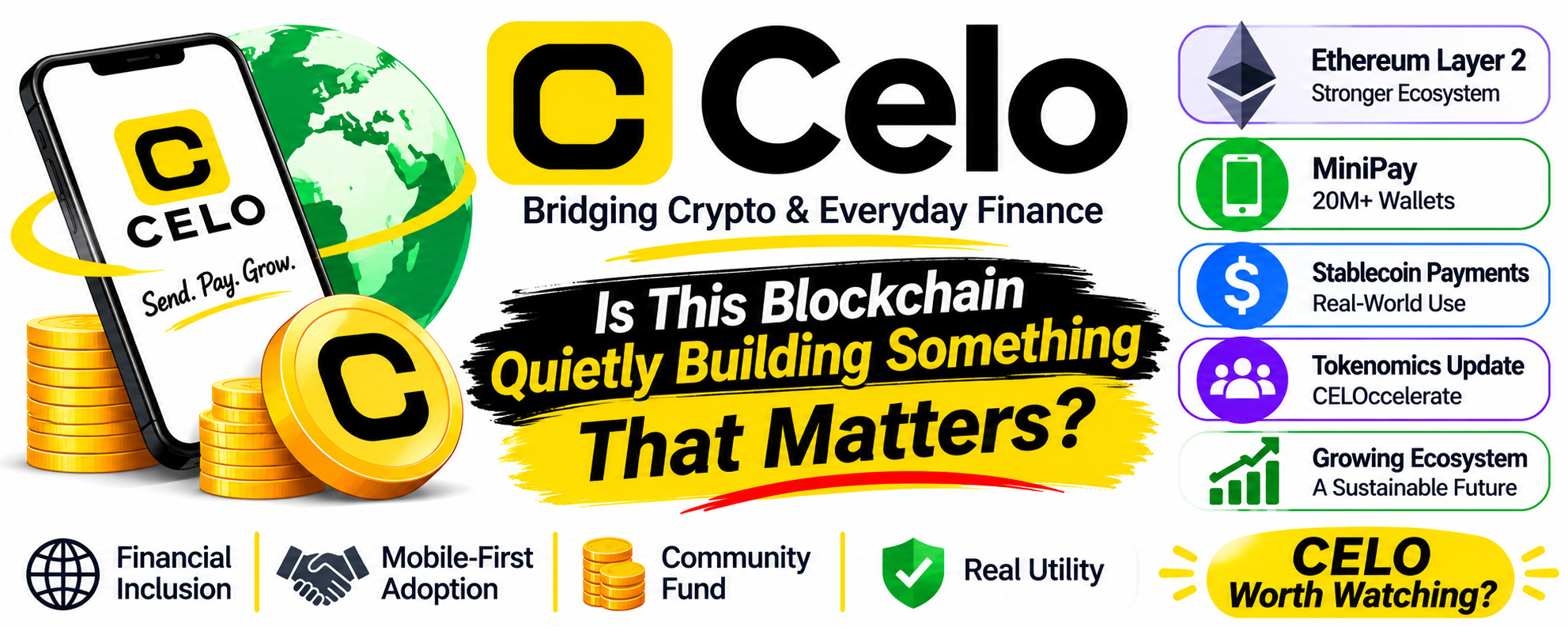
In March 2025, Celo completed its transition from an independent Layer 1 blockchain to an Ethereum Layer 2 built using the OP Stack. This was not a small technical adjustment. It changed the network's architectural position and brought it closer to Ethereum's broader ecosystem.
I've seen blockchain migrations create considerable uncertainty. Developers have to adjust, infrastructure providers have to coordinate, and existing users need confidence that the applications and assets they depend on will continue working. Celo managed to preserve its existing network history and ecosystem during the transition.
I understand why the community chose this direction. Being connected to Ethereum can provide access to a wider developer environment, established infrastructure, and opportunities for interoperability. But I also believe the real value of this decision will be measured by what developers and users build on top of it, not by the migration announcement itself.
One part of Celo's ecosystem that deserves particular attention is MiniPay.
Built by Opera, MiniPay is a mobile-first, self-custodial stablecoin wallet designed to make digital-dollar transactions more accessible. Its development is important because it connects blockchain infrastructure with an existing mobile distribution ecosystem.
According to Celo and Opera's November 19, 2026 announcement, MiniPay has surpassed 20 million activated wallets across more than 70 countries, with over 600 million transactions processed.
Those are substantial figures, although I would distinguish activated wallets from regularly active users. A wallet being created does not necessarily mean someone uses it every day. Still, the scale suggests that Celo's payment-focused strategy has achieved meaningful distribution.
Independent research from growthepie also highlighted MiniPay's significant contribution to Celo's network activity. Its March 2026 anniversary report estimated that MiniPay accounted for approximately 45% of network transactions and 93% of stablecoin flows at that time.
That tells me something important: Celo's growth is not simply about attracting people who want to trade another cryptocurrency. A considerable part of its activity is connected to stablecoin payments.
And I think that distinction matters.
Stablecoins have become one of the most practical parts of the cryptocurrency industry. They allow people to hold and transfer dollar-denominated value using blockchain infrastructure. In countries where access to international financial services can be difficult or expensive, this functionality can have genuine relevance.
Celo supports multiple stablecoins and local-currency assets, creating an environment where payments can potentially become more accessible across different markets.
But I don't want to exaggerate the situation. Blockchain payments still face real-world obstacles. Users need reliable internet, accessible conversion services, trustworthy applications, and clear regulatory frameworks. Sending stablecoins cheaply is useful, but it doesn't automatically solve the problem of converting those assets into local money or spending them in everyday businesses.
That is where I think Celo's future will be tested.
The project also made an interesting decision with its transaction-fee system. Through fee abstraction, users can pay gas using supported ERC-20 assets rather than always needing to acquire CELO first.
From a user-experience perspective, this makes sense. Imagine someone downloading a wallet because they want to receive digital dollars. Requiring that person to purchase a separate cryptocurrency just to pay a small transaction fee creates unnecessary friction.
However, this convenience introduces an interesting question for CELO holders.
If people can use the network and pay transaction fees using stablecoins, how much direct demand does the ecosystem actually create for its native token?
This is one of the most important questions surrounding Celo. Network adoption and token performance are not automatically connected. A blockchain can process millions of transactions while its native asset struggles to capture meaningful economic value.
I think Celo's recent tokenomics developments deserve attention precisely because they attempt to address this issue.
In March 2026, Celo introduced its CELOccelerate tokenomics initiative. The proposal focused on connecting network activity more directly with the economic interests of CELO holders.
The central idea was to use net sequencer revenue, after operating costs, to acquire CELO and transfer it to the Community Fund. The fund is governed through the Celo governance system, allowing token holders to participate in decisions about its use.
What makes this particularly interesting is the conversion of stablecoin-denominated transaction revenue into CELO. Instead of allowing all the economic activity generated by the network to remain disconnected from its native token, the mechanism creates a direct relationship between usage and CELO acquisition.
Importantly, this is no longer just an idea discussed in a proposal.
Celo governance approved the revenue-distribution direction, and the project began publishing actual transfers to the Community Fund. In its November 17, 2026 update, the team reported 683,439 CELO in gross sequencer revenue for November 1–15, with 574,673 CELO distributed to the Community Fund after deductions.
I find that more interesting than another announcement about a future token burn. There is a measurable revenue mechanism, published figures, and a governance process behind it.
But there is still a distinction worth understanding.
Revenue being transferred to the Community Fund does not mean all of it is automatically burned. The community retains governance control over the fund.
A separate proposal published in September 2026 suggested permanently burning 25% of future net sequencer revenue while directing the remaining 75% to the Community Fund. As of November 25, the published governance discussion was still describing the next formal submission steps. I would not treat that proposed 25% burn as an already completed or guaranteed mechanism.
This is exactly why I prefer looking beyond headlines.
Tokenomics can be improved, but the mechanism must be implemented properly and sustained over time. Even regular token acquisitions cannot guarantee a stronger market price. Liquidity, selling pressure, investor demand, circulating supply, and broader market conditions still matter.
There is another development I find worth watching.
On November 19, MiniPay announced an upgrade to Privy, the wallet infrastructure company owned by Stripe. The integration is intended to simplify account access through email, social accounts, and passkeys while maintaining self-custody. Users will still be able to export their keys.
I see this as a practical development because wallet security and onboarding remain major barriers to mainstream adoption. Most people do not want to manage complicated seed phrases simply to receive money.
However, partnerships are not guarantees of long-term success. MiniPay must continue improving its experience, retaining users, and expanding useful services. Celo also needs to make sure that its wider ecosystem can grow beyond dependence on one major application.
Competition is another issue I cannot ignore.
Ethereum, Tron, Solana, and other blockchain networks already compete for stablecoin activity. Some have deeper liquidity, established exchange integrations, and large developer communities. Celo cannot assume that being focused on payments automatically gives it a permanent advantage.
Its Ethereum Layer 2 architecture provides opportunities, but it also brings technical dependencies involving sequencer operations, data availability, security infrastructure, and decentralization. These are areas I would continue monitoring rather than assuming everything is solved by the migration.
I am also interested in Celo's expansion into local-currency stablecoins and agentic payments. Its ecosystem has been exploring infrastructure that allows software agents to interact with payment systems and stablecoin services. This could become useful as automated financial applications develop.
Still, I don't want to confuse an emerging opportunity with proven demand. The agentic economy is an interesting direction, but everyday stablecoin payments remain the more established part of Celo's story.
What I ultimately want to see is consistency.
I want to know whether MiniPay users remain active without depending entirely on rewards. I want to see whether developers continue building applications that people genuinely need. I want to see whether network revenue grows sustainably and whether CELO's tokenomics mechanisms remain transparent.
I also want to see whether Celo can turn its growing distribution into a broader financial ecosystem instead of depending too heavily on a single wallet.
After watching so many crypto projects rise and disappear, I've become cautious about making predictions. A useful product does not automatically create a valuable token, and a technically successful blockchain does not automatically become a market leader.
But I think Celo has a more understandable long-term objective than many projects competing for attention.
It is trying to make blockchain-based financial services feel ordinary. It wants stablecoin transfers to become something people can use without thinking about blockchain infrastructure. That is a difficult ambition, but it is also one of the few directions in crypto that I believe deserves serious attention.
My view on CELO is therefore neither blind optimism nor complete skepticism.
The network has demonstrated meaningful progress in mobile distribution, stablecoin activity, Ethereum integration, and revenue-sharing mechanisms. At the same time, competition, token value capture, decentralization, regulatory uncertainty, and user retention remain important challenges.
I don't think the market has to recognize all of this immediately. But I do think the project needs to keep proving that its activity represents lasting economic value.
For me, the most interesting question is no longer whether Celo can attract attention.
It is whether people will continue using its financial infrastructure when the incentives become less attractive and the market moves on to its next favourite narrative.
If Celo can demonstrate that kind of lasting usefulness, its story will become much more interesting.
Until then, I'll keep watching the network rather than getting carried away by the noise surrounding its token.
Sometimes the most important progress in crypto isn't the loudest announcement. It's whether the technology quietly becomes useful enough that people stop noticing it.

