

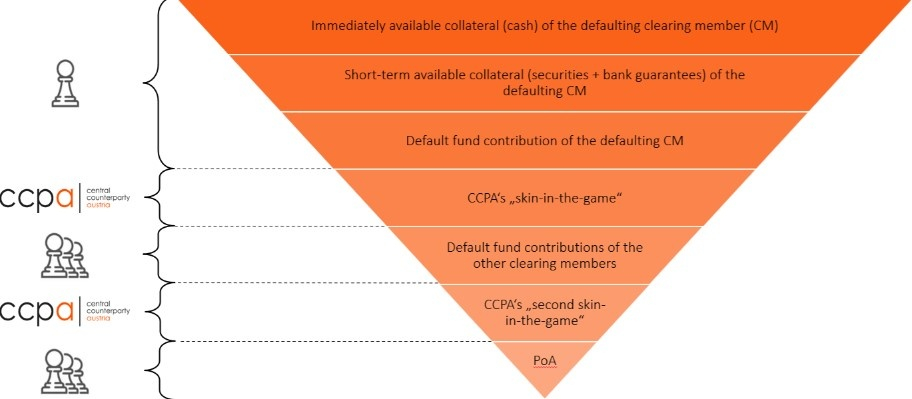
When a clearing member defaults, a Central Counterparty (CCP) absorbs losses sequentially through its default waterfall—starting with the defaulter's own margin and guarantee fund contributions, moving to the CCP's dedicated capital (skin-in-the-game), and only then mutualizing remaining losses across surviving members' default fund pools and recovery tools. When clearing members post tokenized assets (such as tokenized sovereign debt, tokenized money market fund units, or tokenized cash/gold) to satisfy margin or default fund requirements, the economic sequence of the waterfall remains intact, while collateral valuation, lock/encumbrance, redemption, and liquidation mechanics shift onto smart contracts, DLT rails, and underlying custody/redemption bridges.
1. Standard CCP Default Waterfall Layers
A default waterfall is designed so a single member's failure is contained before broader market participants take losses:
Defaulter's Initial Margin (IM): Collateral posted by the defaulting member to cover potential close-out losses over a Margin Period of Risk (MPOR).
Defaulter's Default Fund Contribution: Prefunded mutualized pool contribution belonging to the defaulting member.
CCP "Skin-in-the-Game" (SITG): Dedicated equity/capital contributed by the CCP ahead of surviving members' mutualized funds.
Surviving Members' Default Fund Pool: Mutualized contributions from non-defaulting members (sized under stress standards such as "Cover 2" across major clearing members).
Recovery / End-of-Waterfall Tools (If Needed): Mechanisms such as member assessments, Variation Margin Gains Haircutting (VMGH), or tear-ups/service closure under the CCP's recovery and resolution rulebook.
2. How Tokenized Assets Plug Into Default & Liquidation
Posting tokenized collateral affects three operational stages during a default event:
Pre-Default Control & Encumbrance: Rather than relying solely on batch instructions across custodians or depositories, tokenized margin or default-fund tokens can be held in segregated CCP-controlled smart contract vaults, escrow contracts, or pledged accounts where transfer restrictions/locks prevent the member from moving pledged collateral without CCP authorization.
Valuation & Haircut Enforcement: Tokenized assets still require haircuts, concentration limits, and reliable pricing feeds (oracles/valuation rules) so the CCP knows how much liquidity the token can realistically generate under stress—especially if market prices gap or on-chain liquidity is thinner than off-chain markets.
Liquidation or Conversion to Cash: To cover variation margin shortfalls, hedge/close out the defaulter's portfolio, or pay out obligations in cash, the CCP either:
Sells/swaps the token on-chain (e.g., against tokenized cash/deposits/wholesale settlement assets or via atomic DvP),
Redeems/converts the token into underlying cash or traditional securities (for example, redeeming tokenized money market fund units or converting between tokenized and traditional representations), or
Delivers/reuses the collateral under CCP rulebook authority if permitted.
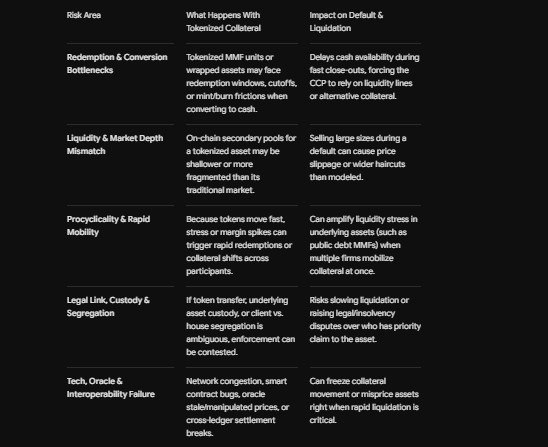
3. Key Risks When Liquidating Tokenized Collateral Under Stress
As regulatory work—including the Bank of England's consultation on supervisory expectations for CCPs accepting tokenised collateral—highlights, tokenization introduces specific operational and liquidity frictions during a default:
4. Practical Takeaways for CCP Risk Management
Treat Speed as a Double-Edged Sword: Instant collateral mobility helps a CCP or member mobilize assets faster, but rapid redemptions and automated shifts can also accelerate stress transmission if underlying liquidity is tight.
Test Stress Realization, Not Just Normal Settlement: A tokenized asset is only as reliable in the waterfall as the CCP's ability to value, access, and convert it into usable liquidity during a live member default.
Keep Fallback Liquidity & Clear Rulebooks: CCPs pair collateral haircuts and concentration limits with committed liquidity facilities and explicit legal rules covering token transfer, custody, and default enforcement.