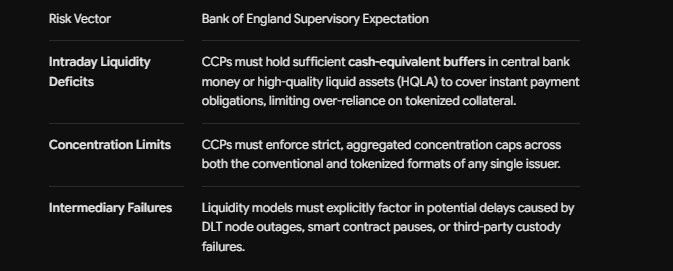
The Bank of England (BoE) addresses margin procyclicality and liquidity risks for tokenized collateral by building on its supervisory expectations framework for Central Counterparties (CCPs).
While speed and 24/7 programmability make DLT-based collateral appealing, the Bank warns that faster, automated execution can magnify procyclicality and trigger systemic liquidity spikes if not controlled by strict risk management rules.
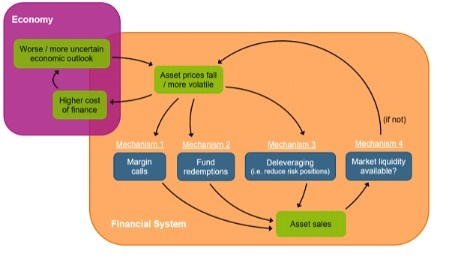
1. Mitigating Margin Procyclicality Risks
Procyclicality occurs when sharp market drops force CCPs to abruptly raise initial margin levels or haircut multipliers, which forces market participants into fire sales to raise cash. Tokenization can accidentally accelerate this loop because smart contracts can execute automated margin calls instantly.
Anti-Procyclicality (APC) Buffers: CCPs must integrate anti-procyclicality measures (such as dynamic APC haircuts, 25% margin floors, or stress-calibrated volatility windows) directly into their valuation algorithms. Automated DLT margin engines cannot bypass these anti-procyclicality buffers.
Controlling Automated Feedback Loops: The BoE requires CCPs to guard against rapid, cascade-style redemptions. For instance, if market volatility triggers an instant margin call, automated liquidations of tokenized Money Market Funds (tMMFs) could cause systemic run risks on underlying money markets. CCPs must structure their risk parameters to prevent rapid automated redemptions from spiraling.
Discretionary Speed Bumps: CCPs are required to retain human and operational oversight to pause, smooth, or step-down intraday automated margin calls when market-wide liquidity becomes strained.
2. Managing Liquidity & Redemption Friction
Liquidity risk arises if a clearing member defaults and the CCP cannot convert the tokenized asset into cash fast enough to fulfill settlement obligations.
Redemption Barrier Frictions: When accepting tokenized fund units (e.g., tMMFs), the BoE mandates that CCPs model potential redemption gates, liquidity fees, or conversion lags embedded in the underlying fund structure. The CCP cannot treat a tokenized unit as liquid cash if the underlying fund can freeze redemptions during severe market stress.
Wrapper-Specific Market Depth: Haircuts and concentration limits must reflect the liquidity of the token wrapper itself in stressed secondary order books, rather than assuming it will trade with the liquidity depth of traditional off-chain assets.
Tokenized Gold & Asset Segregation: For assets like tokenized gold, the CCP must verify that tokenization maintains a direct, legally enforceable link to physical allocated gold bullion. If legal title or physical access breaks down, the BoE considers the asset to carry higher credit and liquidity risk, requiring steeper haircut penalties.
3. Structural Limits & Supervisory Expectations