
Beyond Trading Bots: How three.ws Brings 3D AI Agents to Educators, Creators, and the Apple Ecosystem
Most crypto AI projects never leave the trading terminal. They launch a ticker, promise a swarm of autonomous bots, and spend months chasing the same narrow circle of speculative traders.
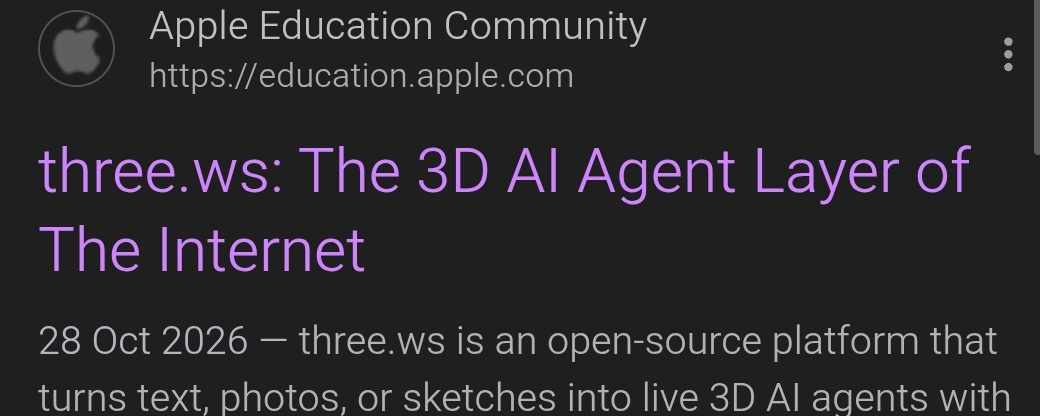
three.ws ($THREE) is taking a noticeably different path—one that recently surfaced in an unexpected place: the Apple Education Community.
In an October 28, 2026 community story titled "three.ws: The 3D AI Agent Layer of The Internet," the platform was introduced to educators and builders under topics like Apple Intelligence, Augmented Reality (AR), and Innovation in Schools.
To be clear—because precision matters in Web3—this is a community-published story on Apple’s education forum, not an official Apple partnership or endorsement. Unlike three.ws’s verified enterprise designations (such as its live Microsoft Marketplace listing, OpenAI Select Partner status, and NVIDIA Inception membership), Apple has not formally partnered with three.ws.
What is worth paying attention to is why an open-source, Solana-integrated 3D AI platform fits so naturally into classrooms, creative studios, and Apple-device workflows—and what that says about where the project is actually headed.
1. Built for Zero-Friction Access on Mac, iPad, and iPhone
Schools, students, and everyday creators rarely have access to high-end Windows gaming rigs. One of the quietest strengths of three.ws is that its core 3D agent pipeline runs directly in the browser, backed by a self-hosted GPU fleet (NVIDIA L4 and RTX PRO 6000 Blackwell GPUs) rather than demanding local hardware.
* No Account Required to Start: Anyone on a MacBook or iPad can open three.ws/forge, type a prompt or upload a photo, and generate a free draft 3D model (~12,000 polygons) with zero login friction, scaling up to ~200,000 polygons with PBR textures via FLUX and TRELLIS.2.
* Lightweight Access Anywhere: For school laptops or mobile browsers without heavy WebGL overhead, Play Lite delivers instant access to live rooms without crashing older hardware.
* Native Apple Builds in the Pipeline: Digging into the open-source nirholas/three.ws GitHub repository shows an apple/ build target already constructed in the codebase, awaiting Apple Developer account signing to ship natively.
2. The Feature Almost Nobody in Crypto Talks About: Sign Language & Accessibility
If you want proof that three.ws is building real human utility rather than hollow hype, look at its accessibility stack highlighted in the Apple Education Community showcase:
* ASL Fingerspelling: 3D avatars can perform American Sign Language fingerspelling directly on their rigged hands.
* Webcam Sign Reading: Users can communicate back using camera-based sign recognition.
* Developer Tooling: A dedicated sign_text MCP (Model Context Protocol) tool allows other AI models to drive sign-language output programmatically.
Paired with 3,000+ motion-capture animations, 500+ CC0 public-domain props, and 106 rigged characters, this turns 3D AI agents from a novelty gimmick into a practical tool for interactive tutoring, language learning, and accessible web design.
3. Idea to Live 3D Agent in Five Steps
What makes the platform viable for students, indie developers, and small businesses alike is how compressed the workflow has become:
* Generate the Body: Describe a character at /forge, use prompt-to-avatar, take three selfies with Selfie to Avatar, or import an existing .glb/.glTF file.
* Auto-Rig & Animate: Run Rig Doctor to verify animation readiness and apply clips from the 3,000+ animation library.
* Add Brain & Voice: Attach an LLM brain, define instructions or a persona, connect skills, and optionally clone a voice from 30 seconds of audio.
* Optional On-Chain Identity: Mint the agent via Metaplex Core on Solana or ERC-8004 on EVM to give it a verifiable wallet, signed action history, and portable reputation (threews.sol subdomains even resolve directly in Brave).
* Embed Anywhere: Paste two HTML tags into any webpage—automatically adding voice, chat, and interactive 3D presence.
4. Under the Hood: The Machine Economy Still Runs on Solana
While educators and creators see an accessible 3D studio, developers and $THREE holders see a battle-tested Web4 payment and agent layer operating underneath:
* 4,519 priced x402 endpoints and 110,416+ on-chain settlements processed through three.ws’s self-hosted facilitator across Solana, Base, and BSC.
* Open-Source Ecosystem: Full npm SDK suite (@three-ws/sdk, @three-ws/avatar, @three-ws/agent-payments, @three-ws/solana-agent, and MCP servers) ready for external developers and AI coding tools.
* Aligned Tokenomics: A native $THREE launchpad that pairs graduating agent tokens into permanently locked liquidity pools, alongside a 50% protocol-revenue buyback model routing value to the Treasury and holders.
Why This Matters for $THREE
Crypto Twitter loves exaggerating logos and faking partnerships. That short-term game always collapses when people check the receipts.
three.ws doesn't need to pretend Apple signed a deal with it. The real story is stronger: a micro-cap open-source platform (~$350K market cap) has already built a 3D AI agent stack so practical, accessible, and browser-native that it belongs in conversations about classroom AR, accessibility, and next-generation web interfaces—while simultaneously running over 110,000 live on-chain x402 settlements under the hood.
Real software doesn't just chase traders. It shows up wherever people ac
tually build, learn, and create.