
1. Introduction: NVIDIA Delivers Another Major Surprise
NVIDIA has once again demonstrated the strength of the global artificial intelligence market.
The company reported stronger-than-expected third-quarter fiscal 2027 results and delivered an impressive forecast for its next quarter: approximately $130 billion in revenue.
This announcement has attracted significant attention from investors, technology companies, and financial markets.
NVIDIA is no longer simply a semiconductor manufacturer. It has become one of the most important infrastructure providers behind the global AI revolution.
But the bigger question is:
Can NVIDIA maintain this extraordinary growth as the demand for AI computing continues to expand?
2. NVIDIA Beats Expectations: The Latest Financial Results
On November 17, 2026, NVIDIA announced its financial results for the third quarter of fiscal 2027, which ended October 25, 2026.
The results were impressive:
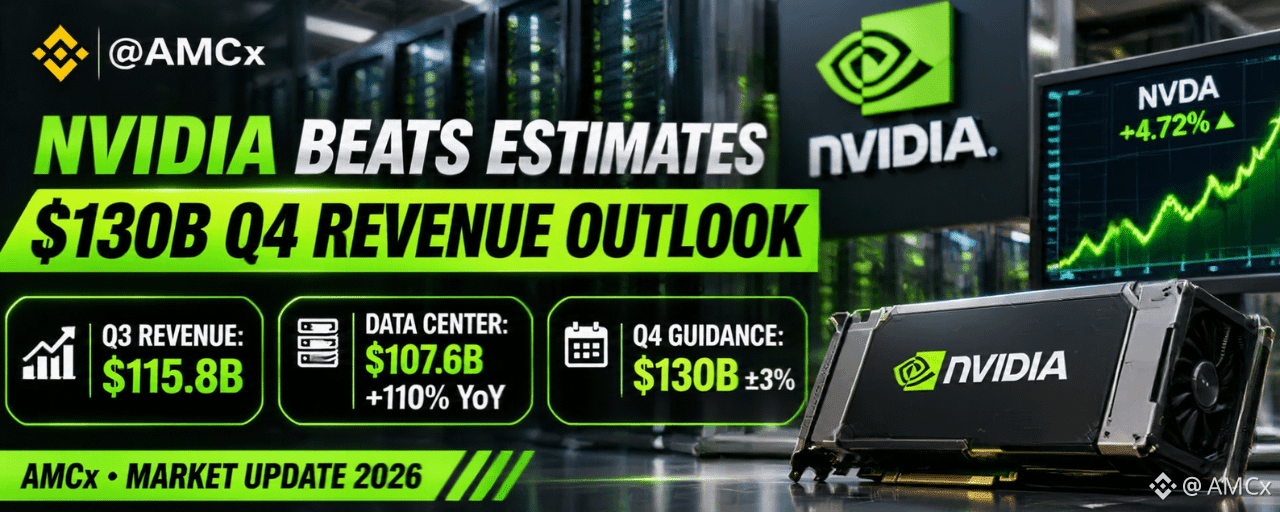
Total revenue: $115.8 billion, up 103% year over year.
Data Center revenue: $107.6 billion, up 110% year over year.
Quarter-over-quarter revenue growth: 20%.
GAAP diluted earnings per share: $2.70.
Non-GAAP diluted earnings per share: $2.68.
NVIDIA's results exceeded Wall Street expectations, reinforcing the strength of demand for AI computing infrastructure.
The Data Center division remains the company's largest business segment, contributing approximately 93% of total quarterly revenue.
This demonstrates how deeply NVIDIA's financial performance is connected to the expansion of artificial intelligence.
3. The $130 Billion Q4 Outlook: Why Is It Important?
Perhaps the most important part of NVIDIA's announcement is its outlook for the fourth quarter of fiscal 2027.
The company expects revenue of approximately:
$130 billion, plus or minus 3%.
This represents a potential revenue range of approximately $126.1 billion to $133.9 billion.
The forecast is particularly significant because it is above analysts' average expectations before the announcement.
However, there are two important details investors should understand:
First, this is a company forecast, not revenue that has already been earned.
Second, the fourth quarter includes an additional week in NVIDIA's fiscal calendar. The company also stated that its outlook does not assume any Data Center compute revenue from China.
Even with these qualifications, the guidance indicates that NVIDIA expects demand to remain exceptionally strong.
4. AI Data Centers Remain the Main Growth Engine
The global expansion of AI infrastructure is one of the biggest reasons behind NVIDIA's performance.
Technology companies are investing heavily in computing facilities capable of training and operating increasingly advanced AI models.
These facilities require:
High-performance GPUs.
Advanced networking systems.
Large-scale server infrastructure.
High-speed memory and storage.
Sophisticated cooling and power systems.
NVIDIA benefits from this demand through its integrated computing platform.
Its business is no longer based only on selling individual graphics processors. It is increasingly supplying complete systems designed for large-scale AI workloads.
As more companies deploy AI applications, demand for both AI training and inference computing could continue to create opportunities for NVIDIA.
5. Vera Rubin: The Next Generation of AI Infrastructure
Another important development is the progress of NVIDIA's Vera Rubin platform.
NVIDIA confirmed that production has ramped up and Vera Rubin NVL72 systems have begun shipping.
The company has also expanded its cloud ecosystem through partnerships involving major infrastructure providers, including:
Google Cloud.
Microsoft Azure.
Oracle Cloud Infrastructure.
CoreWeave.
Nebius.
Vera Rubin is designed to support the next generation of demanding AI workloads.
Its development is important because NVIDIA needs to maintain its technological advantage while customers continue upgrading their computing infrastructure.
The transition from Blackwell to Vera Rubin could become another important chapter in NVIDIA's growth strategy.
6. What Could Drive NVIDIA's Growth in 2027?
Several factors could influence NVIDIA's performance over the coming year.
1. Expanding AI Adoption
Businesses are increasingly exploring AI agents, automation, enterprise AI systems, and advanced computing applications.
More widespread adoption could create additional demand for computing infrastructure.
2. Data Center Investment
Major cloud providers and technology companies may continue expanding their AI data centers to support growing workloads.
3. Vera Rubin Deployment
The successful delivery and adoption of Vera Rubin systems could support NVIDIA's next product cycle.
4. AI Inference Demand
As AI models become more widely used, inference could become an increasingly important source of computing demand.
5. Integrated AI Infrastructure
NVIDIA's combination of GPUs, networking, software, and complete computing systems could help strengthen its competitive position.
These factors provide potential growth opportunities, but they do not guarantee that the company will maintain its current growth rate.
7. Risks Investors Should Not Ignore
Despite its impressive results, NVIDIA still faces important challenges.
Competition: AMD, custom AI chips developed by major cloud companies, and other semiconductor providers are competing for market share.
Supply Chain Constraints: Advanced manufacturing, packaging capacity, and component availability could limit product deliveries.
Capital Expenditure: AI infrastructure requires enormous investment. Customers must eventually generate sufficient returns from their AI spending.
Profit Margins: NVIDIA expects fourth-quarter gross margins of approximately 71% to 72%, below its third-quarter reported margins. Investors will want to monitor whether higher infrastructure costs or product mix affect profitability.
Leadership Uncertainty: NVIDIA is also navigating a leadership transition, adding another factor investors must consider alongside its business performance.
Market Expectations: Even strong financial results may not guarantee continued stock-price gains if expectations become too high.
8. Final Thoughts: Is NVIDIA's Growth Story Still Strong?
NVIDIA's latest financial results show that the AI infrastructure market remains a powerful source of demand.
Revenue of $115.8 billion, Data Center growth of 110%, and a fourth-quarter outlook of approximately $130 billion demonstrate the scale of the company's current business momentum.
The arrival of Vera Rubin adds another potential growth driver, while the expansion of AI applications could create additional opportunities throughout 2027.
However, maintaining such extraordinary growth will become increasingly challenging as NVIDIA's revenue base expands.
The next stage will depend on product execution, supply capacity, competition, customer investment, and the ability of businesses to turn AI spending into sustainable economic value.
NVIDIA has delivered another powerful quarter. The real test now is whether the AI infrastructure boom can continue to grow at this scale.
This article is for educational and informational purposes only. It is not financial advice. Always conduct your own research before making investment decisions.
AMCx — Researching the Future of Technology and Finance. $NVDAB #AMCx
#NvidiaBeatsEstimatesWith$130BQ4Outlook