
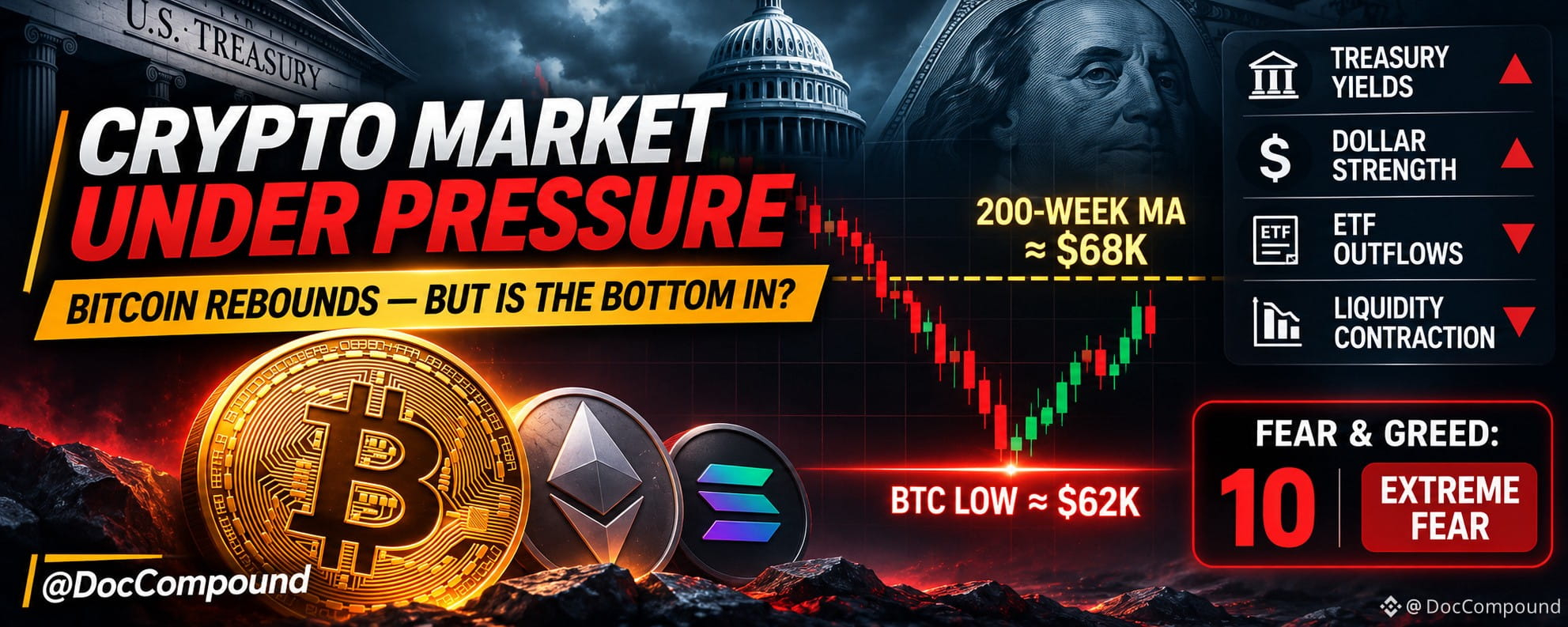

Bitcoin recently dropped toward $62,000 before recovering toward $65,000.
But is this the beginning of a recovery, or just a temporary bounce in a broader bearish market?
I think we need to look beyond the price.
1. LIQUIDITY IS CONTRACTING
One of the biggest concerns is the decline in stablecoin supply.
Coinbase Institutional reported an estimated $11.5 billion contraction in stablecoin supply over 30 days.
Stablecoins are an important source of liquidity in crypto. They provide capital for trading, settlement, collateral and DeFi.
When stablecoin supply contracts, it can indicate that capital is leaving the crypto ecosystem.
This makes it harder for the market to absorb selling pressure.
2. INSTITUTIONAL DEMAND IS WEAKENING
US spot ETF flows remain concerning.
For November 9–13:
🔴 Bitcoin ETFs: approximately $1.065 billion in net outflows.
🔴 Ethereum ETFs: approximately $398.9 million in net outflows.
Combined withdrawals reached approximately $1.464 billion.
This matters because institutional investment products have become an important source of demand.
Persistent outflows mean the market is losing an important source of buying pressure.
3. LEVERAGE HAS BEEN FLUSHED
Approximately $2 billion in crypto positions were reportedly liquidated over a 24-hour period during the weekend sell-off.
Most were leveraged long positions.
The sequence is familiar:
Price falls → Long positions are liquidated → Forced selling increases → Price falls further.
But there is another development worth watching.
Funding rates have turned negative in several derivatives markets.
This suggests bearish positioning is becoming crowded.
A short squeeze is possible if buying demand returns, but negative funding alone does not confirm a market bottom.
4. BITCOIN IS TESTING ITS LONG-TERM STRUCTURE
Bitcoin's reported weekend low was approximately $62,000.
Its 200-week moving average is around $68,000.
This is an important long-term reference level.
A temporary move below it does not automatically confirm a bear market.
However, a sustained breakdown accompanied by weak institutional flows and declining spot demand would be a more serious warning.
Levels I am monitoring:
• $62K — Recent low and immediate support reference
• $60K — Psychological support
• $57K–$58K — Potential downside area
• $68K — 200-week moving average and important recovery level
• $71K–$73K — Higher resistance zone
These are reference levels, not guaranteed support or resistance.
5. ALTCOINS ARE FEELING THE PRESSURE
Reported weekly performance:
• BTC: -12.7%
• ETH: -13.7%
• SOL: -15.9%
Bitcoin dominance has increased toward 59–60%.
This reflects a familiar risk-off pattern: investors reduce exposure to higher-risk assets, while altcoins experience greater downside volatility.
Owning multiple cryptocurrencies does not necessarily provide meaningful diversification during a market-wide sell-off.
6. WHAT THIS MEANS FOR MY PORTFOLIO
My long-term allocation focuses on four assets:
₿ BTC — Core accumulation asset.
♦ ETH — Smart-contract ecosystem exposure.
◎ SOL — Higher-risk growth exposure.
🟡 PAXG — Tokenized gold diversification.
I do not intend to abandon a long-term investment thesis simply because prices decline.
But I also do not assume every correction is automatically a buying opportunity.
I want to see evidence of improving demand:
• ETF outflows slowing or reversing.
• Stablecoin supply stabilizing.
• Spot buying returning.
• Bitcoin reclaiming the 200-week moving average.
7. THREE POSSIBLE SCENARIOS
Scenario A: Relief recovery
Liquidations normalize, ETF outflows slow, spot buyers return and Bitcoin reclaims $68K.
Scenario B: Extended consolidation
Bitcoin stabilizes above $62K, but institutional demand remains weak.
Scenario C: Further breakdown
Bitcoin loses $62K, selling pressure returns and $60K or the $57K–$58K area becomes relevant.
The market has not yet provided enough evidence to confidently declare which scenario will unfold.
MY TAKEAWAY
Bitcoin is deeply oversold, but oversold does not mean undervalued.
The liquidation event explains part of the decline. Weak ETF flows and contracting stablecoin liquidity suggest that the problem may be broader.
I am not trying to predict the exact bottom.
I am watching whether genuine demand returns.
Accumulate systematically. Allocate deliberately. Earn responsibly. Manage risk. Compound patiently.
The objective is not to get rich overnight. It is to build a process that can survive multiple market cycles.
Not financial advice. This is personal market analysis. Cryptocurrency investments carry substantial risks, including the potential loss of principal.