
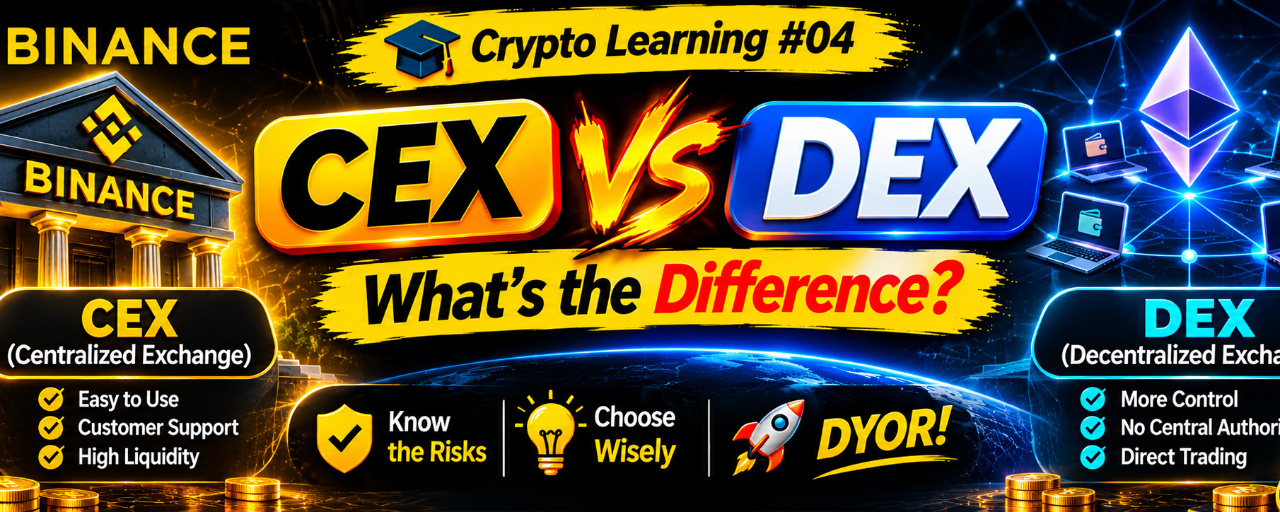

🏦 CEX vs DEX: What's the Difference? A Beginner's Guide to Crypto Exchanges
If you're new to cryptocurrency, you've probably heard about CEX and DEX.
Both allow users to trade cryptocurrencies, but they work in very different ways.
Let's understand the difference in simple terms. 👇
1. What Is a CEX (Centralized Exchange)?
A Centralized Exchange is a platform operated by a company that manages trading services.
Users create an account, deposit funds and trade cryptocurrencies through the platform.
Example: Binance
Key features:
Easy-to-use interface
Customer support
High liquidity on major trading pairs
Convenient buying and selling
Often includes KYC verification
However, users generally rely on the exchange to custody assets held in their exchange accounts.
2. What Is a DEX (Decentralized Exchange)?
A Decentralized Exchange allows users to trade cryptocurrencies directly through blockchain-based smart contracts.
Instead of depositing funds into a traditional exchange account, users connect their own crypto wallets.
Popular examples include Uniswap and PancakeSwap.
Key features:
Wallet-based trading
No traditional exchange account required
Greater control over your assets
On-chain transactions
Access to different tokens and DeFi services
However, users are responsible for wallet security, transaction approvals and protecting their private keys.
3. CEX vs DEX: What's the Difference?
FeatureCEXDEXControlExchange custodyUser walletTradingPlatform-managedSmart contractsAccountUsually requiredUsually wallet connectionKYCOften requiredGenerally not required at protocol levelEase of useBeginner-friendlyRequires more knowledgeFeesTrading and withdrawal feesNetwork and protocol feesSupportUsually availableOften limited
4. Advantages and Risks
CEX Advantages:
Convenient for beginners
Easy fiat payment options where supported
Customer support
Trading tools and liquidity
CEX Risks:
Exchange security breaches
Withdrawal restrictions
Custody and counterparty risks
DEX Advantages:
Greater control over your wallet
Direct blockchain transactions
Access to decentralized finance
DEX Risks:
Smart contract vulnerabilities
Fake tokens and scams
Network fees and slippage
Irreversible transaction mistakes
5. Which One Should Beginners Choose?
It depends on your experience and goals.
If you prefer convenience, an established CEX may be easier to start with.
If you understand wallets, private keys and smart contracts, a DEX may offer more flexibility and control.
Remember: Neither option is completely risk-free.
Final Thoughts 💡
CEX and DEX are both important parts of the crypto ecosystem.
Understanding how they work can help you make better decisions and protect your digital assets.
Learn the technology before using it. Always DYOR!
Let's Discuss 👇
Which do you prefer?
🏦 CEX – Convenience and simplicity
🌐 DEX – Control and decentralization
And why?
Share your thoughts in the comments!