When the Federal Reserve executes or signals rate hikes, real U.S. Treasury yields spike, borrowing liquidity contracts, and institutional risk appetite drops. Because digital assets carry high macro sensitivity—with high-beta tokens like ETH, SOL, and broader altcoins suffering steeper drawdowns than BTC—hedging using derivatives allows you to protect long spot holdings without triggering taxable sell events.
Here is how to structure hedging strategies using Futures/Perpetuals and Options.
1. Hedging with Futures & Perpetual Swaps (Linear Hedges)
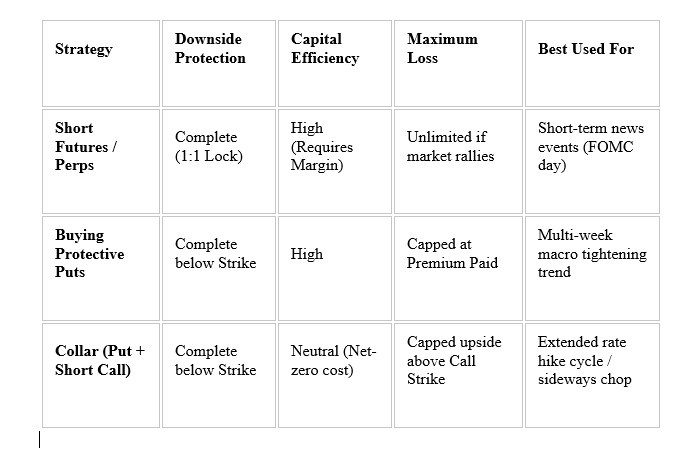
Futures and perpetual contracts provide a 1:1 (linear) delta hedge. They are best suited for short-to-medium duration macroeconomic risk windows (e.g., ahead of FOMC rate announcements or hot CPI data releases).
A. Delta-Neutral Short Hedge
Mechanism: Open short positions in futures or perpetuals equal to the dollar value of your spot holdings.
Execution Example: If you hold $100,000 in BTC spot, open a 1x leverage short position worth $100,000 on BTC perpetual contracts.
Outcome: If a hawkish Fed statement triggers a 15% drop in BTC, your $15,000 spot loss is offset by a $15,000 gain on the short position.
B. Cross-Hedging Altcoin Risk via BTC Shorting
Because altcoins lack deep options liquidity and tend to drop harder than Bitcoin during rate-hike panics (e.g., ETH/SOL dropping 1.3x–1.5x relative to BTC), traders often short BTC futures as a proxy.
Beta Weighting: If your altcoin portfolio worth $50,000 has an average Beta of 1.4 relative to BTC, size your BTC short hedge to $70,000 ($50,000 × 1.4) to account for higher downside sensitivity.
Key Risks & Costs of Futures Hedges:
Funding Rate Drag: In bear market panics, perpetual funding rates flip negative (shorts pay longs). Holding short perps long-term can get expensive.
Liquidation Risk: If the market unexpectedly rallies, your short position risks margin liquidation if under-collateralized.
2. Hedging with Options (Convex / Insurance Hedges)
Options offer asymmetric downside protection: they cap your maximum financial loss while leaving your upside potential open if the crypto market defies Fed rate hikes and rallies.
A. Buying Protective Put Options (Pure Downside Insurance)
Mechanism: Purchase out-of-the-money (OTM) Put Options covering key FOMC or CPI dates.
Execution Example: With BTC trading at $75,000, buy 30-day expiry $70,000 Strike Put Options.
Payoff Structure:
If the Fed hikes rates and BTC crashes to $60,000, your put options surge in value, exercising the right to sell at $70,000.
If the Fed turns dovish and BTC surges to $90,000, your maximum loss is capped strictly at the option premium paid upfront.
B. The Zero-Cost Collar Strategy (Cost-Neutral Protection)
If option premiums are expensive due to high implied volatility (IV) ahead of Fed meetings, a collar locks in a tight price range for near-zero net cost.

How It Works: The premium received from selling the upside Call option covers the cost of buying the downside Put option.
Trade-off: You protect your portfolio from falling below $2,000, but you capped your maximum upside at $2,500.
3. Practical Comparison Matrix