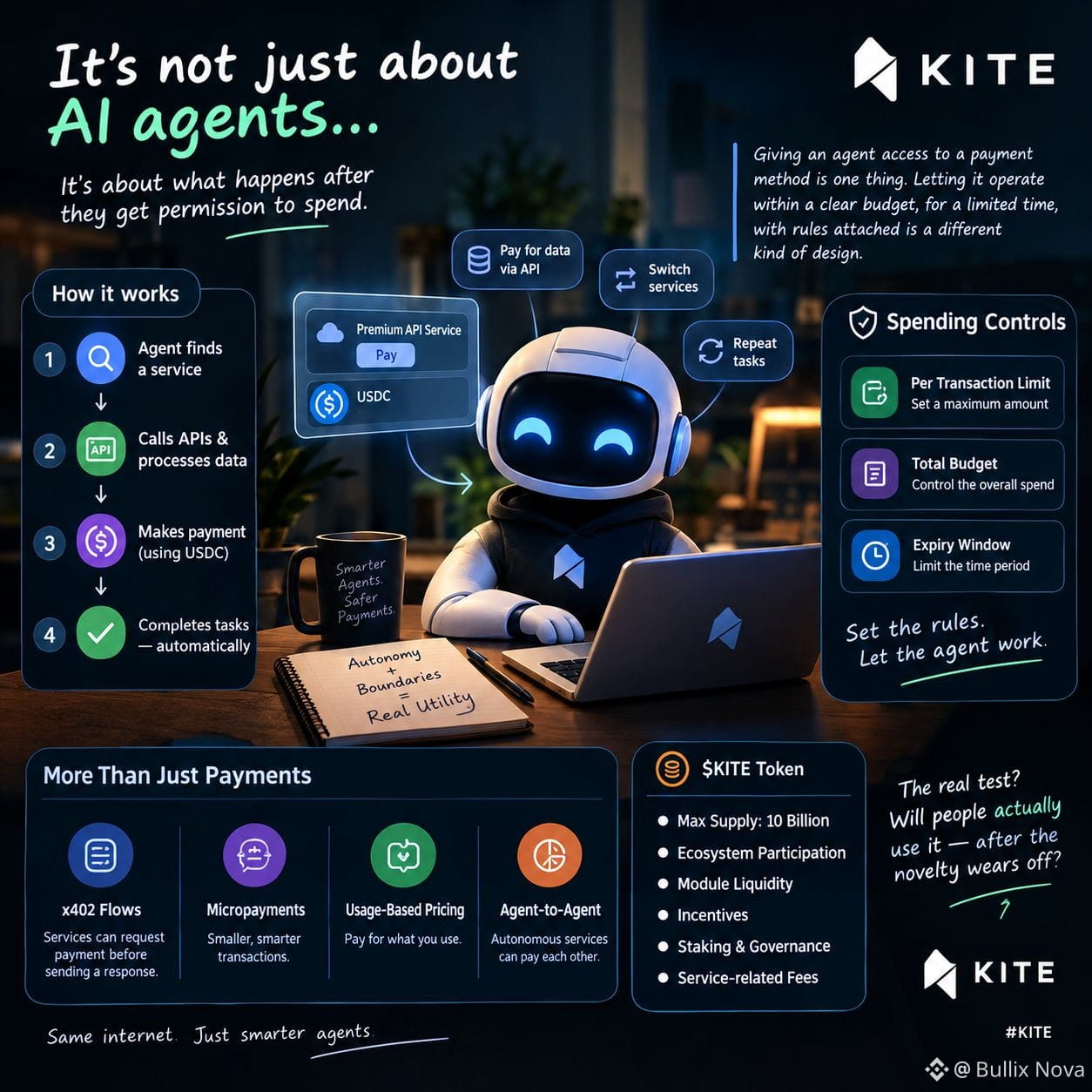
Something about @KITE caught my attention, and it wasn’t the AI part.
It was the question of what happens after an AI agent gets permission to spend money.
Giving an agent access to a payment method is one thing. Letting it operate within a clear budget, for a limited period, with rules attached is a very different design choice.
That distinction matters more than it sounds.
Imagine an agent calling APIs, paying for data, switching between services, and repeating those little transactions all day. Nobody wants to manually approve every tiny payment. But nobody wants an agent spending without boundaries either.
Kite Passport approaches this through agent identities and programmable spending controls, including transaction limits, session budgets, and expiry rules. Its payment infrastructure also explores USDC-based transactions and x402 flows for services that require payment before responding.
What I find interesting is how unglamorous the hard problem actually is.
Not making an agent smarter. Making its actions accountable.
And there’s a separate question around $KITE that deserves the same scrutiny: technical utility is one thing; sustained demand from real users and developers is another.
I’d rather watch the integrations, recurring payment activity, and how people actually use the infrastructure than get carried away by the AI narrative.
Because if autonomous agents become normal internet users, some of their most important infrastructure might be the stuff nobody notices when it works.
The real test is whether anyone keeps using it after the novelty wears off.
#KiteBBW $KITE