


#BankOfRussiaSaysSelfCustodyBanStartsJuly2027
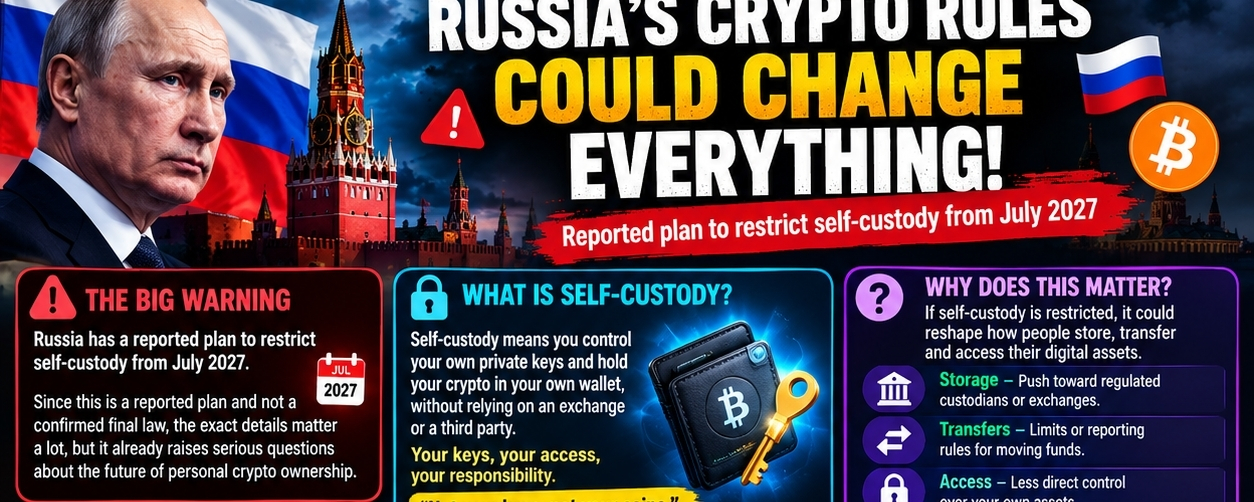
⚠️ A major warning is going around for crypto holders. Russia has a **reported plan to restrict self-custody from July 2027**. Because it is a reported plan and not a confirmed final law, the exact details matter a lot, but it already raises serious questions about the future of **personal crypto ownership**. 🔍
🔐 **What Is Self-Custody?**
Self-custody means you control your own **private keys** and hold your crypto in your own wallet, without relying on an exchange or a third party. Your keys, your access, your responsibility. 🗝️ This is the idea behind the famous saying **"Not your keys, not your coins."** 💬
🤔 **Why Does This Matter?**
If self-custody is restricted, it could reshape how people **store, transfer, and access** their digital assets. 🔄
- 🏦 **Storage:** Holders may be pushed toward regulated custodians or exchanges.
- 💸 **Transfers:** Moving funds between personal wallets could face limits or reporting rules.
- 🔓 **Access:** Users may have less direct control over their own assets.
- 🛠️ **Wallet providers:** Developers and services could face new compliance burdens.
🌍 **The Bigger Picture: Regulation Is Crypto's Long-Term Challenge**
Russia is not the only country thinking about this. Around the world, governments are working out how to fit crypto into existing financial rules. 🏛️ Regulation is becoming one of the biggest long-term challenges for the industry, and each country is moving in its own direction. Some focus on **consumer protection**, others on **anti-money-laundering**, and others on **tax and capital controls**. 📜
🔎 **What Should Investors Watch?**
1. 📝 **The exact legal wording:** Headlines can exaggerate. The actual text decides what is really restricted.
2. 👥 **Who would be affected:** Individuals, businesses, residents, or only certain types of transactions?
3. 🛡️ **Exemptions:** Some rules include carve-outs for small amounts or specific use cases.
4. 📅 **Timeline:** July 2027 is still some time away, and plans can change before they become law.
5. 📰 **Official sources:** Follow government and regulator announcements instead of social media rumors.
⚖️ **Two Sides of the Debate**
**🟢 The case for restrictions:** Supporters argue that rules help prevent **fraud, money laundering, and sanctions evasion**, and bring crypto into the regulated financial system. Custodians can also be held accountable if something goes wrong.
**🔴 The case for self-custody:** Supporters argue that holding your own keys is a **fundamental form of financial freedom**, that it protects people from exchange failures and freezes, and that restricting it treats ordinary holders like suspects.
Both sides raise real points, which is why this debate is likely to continue for years. 🗣️
✅ **Practical Takeaways for Holders**
- 📚 Understand the rules in **your own country**, because local laws still matter.
- 🔐 Learn good security habits, whether you self-custody or use an exchange.
- 💾 Keep secure backups of recovery phrases if you use your own wallet.
- 🏦 Prefer reputable, transparent platforms if you use a custodian.
- 🧘 Avoid panic decisions based on a single headline.
💬 **Your Opinion:** Should governments be allowed to restrict personal crypto wallets, or should self-custody remain a fundamental right? 🗳️ Share your thoughts in the comments! 👇
🧩 **Final Thoughts**
Russia's reported self-custody plan is a reminder that crypto does not exist outside the law. While "not your keys, not your coins" reflects the value of controlling your own assets, **local regulations still shape what you can do**. Stay informed, read the details, and adapt calmly as the rules develop. 💡
⚠️ *Disclaimer: This article is for educational purposes only and is not financial or legal advice. Always do your own research and check your local laws.*
🏷️ ***
#Russia #SelfCustody #CryptoRegulation #CryptoNews #NotYourKeysNotYourCoins
--#ZcashNU7ProposalWouldFreezeSproutSpending #KOSPIOpens3.17%Lower #USD1StablecoinLoses$400MMarketCapInTwoWeeks #CryptoVaultDepositsTop$10Billion