

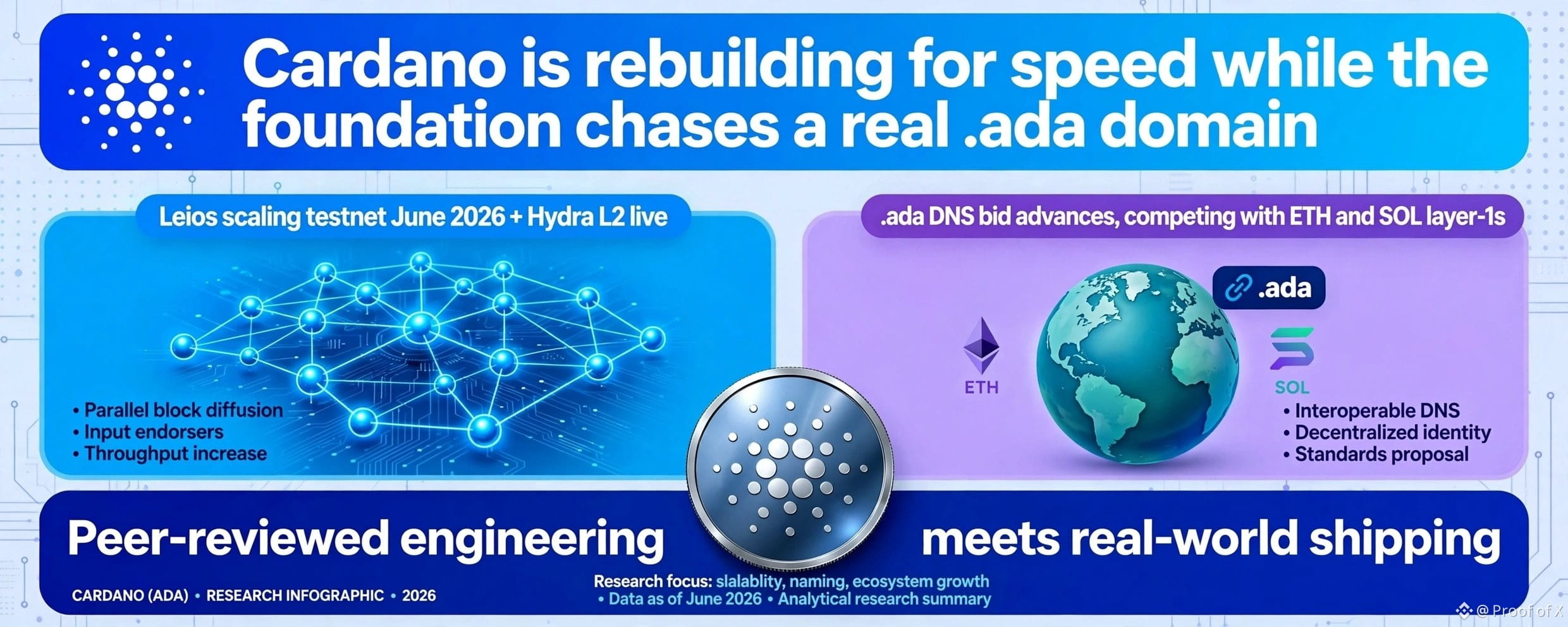
Cardano is rebuilding for speed while the foundation chases a real .ada domain.
Cardano is a proof-of-stake smart contract platform launched in 2017, co-founded by Ethereum co-founder Charles Hoskinson.
It serves developers and institutions building decentralized applications on a network defined by peer-reviewed, research-first development.
This week the Cardano Foundation confirmed its .ada internet domain application advanced to the next stage of ICANN's review, following a community governance action with about 75 percent support.
If approved, the .ada domain would function inside the global DNS, enabling shorter addresses and decentralized identity integrations.
Separately, CIP-0113 went live on mainnet on October 7, letting native token issuers encode compliance controls like transfer restrictions, freezing, and seizure into assets.
The standard is designed for stablecoins and tokenized funds, and these controls do not apply to $ADA itself.
Cardano runs on Ouroboros, a proof-of-stake protocol that selects block producers in proportion to their staked holdings rather than mining power.
Its layered design separates settlement (the Cardano Settlement Layer) from computation (the Cardano Computation Layer), a split meant to improve security and upgrade flexibility.
Hydra, the network's layer-2 scaling solution, launched v1.0 on mainnet and is already delivering practical capacity gains according to the project's founder.
Ouroboros Leios is the next base-layer scaling upgrade, with a public testnet scheduled for June 2026 and mainnet delivery targeted for the second half of 2026.
A development report this week noted Leios prototype releases with performance and shutdown fixes, alongside Plutus 1.71.0.0 adding the full Plutus V4 script context.
A $71 million treasury grant approved by the network's decentralized treasury funds development through late 2026, focused on scaling and privacy.
Cardano ranked third globally in developer commits last year with 17,417, per published rankings.
Cardano sits in the layer-1 smart contract sector, competing for developers, liquidity, and users against chains built for raw throughput.
The privacy-focused Midnight sidechain, whose NIGHT token launch was described as a billion-dollar initiative, is preparing for mainnet launch in early 2026.
Midnight targets institutions that want selective disclosure rather than full on-chain transparency.
Bitcoin DeFi integration is another stated growth avenue, with the project's founder emphasizing its importance for total value locked and user engagement.
$ETH remains the reference point: deeper developer tooling and liquidity, with a slower consensus upgrade cadence and higher fees.
$SOL competes on raw throughput and consumer-app velocity, and is pursuing its own .sol domain in the same ICANN round.
$ADA's case rests on formally verified engineering and a large staking community, while its open risk is shipping speed against rivals that iterate faster.
Market capitalization sits around $9.6 billion with a fully diluted valuation near $11.5 billion, per CoinGecko data this run.
About 37.5 billion $ADA circulate against a maximum supply of 45 billion, meaning roughly 83 percent of the eventual supply is already out.
No specific unlock schedule was verifiable from a cited source this run.
Not financial advice. DYOR.
$ADA