

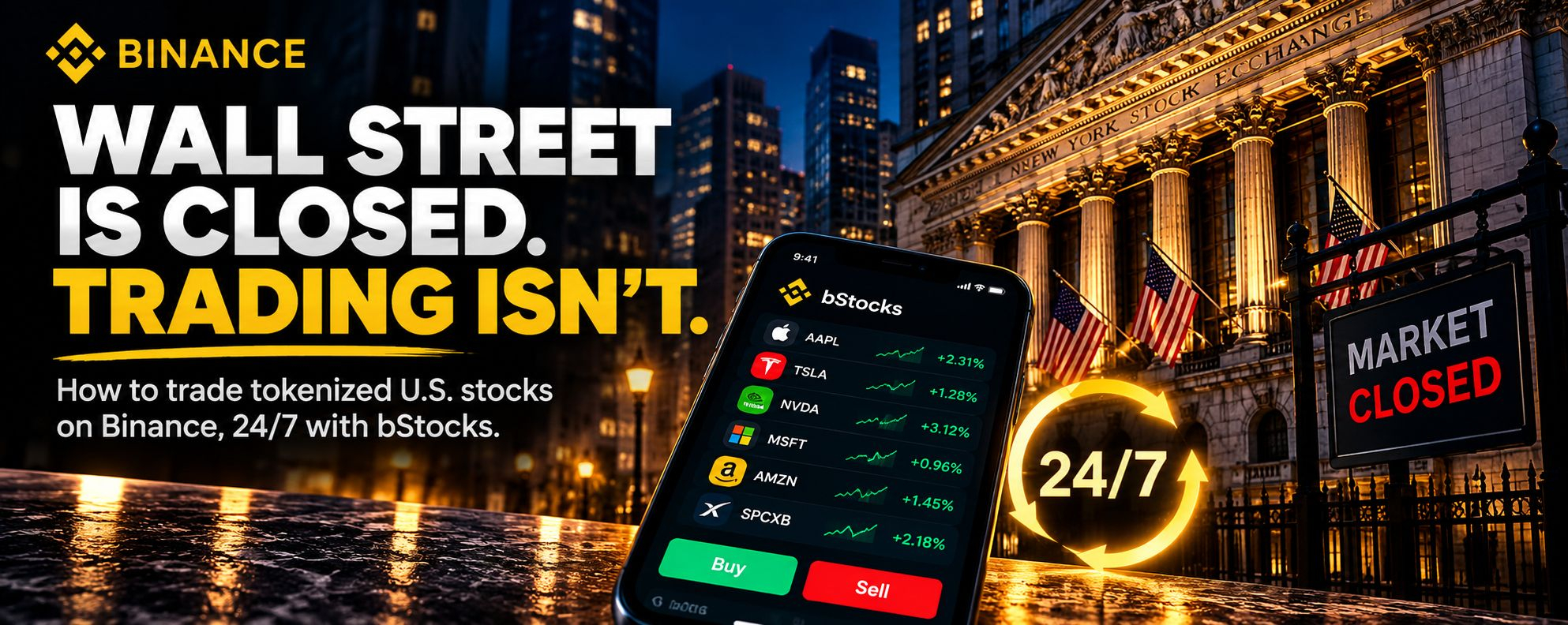

Yes, eligible users can buy tokenized stocks on Binance even when the U.S. stock market is closed, including weekends, through bStocks. These instruments trade 24/7 in permitted jurisdictions and provide economic exposure to underlying shares rather than direct share ownership.
I bought and sold Tesla and SpaceX bStocks on Binance, and what struck me most was how familiar the whole experience felt.
I remember when getting into stocks meant opening a traditional brokerage account and dealing with a completely separate platform. This time, buying and selling tokenized securities felt much like trading crypto. I found the asset, placed my order, and managed the position through an interface I already knew.
That might sound like a small thing. But I think it points to something bigger.
I've been following real-world asset tokenization (RWA) for years. The idea of bringing stocks, bonds, and other financial assets onto blockchain networks used to be mostly a conversation about the future. Now, at least part of that vision has become a product people can actually use.
The convenience impressed me. But it also made me wonder: what happens when exposure to traditional stocks becomes available around the clock?
How Does Binance bStocks Enable 24/7 Trading?
Regular trading on major U.S. stock exchanges runs from 9:30 a.m. to 4:00 p.m. Eastern Time, Monday through Friday, excluding market holidays. Some brokers offer extended-hours trading, but that still comes with specific schedules and conditions.
Binance bStocks work differently.
They're tokenized securities issued by BTech Holdings Limited, a Binance group affiliate. According to Binance, each bStock is backed 1:1 by a corresponding underlying share held through custody arrangements.
The tokens use the BEP-20 standard on BNB Smart Chain and can trade on Binance Spot 24 hours a day, seven days a week, including weekends.
For example, Tesla's bStock is TSLAB, and SpaceX's is SPCXB.
But there's one distinction that matters more than the trading schedule: holding a bStock does not make you a direct shareholder of the underlying company.
Under the product's legal structure, bStocks are certificates representing certain financial instruments. They provide economic exposure to the underlying shares, but not direct share ownership or ordinary shareholder voting rights.
Dividend-related benefits, where applicable, are handled through a reinvestment mechanism called the Multiplier. Rather than receiving conventional cash dividends, holders may benefit from adjustments reflecting reinvested distributions after applicable taxes, according to the product terms.
Eligible holders can also withdraw supported bStocks to compatible BNB Smart Chain wallets, subject to transfer restrictions and applicable rules.
For me, this is one of the most interesting aspects of tokenization. Financial instruments linked to traditional companies can now be accessed through blockchain infrastructure, creating another way to interact with markets that previously required conventional brokerage systems.
How Do You Buy bStocks on Binance?
I tested both buying and selling with Tesla and SpaceX bStocks. The interface was straightforward, especially since I was already familiar with Binance Spot trading.
That doesn't mean every part of the product is simple. Understanding what you own is a different matter from knowing how to place an order.
If you're eligible to access bStocks, the process generally works like this:
1. Confirm your eligibility
bStocks are offered under an approved prospectus in Abu Dhabi Global Market (ADGM). Outside that offering jurisdiction, access is limited to eligible users in permitted jurisdictions on a secondary-market basis.
For readers in MENA, this distinction matters. Availability in one country doesn't mean availability across the entire region.
2. Find the supported trading pair
On Binance Spot, search for the relevant bStock, such as TSLAB/USDT or SPCXB/USDT.
Make sure you're selecting the official tokenized security rather than another asset with a similar name.
3. Review the market
Before placing an order, check:
- The current bid and ask prices.
- Trading volume and available liquidity.
- The spread between buying and selling prices.
- Applicable trading fees.
These details can affect the actual cost of your trade, especially outside regular U.S. market hours.
4. Place your order
Choose a supported order type and enter the amount you want to trade.
A market order seeks execution at available prices. A limit order allows you to specify an acceptable price, although execution isn't guaranteed.
5. Manage your holdings
After buying, you can monitor your position and sell through the supported Spot market.
Eligible users may also have access to conversion services between supported direct-stock positions and corresponding bStocks. These are separate processes with their own terms, availability requirements, and restrictions.
What I liked about the experience was not having to switch to a separate brokerage interface just to trade these instruments.
It felt natural alongside the crypto trading I was already used to.
And that's a meaningful improvement in accessibility, provided users also understand the financial product behind the familiar interface.
What Should You Check Before Trading bStocks Over the Weekend?
I consider weekend trading a genuine advantage, especially when important financial news breaks outside U.S. market hours.
Being able to react without waiting for Monday gives traders more flexibility.
Still, there are a few things worth checking before acting.
Liquidity and the bid-ask spread
A market can stay open even when trading activity is relatively low.
If fewer buyers and sellers are participating, the gap between the highest bid and lowest ask can widen. Larger orders may also become harder to execute at the expected price.
That's why I watch the order book, not just the last traded price.
Weekend prices versus the underlying stock
Imagine major news about Tesla breaks on a Sunday.
TSLAB may continue trading while Tesla shares aren't trading on their primary U.S. exchange.
The tokenized market can react immediately, but its price reflects the expectations and liquidity of participants in that market.
When traditional trading resumes, the underlying share may open at a different price than weekend participants anticipated.
Being able to react earlier can be useful. It doesn't guarantee a better outcome.
Fees and execution costs
Binance applies Spot trading fees to bStocks, subject to any applicable promotions.
Spreads and slippage can also affect the final execution price. If you withdraw tokens to an external wallet, network fees may apply.
It's worth checking current fees before placing an order rather than assuming tokenized trading is always cheaper.
Risks specific to tokenized securities
In addition to ordinary market risk, bStocks involve issuer, custody, operational, regulatory, and blockchain-related risks.
Self-custody adds further responsibilities. Transfers are subject to restrictions and smart-contract controls, and sending tokens through an unsupported network may result in permanent loss.
The underlying share backing is important, but it doesn't eliminate these risks.
My view is that having access to a market during weekends is valuable. Whether a particular weekend trade makes sense still depends on the price, liquidity, and reason for entering the position.
Why Tokenization Matters Beyond Trading Hours
What interests me about tokenization is how it could change the way people access financial markets.
A familiar trading interface, blockchain-based infrastructure, and more flexible market hours can remove some of the practical barriers that previously separated crypto users from traditional financial products.
But easier access raises an important question.
If buying exposure to a stock becomes as simple as buying cryptocurrency, will people take enough time to understand what they're actually purchasing?
That's where I think the next challenge lies.
Making financial products easier to access is valuable. Making their ownership structures, risks, and limitations equally easy to understand matters just as much.
The next stage of RWA adoption shouldn't be measured only by how many assets become tokenized, but also by how effectively people can understand and use them.
FAQ
Can I buy stocks when the U.S. market is closed?
Yes. Eligible users can trade supported tokenized securities through Binance bStocks outside regular U.S. stock-market hours.
However, buying a bStock is not the same as directly purchasing shares in the underlying company. It provides economic exposure through a separate financial instrument.
Can I trade bStocks on Saturday and Sunday?
Yes. Binance supports 24/7 bStocks Spot trading, including weekends, subject to eligibility, product availability, and operational restrictions.
Liquidity, spreads, and prices may differ from conditions during regular U.S. trading hours.
What is the difference between Binance Stocks and bStocks?
Binance offers direct-stock services and bStocks as separate products for eligible users.
Binance Direct Stocks provides access to actual shares through brokerage and custody arrangements, with beneficial ownership rights determined by the applicable product terms.
Binance bStocks are tokenized securities backed 1:1 by underlying shares. They provide economic exposure without direct shareholder ownership.
The main differences include legal rights, custody arrangements, trading hours, and blockchain functionality.
bStocks support 24/7 trading and, where permitted, withdrawal to compatible BNB Smart Chain wallets. Direct stocks follow their supported securities-trading schedules.
Availability and applicable restrictions vary by jurisdiction.
Final Thoughts
I don't expect blockchain to replace traditional financial infrastructure overnight. There are still important questions around regulation, custody, liquidity, and investor protection.
But I believe we're seeing the early stages of a meaningful transition.
For me, bStocks are worth following not simply because they trade 24/7, but because they offer a practical glimpse of how traditional finance and blockchain technology may increasingly connect.
---
References
1. Binance Academy — What Are bStocks? A Guide to Tokenized Stocks on Binance https://www.binance.com/en/academy/articles/what-are-bstocks-a-guide-to-tokenized-stocks-on-binance
2. Binance — bStocks Official Product Page
https://www.binance.com/en/bstocks-landing
3. Binance — bStocks: Frequently Asked Questions on Deposit, Withdrawal, and Conversion
https://www.binance.com/en/support/faq/detail/f0d41139fadc4790bf9a4c0c7bce2e88
4. Binance — From Pre-IPO to Stocks to On-Chain and Beyond https://www.binance.com/en/blog/markets/3291762588579390744
5. Binance — bStocks Trading Pairs and Product Announcements
https://www.binance.com/en/support/announcement/detail/d9c3577e8ed249a88af7ec55a3d3a284
---
Disclaimer: This article reflects my personal experience and research and is intended for educational purposes only. It is not financial advice or an offer to buy or sell securities. Tokenized securities involve financial, technical, and regulatory risks. bStocks are not direct shares and do not represent direct ownership of the underlying company. Availability depends on jurisdiction and eligibility.
#Binance #bStocks #TokenizedStocks #RWA #BNBChain