




On November 28, 2012, Bitcoin cut its own block reward in half, from 50 to 25 BTC, on a schedule written into the code years earlier. Here's what the first halving looked like, why it exists, and where the schedule stands today.
What a Halving Is
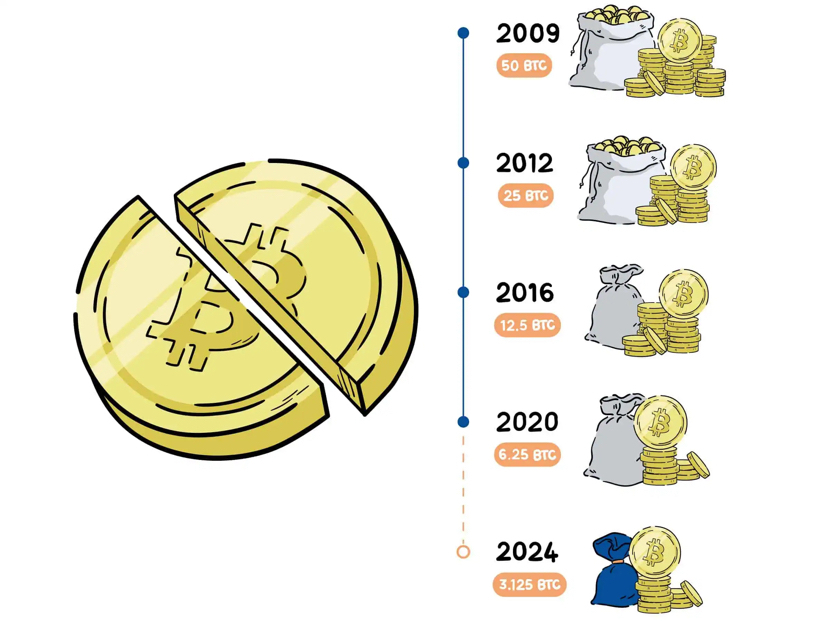
New $BTC enters circulation as a reward to the miners who add blocks to the chain. Every 210,000 blocks, that reward halves. At about 10 minutes per block, that works out to roughly every four years.
You can see it in Bitcoin Core's GetBlockSubsidy function. The reward starts at 50 BTC and halves every nSubsidyHalvingInterval blocks, a value set to 210,000. A comment in the code says it "will occur approximately every 4 years."
Why Satoshi Designed It This Way
In the January 2009 email announcing Bitcoin v0.1, Satoshi Nakamoto wrote: "Total circulation will be 21,000,000 coins. It'll be distributed to network nodes when they make blocks, with the amount cut in half every 4 years."
The same email laid out the schedule: 10,500,000 coins in the first four years, 5,250,000 in the next four, then 2,625,000, then 1,312,500, and so on. Because each step is half the last, total issuance approaches 21 million and never goes past it. Supply is predictable, it shrinks over time, and nobody can change it on a whim.
The Setting: Late 2012
Bitcoin was still a niche project. The Bitcoin Foundation, founded in September 2012, put out a press release on halving day giving the price as $12.34, up 1% from the previous close of $12.20. It also noted the price had risen more than 230% since January 1, 2012, from about $5.27.
The community made a party of it. The release said the halving was "being treated as a community-wide holiday," with forums buzzing and people posting under the hashtag #bitcoinhalvingday.
The Block Itself: #210,000
Mined: November 28, 2012, at 15:24:38 UTC (block timestamp, per mempool.space and Blockchain.com)
Hash: 000000000000048b95347e83192f69cf0366076336c639f9b7228e9ba171342e
Found by: Slush's Pool, today known as Braiins. The coinbase message reads "/slush/", and the Bitcoin Wiki credits a pool miner nicknamed "laughingbear."
Contents: 457 transactions, a 25 BTC subsidy, and about 13.56 BTC in fees
According to the Bitcoin Wiki, 10,500,000 BTC had been mined just before the halving, exactly half of the 21 million cap.
Price: Before and the Year After
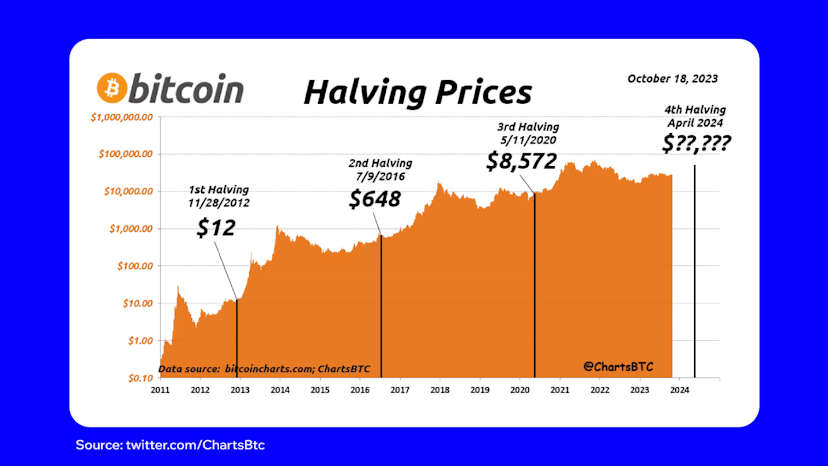
CoinGecko's research puts BTC at about $12 at the first halving. By November 28, 2013, a year later, it was around $1,075, and it reached a post-halving high of $1,127 on November 30, 2013, based on CoinGecko's daily data. Other indexes show the late-2013 high a little higher (Bitcoin Magazine cites $1,163), because exchanges and data sources differ.
Halvings cut the flow of new supply, but price is driven by demand, liquidity, adoption and the wider market. Many things happened in 2013 besides the halving.
The Halvings That Followed
Block timestamps from mempool.space:
2nd halving: block 420,000, July 9, 2016 (25 - 12.5 BTC)
3rd halving: block 630,000, May 11, 2020 (12.5 - 6.25 BTC)
4th halving: block 840,000, April 20, 2024 (6.25 - 3.125 BTC)
Each one happened right on schedule, at its block height. That's the point: the date is set by block count, not by any calendar or committee.
The Next One: Block 1,050,000
The 5th halving will cut the reward from 3.125 to 1.5625 BTC at block 1,050,000. When I checked mempool.space at 14:40 UTC on Oct 8, 2026, the chain tip was block 970,498, which leaves 79,502 blocks to go. At an average of 10 minutes per block, that's about 552 days, which points to around spring 2028. The real date will move with actual block times, so treat it as an estimate.
For context, $BTC is at $82,600.78 (Binance BTC/USDT, Oct 8, 2026, 14:40 UTC).
The Takeaway
The first halving showed that Bitcoin's monetary policy runs on code, not promises. Four halvings in, the issuance schedule Satoshi described in 2009 has held at every step, and anyone can check it on-chain. Past performance doesn't guarantee future results, though. Halvings are a supply event, not a price forecast. This article is for education only and isn't financial advice.
What do you think matters more for $BTC over the long run: the halving schedule or adoption?
#Bitcoin #BitcoinHalving #CryptoHistory