

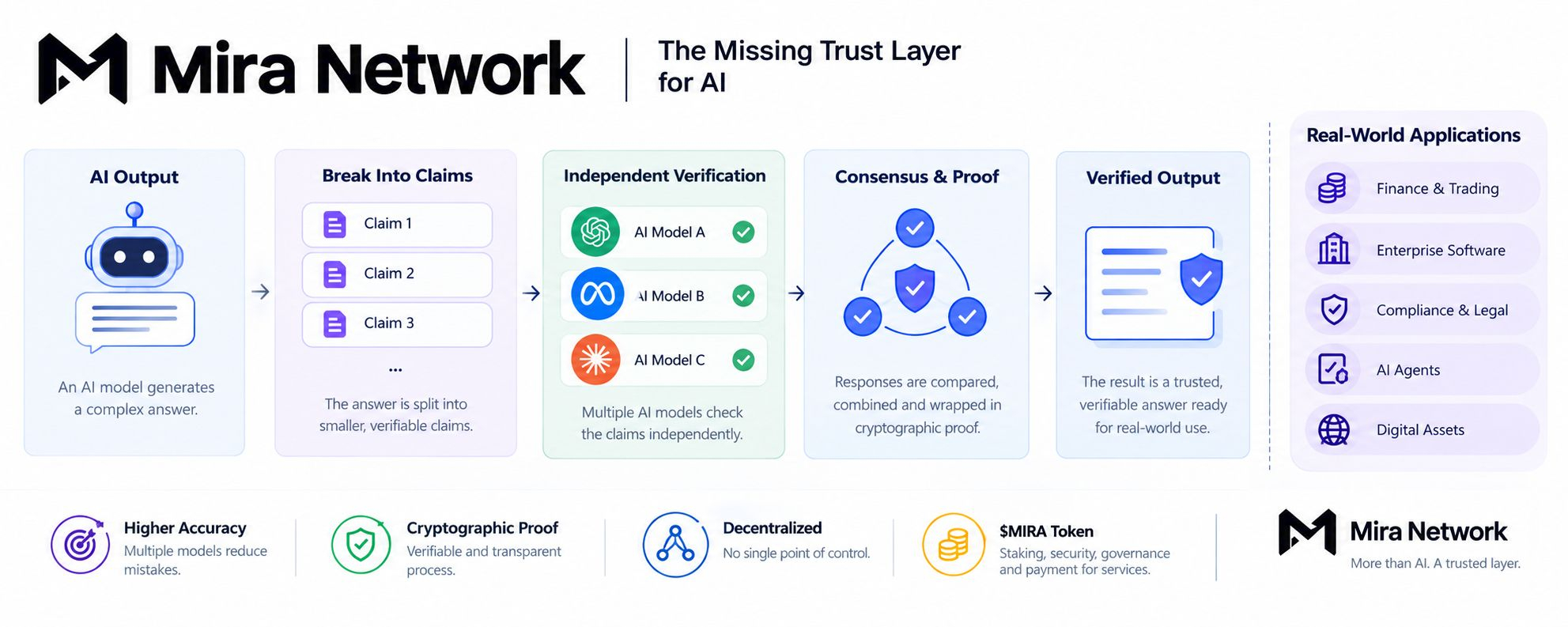

AI is getting smarter almost every day, but there is still one problem nobody can ignore: we cannot always trust what it tells us. Modern AI models can write, analyze, code and answer questions in seconds, yet they can also confidently give us information that is simply wrong. That might be acceptable when asking a chatbot a casual question, but it becomes a serious problem when AI starts handling money, making business decisions, executing transactions or operating without a human checking every step. This is the problem Mira Network is trying to solve. Instead of building another AI model and hoping it becomes perfect, Mira is building a decentralized verification layer that checks AI-generated information before it can be trusted.
The idea behind Mira is actually quite simple. When an AI produces a complicated answer, Mira can break that answer into smaller claims and send those claims to different AI models for independent verification. The responses are then compared and combined through a consensus process. The goal is to make it much harder for one model's mistake to become the final answer. Mira can also create cryptographic proof around the verification process, giving applications a way to know that an output was actually checked rather than simply accepted because one AI model sounded confident.
Mira's own research gives an interesting indication of what this could achieve. In one published test, the project reported that GPT-4o produced 73.1% accuracy on its baseline, while using two-model consensus increased the result to 93.9%, and three-model consensus reached 95.6%. Those numbers should not be treated as a guarantee that multiple models will always be correct, but they show why the idea is interesting. If different models have different weaknesses, making them challenge each other can potentially reduce mistakes. The biggest issue, however, is whether those models are genuinely independent. If several models learned the same incorrect information, they could all agree on the same wrong answer. So Mira's long-term success will depend heavily on model diversity and the quality of the information being verified.
The project has also developed beyond a simple idea. Mira raised $9 million in seed funding in 2024 from investors including BITKRAFT Ventures, Framework Ventures, Accel and Mechanism Capital. Its early focus included decentralized AI infrastructure and products such as Klok, before the project increasingly moved toward verified intelligence. That history matters because Mira has been building actual AI infrastructure rather than simply launching a token around an AI narrative.
The MIRA token is now part of that ecosystem. The total supply is capped at one billion tokens, and MIRA is designed for staking, network security, governance and payments for verification services. Validators can have economic value at risk, creating an incentive to participate honestly. But there is also an important investment risk here: a large amount of the total supply is still scheduled to enter circulation. For the token to perform sustainably, genuine demand for Mira's services needs to grow faster than the additional supply entering the market.
Where could this become useful? The most obvious opportunities are areas where an incorrect AI answer can be expensive. Financial research, autonomous trading systems, enterprise software, compliance, legal technology and AI agents are all potential markets. Imagine an AI agent preparing a large financial transaction. Instead of trusting one model, the transaction could first be checked by several independent models through Mira before anything happens. In that scenario, Mira is no longer just a fact-checking tool. It becomes a security layer around autonomous AI.
That is also where the biggest opportunity lies. If AI agents eventually become responsible for managing money, contracts, businesses and digital assets, companies will need a reliable way to verify what those agents are doing. Mira could potentially sit between AI-generated decisions and real-world execution.
But the competition will be intense. Large AI companies can build their own verification systems, while other crypto projects are also working on decentralized AI, compute and verifiable inference. Mira therefore has to prove that decentralization provides a real advantage rather than simply adding complexity and cost.
The most important thing to watch is not another partnership, exchange listing or short-term price move. It is whether developers are willing to pay for Mira's verification services because they genuinely make AI more reliable.
If that happens, Mira could become much more than another AI-related crypto project. It could become part of the infrastructure that determines whether autonomous machines are allowed to act on the information they generate.
And that may become one of the most important questions in the AI era: not how intelligent AI becomes, but how much we can trust it before we let it act.
