

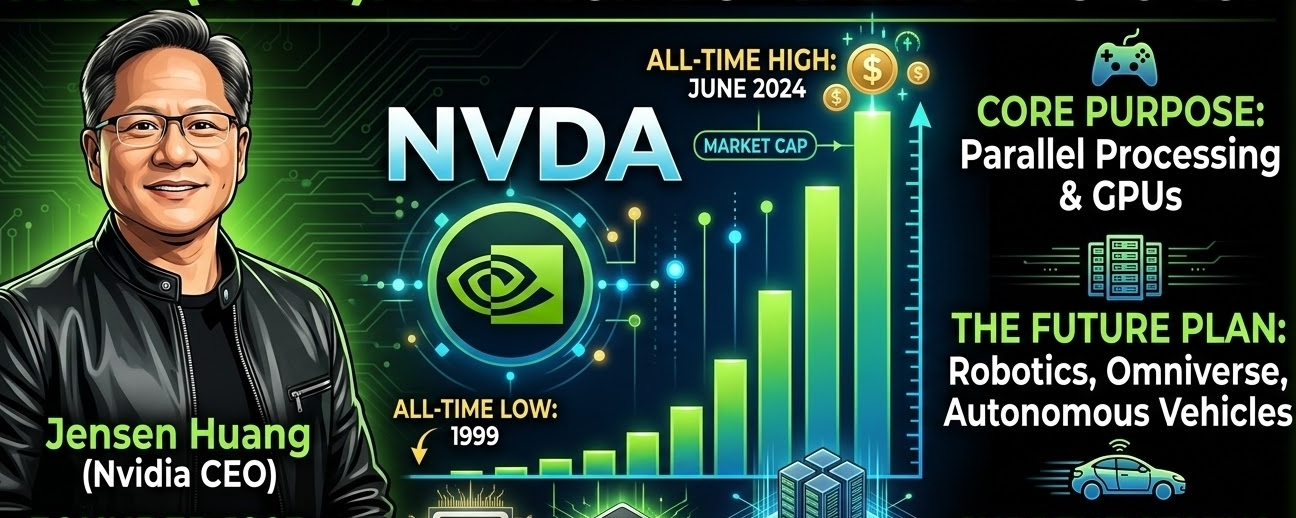

$NVDAB ia Corporation stands as one of the most valuable and influential technology companies in the world today. What began as a venture focused purely on 3D computer graphics has evolved into the primary engine driving the global Artificial Intelligence (AI) revolution.
History and Foundation
Nvidia was founded in 1993 by Jensen Huang, Chris Malachowsky, and Curtis Priem. The founders recognized that the future of computing would require specialized hardware to render complex 3D graphics for PC gaming—a task traditional CPUs could not handle efficiently.
Early Struggles & Breakthroughs: Their first product, the NV1, was a commercial failure. However, in 1997, the release of the RIVA 128 graphics processor saved the company from near-bankruptcy.
Inventing the GPU (1999): In 1999, Nvidia introduced the GeForce 256, marketing it as the world’s first official Graphics Processing Unit (GPU). This innovation reshaped the gaming industry forever.
The CUDA Paradigm Shift (2006): Nvidia launched CUDA, a parallel computing platform and programming model. CUDA enabled developers to use GPUs for general-purpose scientific computing and complex data processing, laying the essential technical foundation for modern AI deep learning.
Core Purpose and Mission
$NVDAB was built to solve the limits of sequential computing through Parallel Processing:
Initial Objective: Accelerate real-time 3D graphics rendering for PC gaming, digital art, and visual effects.
Expanded Mission: Build an end-to-end accelerated computing ecosystem—spanning hardware, networking, and software—that powers Supercomputing, Artificial Intelligence, Data Centers, and Autonomous Systems.
All-Time High (ATH) and Key Drivers
All-Time High: Nvidia reached an all-time high valuation in mid-2024, surpassing $140+ per share (adjusted for its 10-for-1 stock split), which pushed its total market capitalization past $3.3 Trillion and briefly made it the most valuable public company in the world.
Why It Happened:
Generative AI Boom: The global rush to build LLMs (like OpenAI's ChatGPT, Google Gemini, and Anthropic Claude) created unprecedented demand for Nvidia’s H100, A100, and Blackwell AI GPUs.
Near-Monopoly Position: Nvidia captured an estimated 80% to 90% share of the AI training chip market.
Unprecedented Financial Growth: Massive quarterly revenue and net income surges driven by data center hardware sales.
All-Time Low (ATL) and Key Drivers
All-Time Low: Nvidia went public (IPO) in January 1999 at $12.00 per share. On a split-adjusted basis across its entire corporate history, its all-time low sits at approximately $0.03 to $0.04 per share.
Why It Happened:
Early Market Volatility (1999–2002): As a young company, Nvidia faced intense competition from established graphics vendors like 3dfx and ATI.
Dot-Com Crash: The broader technology sector collapse in the early 2000s dragged down valuations across all semiconductor and hardware stocks.
Present Status
Today, Nvidia is no longer just a chip manufacturer; it is a Full-Stack Accelerated Computing and AI Infrastructure Company:
Data Center Dominance: Data center hardware and networking (via its Mellanox acquisition) form the majority of its massive revenue stream.
Software Lock-in: Its proprietary software stack (CUDA, TensorRT, NeMo) makes it difficult for enterprise customers to migrate to competitor chips.
Backbone of Big Tech: Major cloud providers (Microsoft Azure, AWS, Google Cloud, Meta) rely heavily on Nvidia clusters to run their AI workloads.
Future Roadmap and Strategy
Nvidia's strategic focus extends beyond raw hardware sales to controlling the entire AI and digital simulation pipeline:
Next-Generation Architectures: Scaling advanced GPU architectures (such as Blackwell and its successors) to deliver higher AI throughput while dramatically reducing energy consumption per compute unit.
Omniverse & Industrial Digital Twins: Expanding Nvidia Omniverse—a platform for real-time 3D simulation and design—allowing manufacturing, automotive, and logistics companies to simulate entire factories and complex systems digitally before building them physically.
Physical AI & Robotics: Developing dedicated platforms (such as Nvidia Isaac and DRIVE) to power humanoid robotics, automated factory equipment, and autonomous vehicles.
AI-as-a-Service (DGX Cloud): Offering cloud-based AI infrastructure and enterprise software subscriptions, enabling businesses to access high-performance AI compute without building physical data centers.
#NVDA #NVDAUS #artificialintelligence #StockTrading #MarketAnalysis