


Background
On April 1, 2026, Drift Protocol (Solana-based perpetual futures exchange) suffered a sophisticated exploit resulting in ≈ $295.4 million in verified user losses.
The attack was a 6-month social engineering operation attributed (with medium-to-high confidence by Mandiant and SEAL 911) to North Korean state-affiliated actors (UNC groups, linked to prior incidents such as Radiant Capital). Attackers posed as a quantitative trading firm, met contributors in person at multiple conferences, deposited capital to build trust, and compromised systems leading to a rapid drain of funds.
The protocol was later rebuilt and relaunched elements as Velocity DEX (USDT-settled perps exchange), with leadership changes including co-founder Cindy Leow stepping down in late September 2026.
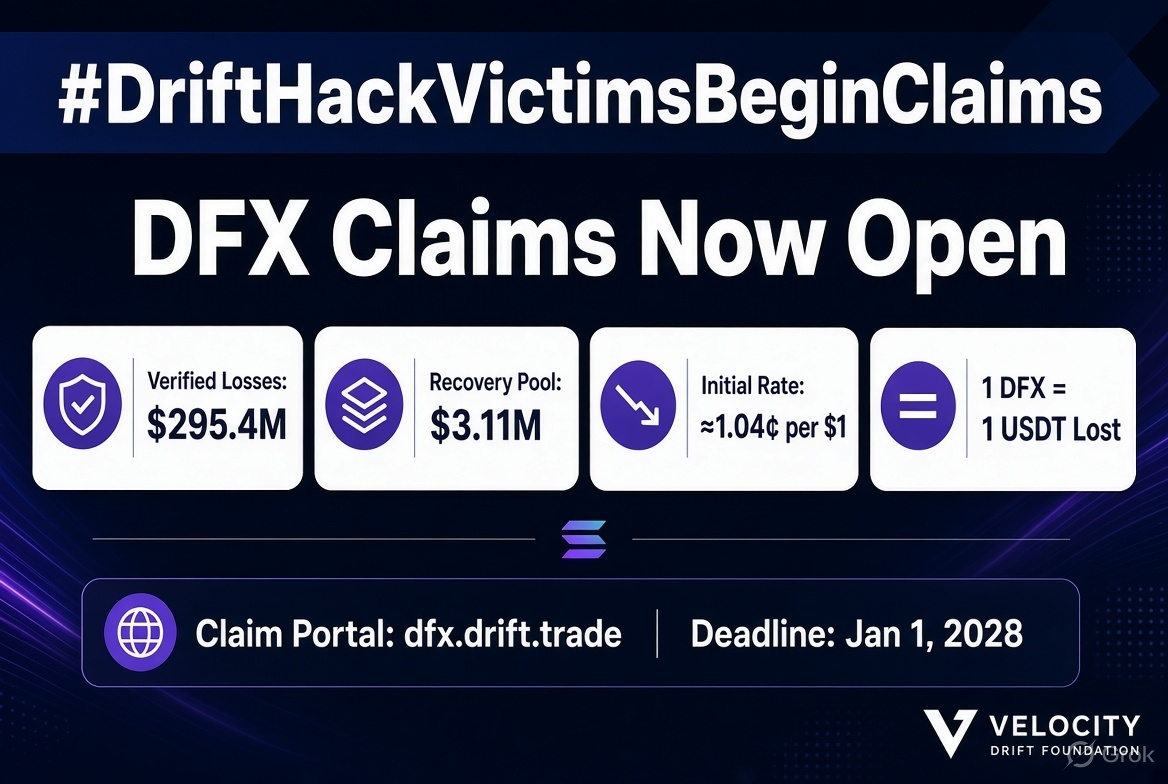
DFX Recovery Claims Now Open
Claims & redemptions started: October 1, 2026
Official portal: dfx drift trade
Allocation: 1 DFX token = 1 USDT of verified loss (snapshot taken at protocol pause: ~18:31 UTC on April 1, 2026)
Total fixed DFX supply: 299,500,810.998 tokens (no new minting ever)
Claim window closes: 00:00 UTC on January 1, 2028
Unclaimed DFX is permanently burned (increasing the relative value for remaining holders)
How to claim (official guidance):
Use the exact wallet that controlled your Drift account on April 1, 2026.
Visit dfx drift trade and connect that wallet (needs a small amount of SOL for fees).
View allocation via Merkle proof check.
Accept terms and claim.
DFX is a standard Solana SPL token, freely transferable and tradable (e.g., on Raydium). It is completely separate from the DRIFT governance token.Initial Recovery Economics (Launch Data)
Recovery Pool balance at launch: ≈ $3.11 million USDT
Initial redemption rate: ≈ 0.0104 USDT per DFX (≈ 1.04 cents per dollar lost)
Example: $1,000 verified loss → ≈ $10.40 immediate redemption
$100,000 loss → ≈ $1,040
Redemption formula: Recovery Pool Balance ÷ Outstanding DFX Supply.
Redeeming burns the DFX and is irreversible (you forfeit future pool growth on those tokens).
Early Activity Stats (First Days)
First Friday after launch: ≈ 216,480 DFX redeemed for ≈ 2,250 USDT
Velocity’s first daily revenue transfer into the pool: only 31 USDT
Low early redemption volume indicates most holders are waiting for potential pool growth rather than taking the ~1% immediate recovery.
Future Funding Sources for the Recovery Pool
The pool grows daily (at 00:00 UTC) until it reaches the full verified loss amount (~$295.4M):
Velocity Net Protocol Revenue (tiered share):
60% of first $30,000 daily revenue
70% of next $70,000
90% of revenue above $100,000
Tether commitment: Up to $127.5 million USDT (matched/deployment linked to relaunch & recovery — not a one-time lump sum already received)
Strategic partners: Up to $20 million USDT
Recovered stolen assets (any freezes, bounties, or law-enforcement recoveries)
Stolen funds tracking (as of late September / early October updates):
≈ 130,259 ETH concentrated across four Ethereum wallets (majority unmoved)
≈ 23,094 ETH previously passed through Tornado Cash
≈ $9.2 million in assets frozen at other addresses
Data Analysis & Key Insights
Initial recovery rate ≈ 1.04%: This is a distressed, progressive mechanism — not a full bailout. Immediate cash-out delivers very low recovery.
Upside for holders: Every new deposit into the pool increases the redemption value of remaining DFX. Early redeemers exit at low rates and give up future upside.
Supply dynamics: Fixed supply + burning of redeemed/unclaimed tokens creates a shrinking outstanding supply, which mathematically supports higher per-token value over time if inflows materialize.
Dependency risk: Recovery speed depends heavily on Velocity’s trading volume/revenue growth + actual delivery of Tether/partner commitments + successful asset recovery. Early revenue contribution was negligible.
Opportunity cost: Holding DFX is a bet on the long-term success of the relaunched exchange and external support. Selling on secondary markets provides liquidity but at market-determined prices (which may differ from the official redemption rate).
Scale comparison: $295.4M verified losses vs. $3.11M starting pool highlights the multi-year runway required for meaningful recovery under the current structure.
Important Warnings
Official team will never DM you, ask for fees, private keys, or seed phrases.
Only connect wallets on the official portal: dfx.drift.trade.
There is an independent Drift Victims Committee (@DriftVictims) focused on coordination, FBI IC3 reporting, anti-scam guidance, and collective action.
Separate proposed class action exists involving Circle (USDC) regarding freezing of certain funds — distinct from the DFX process.
Always review full DFX terms before claiming or redeeming. Consider personal legal/tax implications.
This is a progressive recovery framework designed around platform performance rather than immediate full reimbursement. Values, pool size, and rates will evolve with inflows and redemptions.
Sources: Official Drift Foundation updates (drift.trade), dfx.drift.trade portal, and contemporaneous reports from KuCoin, CryptoSlate, Unchained, Solana Compass, and on-chain trackers (October 1–4, 2026 data).
#SolanaTokenizedStockVolumeTops$4.4BInSeptember #BitcoinSpotETFsDraw$6.34BInflowsInQ3 #BinanceSquare


Click here for Article "Ethereum Validator Exit Queue Surges 393%"
(Not financial advice. DYOR. Verify all details on official channels.)