

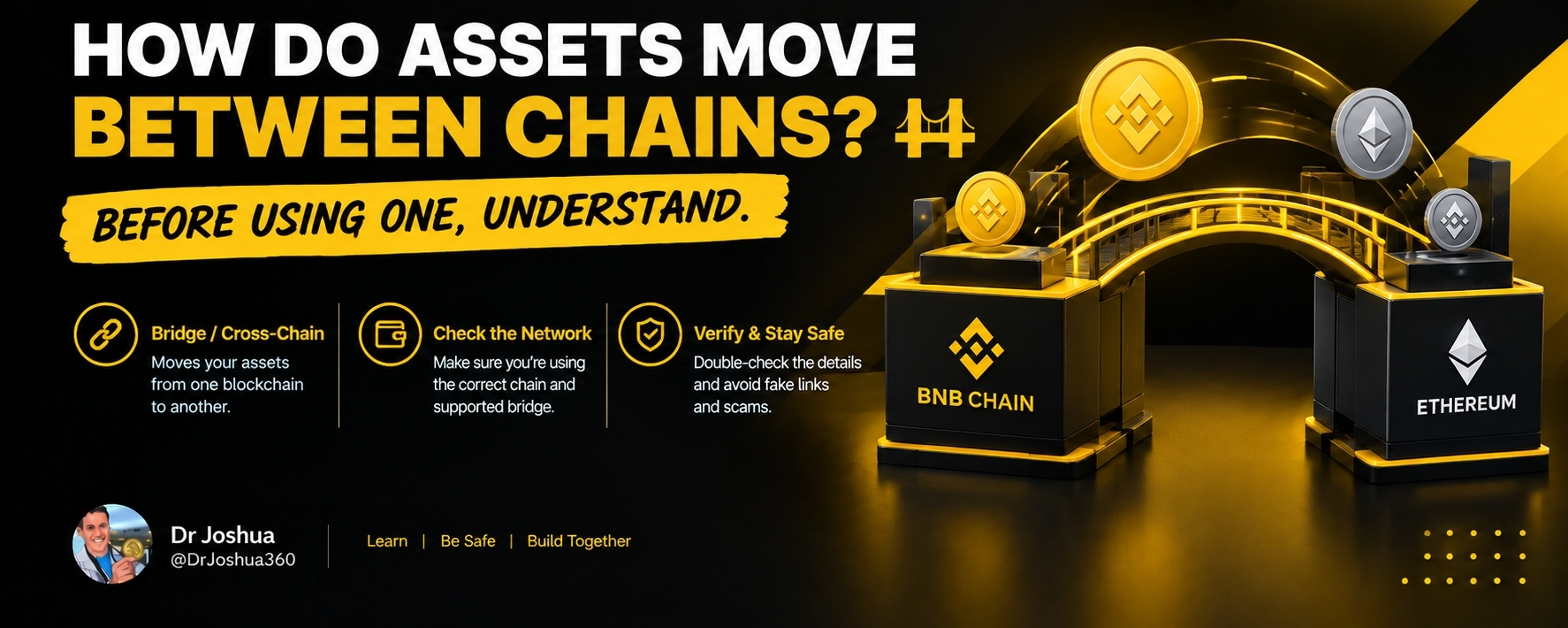

You’ve seen the glowing portals, the shiny coins flying between pedestals labeled BNB Chain and Ethereum, and the bold warning: “Before using one, understand.” That Binance graphic isn’t just pretty design it’s a quiet alarm for every crypto user who’s ever lost tokens to a wrong network, a fake bridge, or a “support” link that drained their wallet.
Let’s unpack what’s really happening when you move assets across blockchains, why it’s riskier than it looks, and how to stay SAFU while doing it.
The Simple Truth: Your Tokens Don’t “Travel”
Blockchains are separate universes. Bitcoin lives on Bitcoin. ETH lives on Ethereum. BNB lives on BNB Chain. They don’t talk to each other by default.
When you “bridge” assets, you’re not shipping coins through a digital tunnel. You’re usually doing one of two things:
1. Lock-and-mint
Your tokens get locked in a smart contract on the original chain. A matching amount of “wrapped” or synthetic tokens is minted on the destination chain. The original tokens sit frozen until someone burns the wrapped version and unlocks them.
2. Burn-and-mint or liquidity-pool bridges
Tokens are burned on one side and freshly minted (or released from a pool) on the other. Some modern bridges use liquidity networks or messaging protocols so the process feels almost instant.
Either way, you’re trusting a third-party system the bridge to keep the books honest. That trust is where the danger lives.
Moving assets from one blockchain to another is a real service, but every bridge is a potential single point of failure. History is littered with bridges that got drained for hundreds of millions. The bigger and more popular the bridge, the juicier the target.
This is the silent killer of beginner portfolios.
You copy an address, paste it, hit send… and realize too late you were still on Ethereum while the recipient was waiting on BNB Chain (or Solana, or Arbitrum, or Base). The tokens are now sitting on the wrong chain, often unrecoverable without advanced (and expensive) recovery tools if they’re recoverable at all.
Always double check the network selector in your wallet before you sign. Always.
Fake bridges, phishing sites that look identical to the real ones, Discord “support” agents offering to “help” you bridge these scams never sleep. One wrong click and your seed phrase or approval is gone.
How to Actually Stay Safe When You Need to Bridge
Bookmark official bridge URLs. Never Google “Binance Bridge” or “Stargate Bridge” and click the first result.
Start with tiny test amounts. Always.
Check the contract address on the official docs or explorer, not on a random Twitter reply.
Prefer bridges that are battle tested and have clear security audits (and still treat them with caution).
If a site asks you to “approve unlimited” spending, pause. Unlimited approvals are how many bridge exploits turn into full wallet drains.
The Bigger Picture:
Cross-chain movement is one of the most important and still most fragile parts of crypto. As more chains launch and users demand seamless experiences, better bridges and messaging layers are being built. But until the technology matures further, the responsibility sits with you.
Before using one, understand.
Understand that bridges are powerful tools.
Understand that they are also attack surfaces.
Understand that one wrong network or one fake link can cost you everything.
Stay curious. Keep building. Stay SAFU.