
I keep opening the same apps and closing them again because nothing feels worth the attention anymore. Every cycle starts the same way. A few genuine improvements get buried under a mountain of noise until you can’t tell the difference between a real shift and another marketing campaign dressed up as inevitability. This time the noise is thicker than usual. AI tokens that still can’t explain what they’re actually useful for. Influencers recycling the same three talking points with new thumbnails. Projects launching with the energy of people who have never lived through a proper winter. After a while the fatigue stops being dramatic and just becomes the default setting. You stop expecting the next thing to save you and start treating most of it like background radiation.
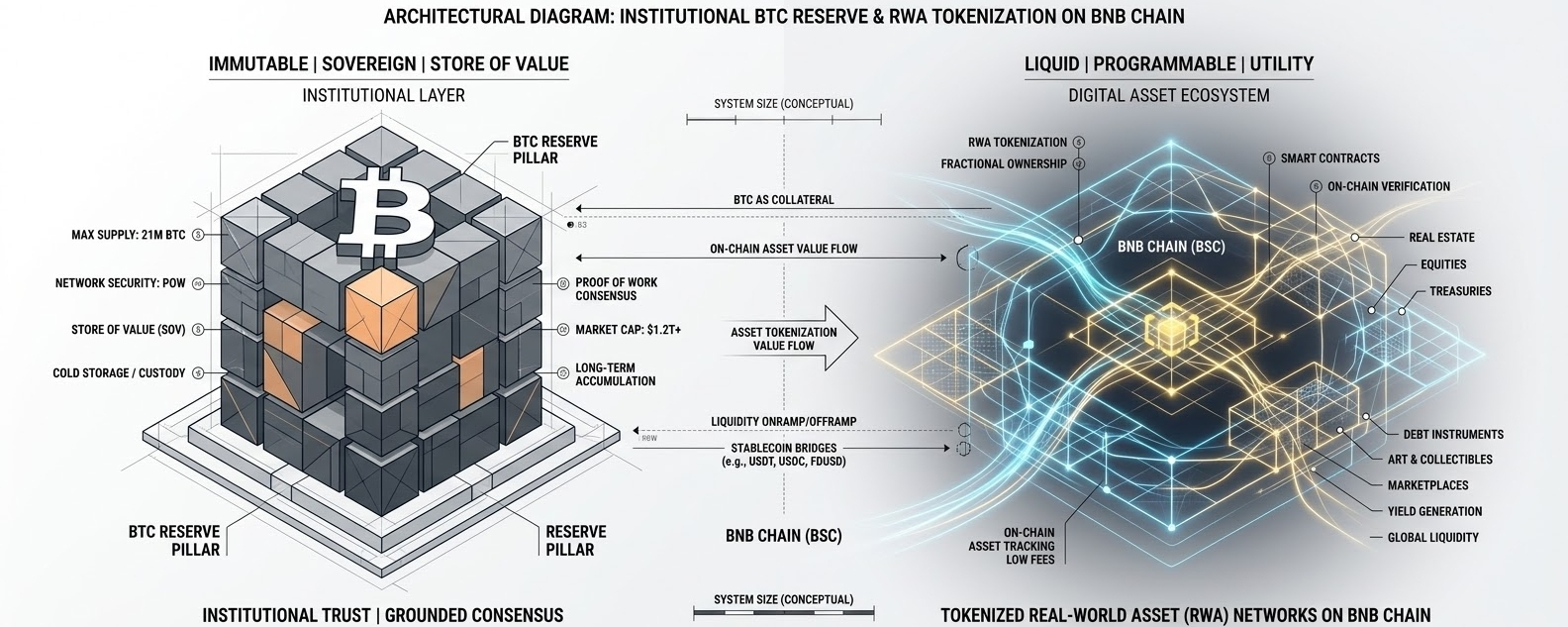
Against that backdrop the two stories that keep pulling at the edges of my attention feel almost out of place because they are quieter. Bitcoin’s slow absorption into institutional portfolios and the continued push around tokenized assets on BNB Chain. Neither of them is sexy. Neither of them needs a viral thread to stay relevant. And that is precisely why I can’t quite dismiss them the way I dismiss most of the rest.
Bitcoin’s institutional chapter has been a long, awkward courtship. For years the big names treated it like a curiosity they could study from a safe distance. Then the ETFs arrived, the custody solutions matured just enough, and the narrative finally shifted from speculative casino to another asset that belongs in the same conversation as gold or certain fixed-income products. The money that came in was not the same hot retail flow that used to disappear overnight. It was slower, larger, and more deliberate. That changes the texture of the market even if it doesn’t change the underlying volatility. When balance-sheet capital starts treating Bitcoin as a permanent allocation rather than a trade, the asset stops behaving purely like a risk-on toy. Liquidity has a different quality. Drawdowns still hurt, but they don’t always cascade the same way. I’ve lived through enough cycles to know that “institutional adoption” has been promised before and mostly failed to stick. This time the plumbing is better and the regulatory posture, while still messy, is less openly hostile in several major jurisdictions. That doesn’t make it permanent. One serious custody failure or a sharp political reversal could still push a lot of that capital back to the sidelines. But the scale is different enough that it forces a recalibration.
Then there is the tokenization story, particularly the version playing out on BNB Chain. Real-world assets have been the perennial almost-there narrative for as long as I’ve been in this market. Treasuries, credit, funds, the usual list. The pitch is always the same: take something that already works in traditional finance, wrap it in a token, and suddenly it can move faster, settle cleaner, and become accessible to a wider set of participants. On BNB Chain the push has been more persistent than most. They have the user base, the transaction volume, and a culture that is willing to chase practical use cases even when they look boring from the outside. Tokenized products keep appearing. Some of them actually hold underlying assets that generate real yield. A few even manage to attract capital that is not purely speculative.
And yet the same doubts refuse to leave. Tokenization is rarely the hard part. The legal structures, the custodians, the ongoing compliance, and the simple fact that most of the people who already own these assets have no urgent need to move them on-chain are the real barriers. Most of the time the on-chain version ends up more complicated for the end user, not less. Liquidity is thinner. The secondary market is thinner. The trust assumptions just shift from traditional institutions to a different set of intermediaries who happen to operate with smart contracts. I’ve watched enough of these experiments to know that “on-chain” does not automatically equal better. Sometimes it just means the same old risks wearing new clothes.
What keeps me from writing the whole thing off is the potential interaction between the two trends. Institutional Bitcoin creates a larger pool of capital that is already comfortable sitting in crypto-native venues. That capital eventually looks for yield that is not purely reflexive. Tokenized assets, if they can clear the practical hurdles, offer something closer to the kind of return profile those allocators already understand. In a clean version of the future the two reinforce each other. Bitcoin provides the reserve asset and the legitimacy. Tokenized products provide the productive use of capital. The market deepens instead of just inflating.
The clean version is rarely the one we get. Crypto has a long record of parallel experiments that never quite connect. Bitcoin can keep growing inside its regulated perimeter while tokenization remains a mostly retail and crypto-native activity that never reaches the scale required to matter. Distribution is still fragmented. User experience is still uneven. Regulatory clarity is still patchy enough that many serious players prefer to stay on the traditional side of the fence. Adoption is not a technology problem. It is a habit problem, a trust problem, and a convenience problem. Changing any of those takes longer than a bull market.
I find myself returning to the same basic test. Does any of this actually make life easier or cheaper for the people who are supposed to use it, or does it mainly create new products for people who already live inside the ecosystem? The problem of slow, expensive, gated traditional finance is real. The opportunity to improve settlement, transparency, and access is real. Whether the current versions of tokenized assets on BNB Chain or anywhere else are the ones that finally deliver is still an open question. The institutional Bitcoin story feels more durable than previous attempts, but durability is not the same as inevitability.
So I watch both developments with the same low-grade wariness I bring to most things in this market now. Not excitement. Not dismissal. Just the recognition that something quieter and more structural might be forming underneath the usual noise. It could matter. It could also turn out to be another chapter that looks important in real time and less decisive in hindsight. After enough cycles you learn to sit with that uncertainty instead of trying to force a conclusion. The money is getting more boring. That might be the most interesting part.