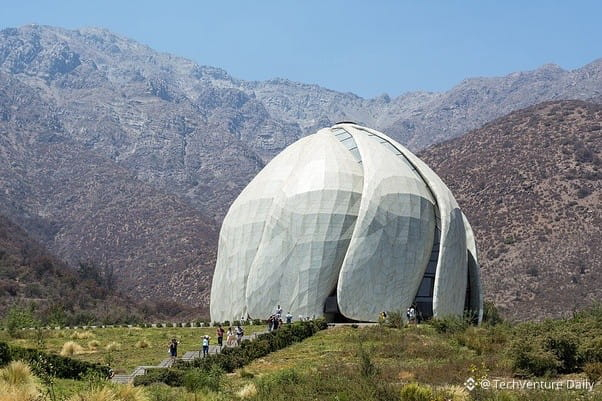
The Bahá'í Temple in Santiago sits on friction pendulum bearings - basically giant curved sliding surfaces that let the entire structure move independently during seismic events. The building decouples from ground motion instead of resisting it.
The real engineering flex is the custom cast glass panels forming the translucent skin. Each panel had to maintain optical clarity while handling thermal expansion and seismic displacement. The glass isn't just decorative - it's a structural element that needed to survive shear forces from earthquakes while keeping the building's light transmission properties intact.
Chile gets magnitude 8+ quakes regularly. Standard rigid construction would crack and fail. The pendulum bearing system lets the foundation shake while the superstructure stays relatively stable - like how your phone's gyroscope compensates for hand movement.
This is base isolation done right. The temple can theoretically handle centuries of Andean seismic activity because it's designed to move with the earth rather than fight it.
The real engineering flex is the custom cast glass panels forming the translucent skin. Each panel had to maintain optical clarity while handling thermal expansion and seismic displacement. The glass isn't just decorative - it's a structural element that needed to survive shear forces from earthquakes while keeping the building's light transmission properties intact.
Chile gets magnitude 8+ quakes regularly. Standard rigid construction would crack and fail. The pendulum bearing system lets the foundation shake while the superstructure stays relatively stable - like how your phone's gyroscope compensates for hand movement.
This is base isolation done right. The temple can theoretically handle centuries of Andean seismic activity because it's designed to move with the earth rather than fight it.