
U.S. stocks ended Wednesday mixed as traders wrapped up the month and waited on the jobs report due later this week.
August's personal consumption expenditures (PCE) price index, the Fed's preferred inflation measure, rose 3.4% from a year earlier, slower than July's 3.7%. Economists polled by Dow Jones had expected no change. Core PCE, which excludes food and energy, was better still: up 3% year on year against 3.3% the month before, and under forecasts.
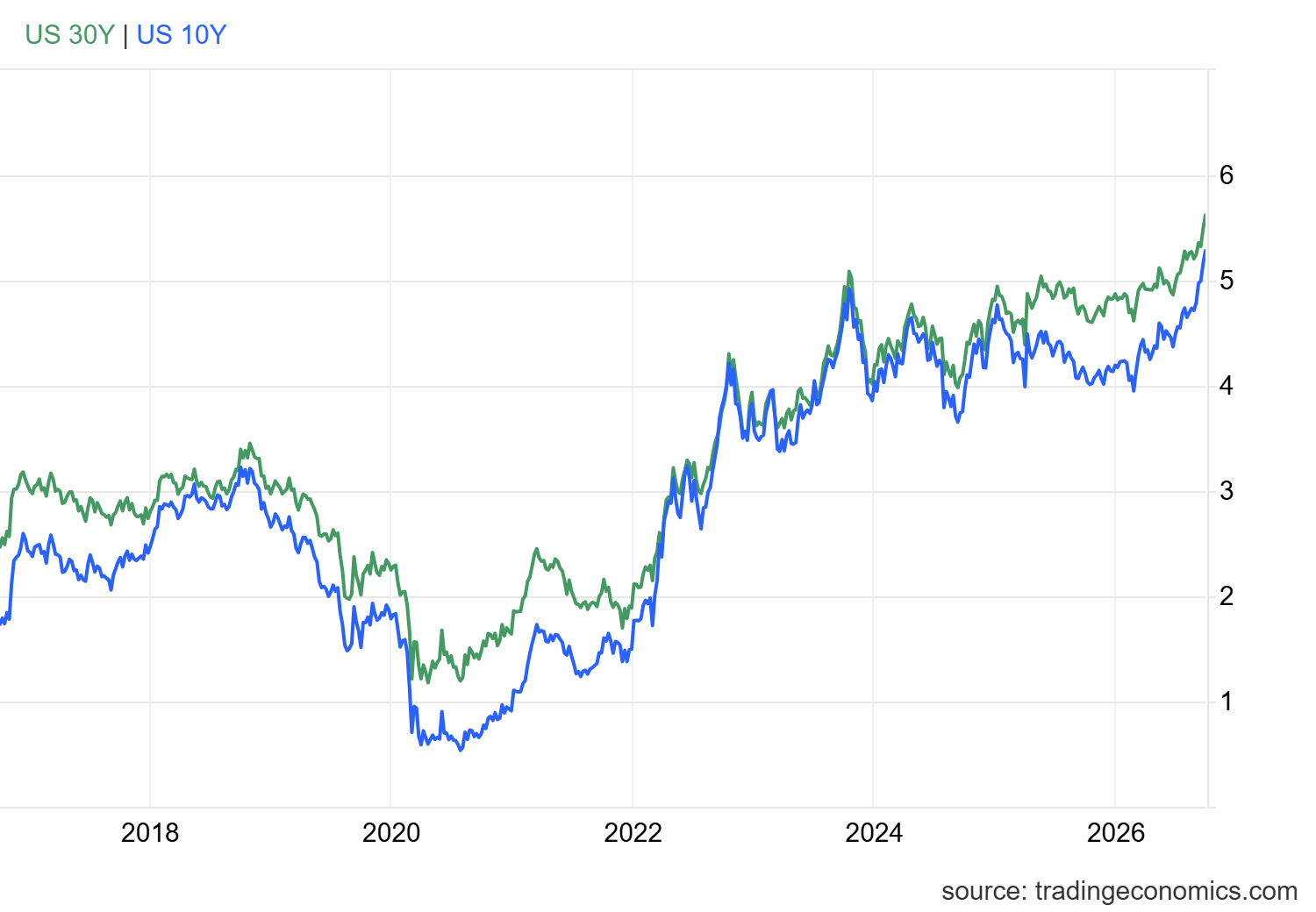
Treasury yields rose anyway. Investors seemed to shrug off the softer numbers and fix their attention on the employment data. The 10-year yield closed up about 4 basis points at 5.298%, having cleared 5.3% at its high for the session. The 30-year added nearly 5 basis points to 5.642%. The charitable interpretation is that yields are climbing because growth is running stronger than expected, which would mean the neutral rate, or R-Star, sits higher than Fed officials thought at the start of the year.
The odds of a rate hike came down. According to CME Group's FedWatch tool, traders now see a 35% chance of a quarter-point increase next month, compared with roughly 51% a day earlier.
That cooler PCE reading backed the view that the Fed can hold off, and tech responded. The Nasdaq Composite was the only gainer among the major indexes, adding 0.24% to finish at 26,861.06.
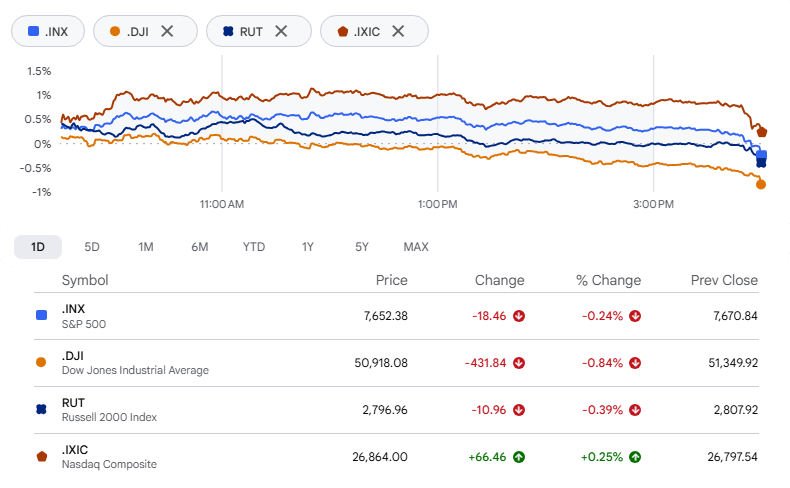
It wasn't the same for the rest of the market. Futures tied to the 30-stock Dow Jones Industrial Average fell 0.84%. The S&P 500 lost 0.25% to close at 7,651.54 on the final day of September. It had been up nearly 0.7% earlier in the session before surrendering those gains, even with fresh data showing inflation cooling last month. The Russell 2000 index of smaller companies dropped 11.06 points, or 0.4%, to 2,796.86.
September was a losing month for the Dow, S&P 500 and Nasdaq alike, as rising Treasury yields and nerves ahead of key inflation data weighed on sentiment. The S&P 500 had its worst month since June.
For the week so far, the S&P 500 is down 91.87 points (1.2%), the Dow has lost 922.57 points (1.8%), the Nasdaq has slipped 207.65 points (0.8%), and the Russell 2000 has shed 40.69 points (1.4%). Year to date, the S&P 500 is ahead 806.04 points (11.8%), the Dow 2,842.76 points (5.9%), the Nasdaq 3,619.07 points (15.6%), and the Russell 2000 314.96 points (12.7%).
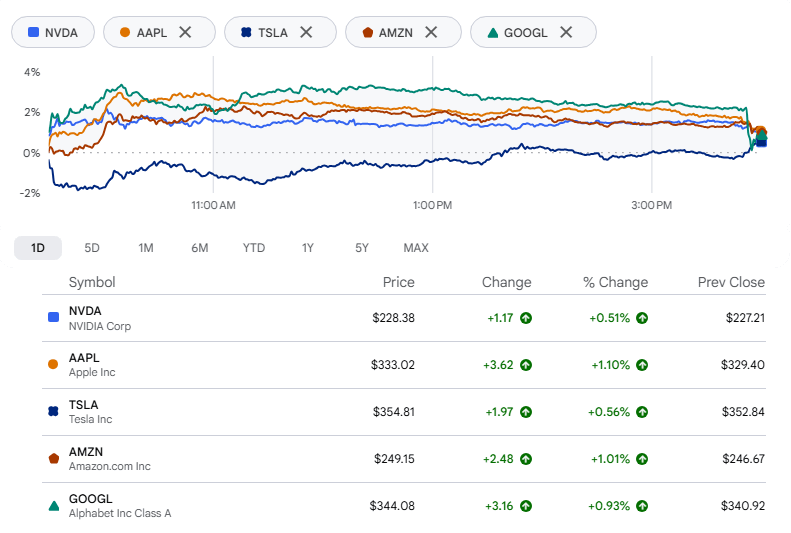
Five of the "Magnificent Seven" were in positive territory; Alphabet, Amazon, and Apple each rose 1% while Tesla and Nvidia rose by half a percent.
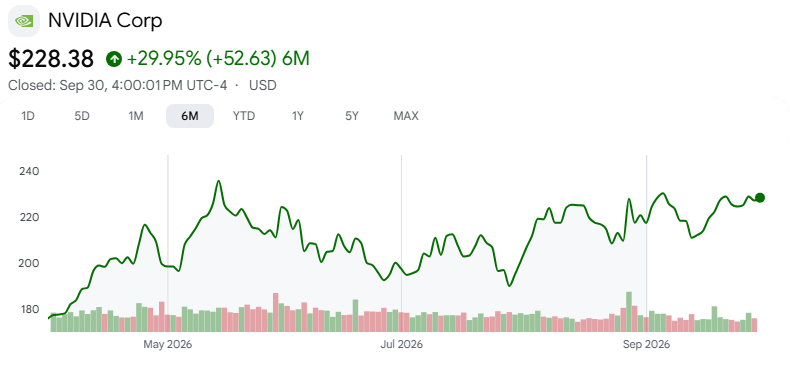
Nvidia (NVDA) closed out a big quarter. CEO Jensen Huang was everywhere in the third quarter: on an earnings call, in media interviews, at tech conferences, and at dinner and lunch events with President Trump. He also spent $12.9 billion to buy Hugging Face. All that visibility for the world's best-known tech CEO, black leather jacket included, seems to have worked in shareholders' favor. Nvidia stock has surged 17% this quarter, which officially ends today, while the S&P 500 (^GSPC) has gained 4.3%. Year to date, Nvidia is up 23%.
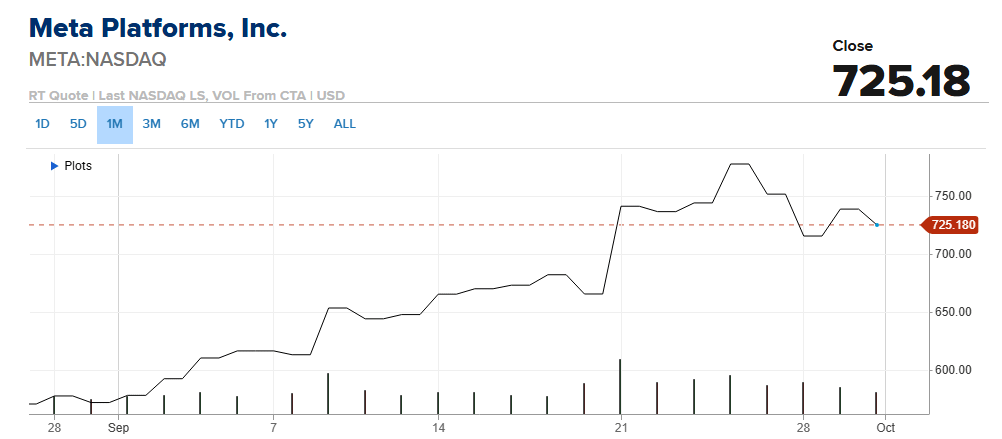
Meta climbed 25% in September, largely on the warm reception for Muse, its first consumer AI agent. "Agentic commerce has been touted as the next biggest evolution in digital commerce since the rise of eComm," Deutsche Bank's Nate Svensson said in a Tuesday client note. "Meta's Muse represents the first real large-scale consumer platform built around autonomous commerce, moving AI beyond recommendations and into transaction execution."
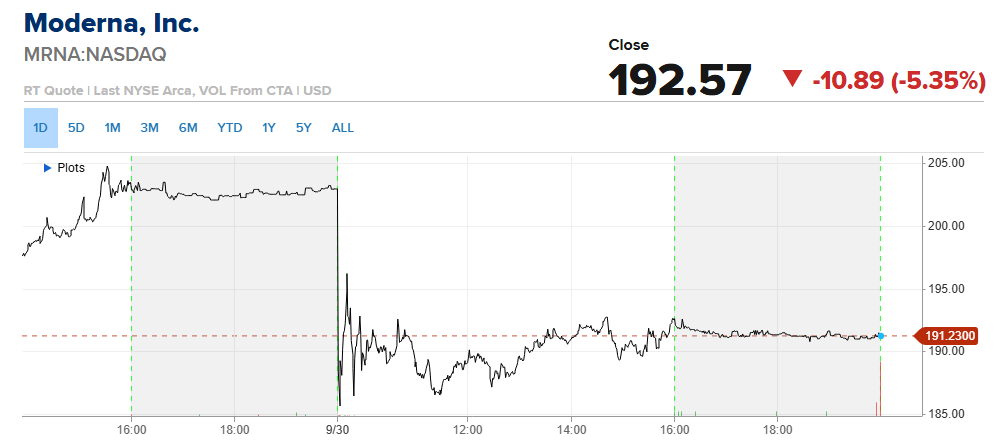
Moderna dropped more than 5% after Citi cut the stock to sell. The bank's analysts set a price target 60% below Tuesday's close and argued the current valuation can't be justified.
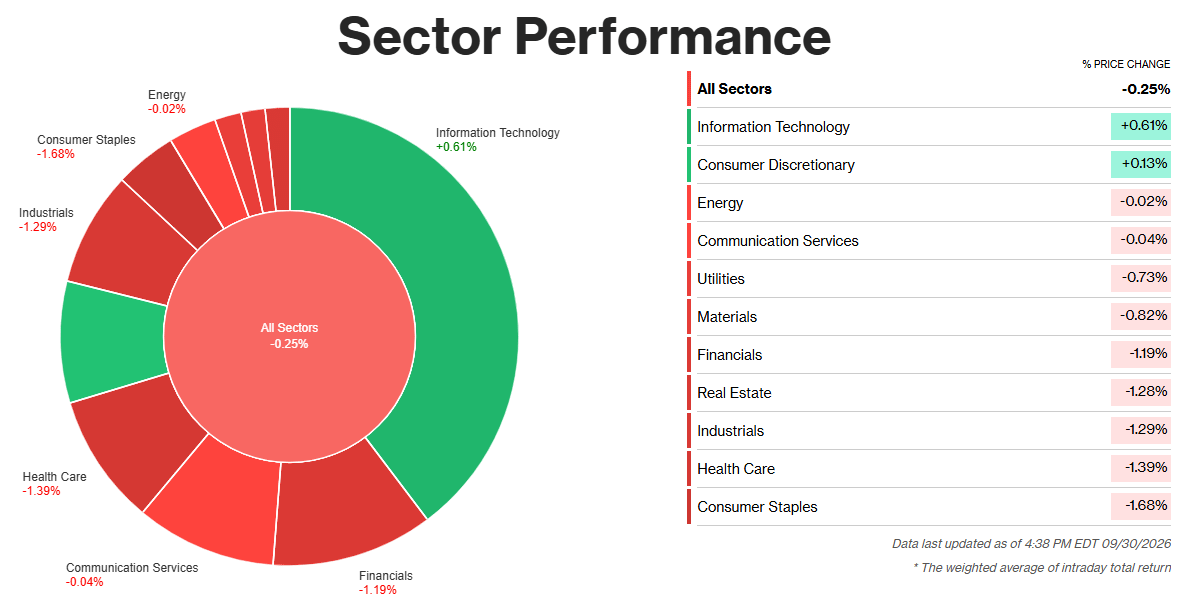
Sector Performance Summary
Best-Performing Sectors
Information Technology (+0.61%) and Consumer Discretionary (+0.13%) were the only sectors to finish higher on a day the S&P 500 slipped 0.25%. Tech's gain was an AI-hardware story. Hewlett Packard Enterprise jumped after landing a $1.2 billion Vultr order for AMD's Helios AI racks and raising its long-term networking growth forecast, and Gen Digital recovered after announcing a bid for GoDaddy earlier in the week. The bigger point is the trend. Tech was the only sector to gain in September, and Nvidia is up 17% for the quarter. With Micron reporting after the bell, this looks like sustained leadership, not a one-day rotation.
Consumer discretionary's thin gain owed more to the economy than to any single headline. Inflation-adjusted consumer spending rose 0.6% in August, evidence that households are still spending despite higher borrowing costs. Amazon, the sector's heaviest weight, added about 1% as Rosenblatt lifted its price target to $360.
Worst-Performing Sectors
Consumer Staples (-1.68%) fell furthest. Rising Treasury yields pressured defensive, dividend-paying names and made them less appealing next to fixed income, and General Mills led the group lower after announcing that COO Dana McNabb will replace CEO Jeff Harmening. The yield pressure was sector-wide, while the CEO change was company-specific.
Health Care (-1.39%) had no single dominant driver. Moderna closed down more than 5% after Citi downgraded it to Sell, calling its valuation unjustifiable following a 200%-plus rally, and a Delaware court denied its motion to dismiss key patent claims. One stock can't explain a slide this size, and no sector-wide catalyst emerged. The group looks to have traded with the market's rate-driven tone.
Industrials (-1.29%) were hit by higher financing costs. Rising yields weighed on the economy-sensitive names that dominate the Dow, which lost 443 points and ended September down 4.3%. Northrop Grumman added company-specific pain, falling nearly 4% after the Navy picked Boeing for the $20 billion-plus F/A-XX fighter program. Boeing rose before the bell, but that did little to cushion the sector.