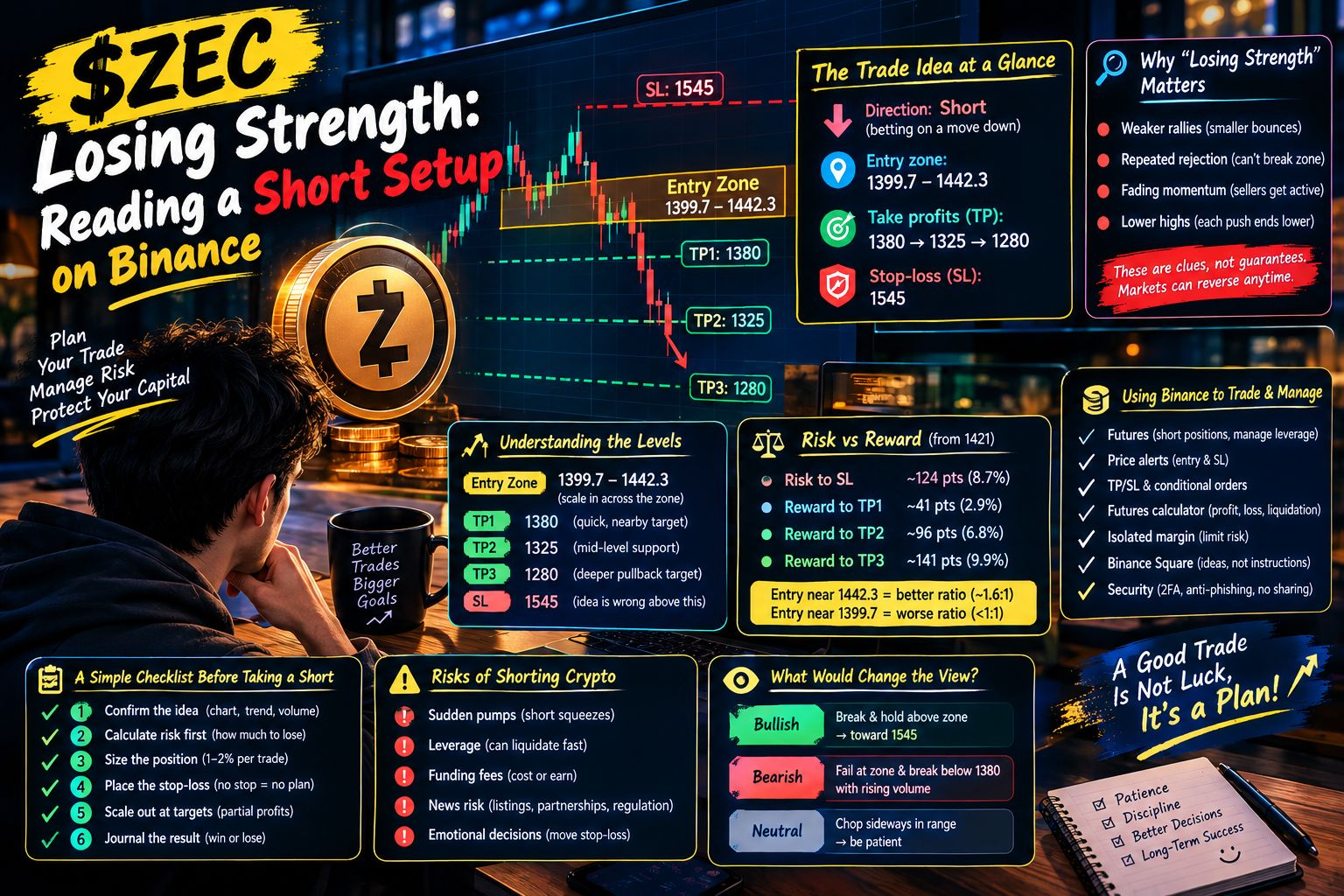

⚠️ **$ZEC is losing strength around this zone, and the setup points toward a deeper pullback.** The short idea targets the lower support levels, with a defined entry, three take-profit targets, and a stop-loss. Let's break it down step by step. 🧩
## 📋 The Trade Idea at a Glance
- 🎯 **Direction:** Short (betting on a move down)
- 📍 **Entry zone:** 1399.7 – 1442.3
- 💰 **Take profits (TP):** 1380 → 1325 → 1280
- 🛑 **Stop-loss (SL):** 1545
The idea is simple: price is struggling in this area, so the trader expects sellers to push it down toward lower support levels. 🔽
## 🔍 Why "Losing Strength" Matters
When an asset "loses strength" near a zone, traders usually look for signs like:
- 📉 **Weaker rallies:** Bounces get smaller and fade quickly.
- 🧱 **Repeated rejection:** Price tests the zone but can't break through.
- 📊 **Fading momentum:** Buying pressure slows while sellers become more active.
- 🔄 **Lower highs:** Each push up ends below the last one.
These are only clues, not guarantees. 🕵️ Markets can reverse at any moment.
## 🧮 Understanding the Levels
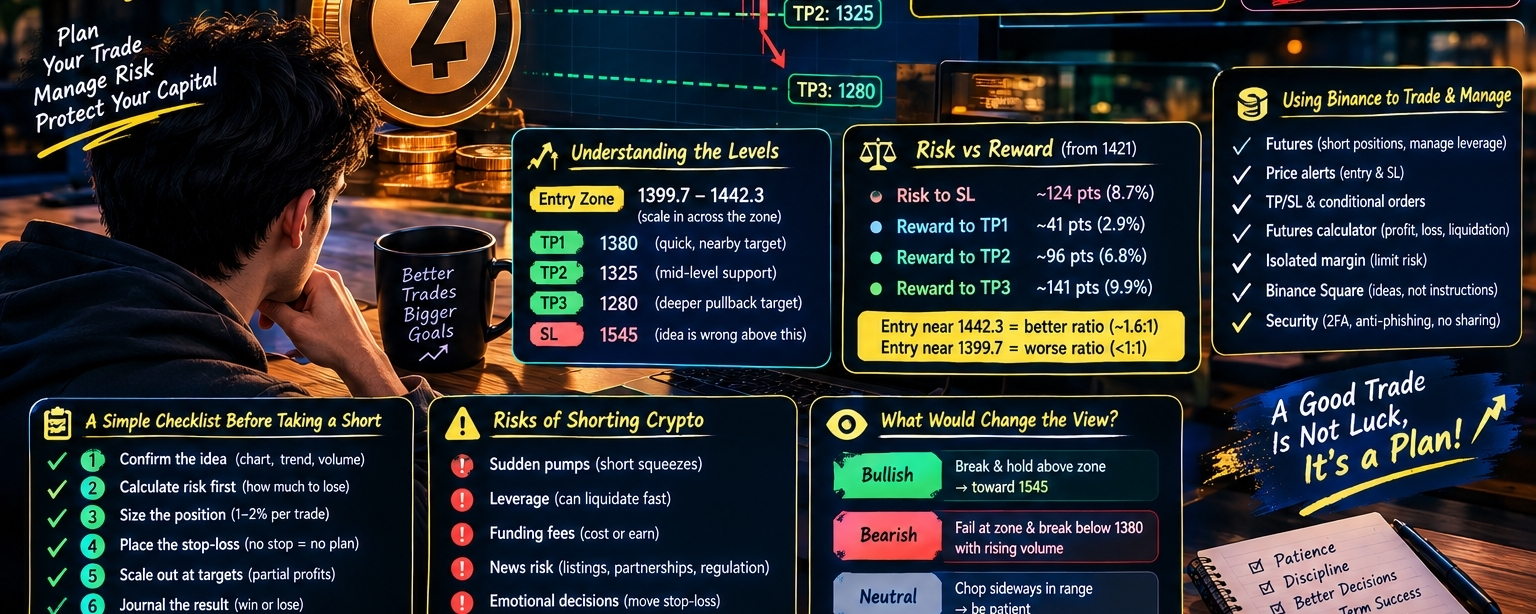
**📍 Entry zone (1399.7 – 1442.3):** A range gives flexibility. You can scale in across the zone instead of placing everything at one price.
**💰 Three take-profits:** Taking profit in stages locks in gains along the way:
- 🥉 **TP1 (1380):** A quick, nearby target to reduce risk early.
- 🥈 **TP2 (1325):** The mid-level support target.
- 🥇 **TP3 (1280):** The deeper target if the pullback fully develops.
**🛑 Stop-loss (1545):** This is where the idea is proven wrong. If price climbs above the entry zone and reaches 1545, the bearish view is invalid and the trade closes with a controlled loss.
## ⚖️ The Risk-Reward Reality Check
This is where smart traders slow down. 🧠 Using the middle of the entry zone (about 1421):
- 🔻 **Risk to SL:** about 124 points (~8.7%)
- ✅ **Reward to TP1:** about 41 points (~2.9%)
- ✅ **Reward to TP2:** about 96 points (~6.8%)
- ✅ **Reward to TP3:** about 141 points (~9.9%)
**What this tells us:**
- 📌 TP1 alone pays much less than the risk, so it only makes sense as part of the full plan.
- 📌 Reaching TP3 gives roughly a 1.1 to 1 reward-to-risk ratio from the middle of the zone.
- 📌 **Entry price matters a lot.** Entering near the top (1442.3) gives a better ratio, around 1.6 to 1 to TP3. Entering near the bottom (1399.7) makes it worse, below 1 to 1.
The lesson: **don't just follow the targets, check the math before you enter.** 🎓
## 🏦 Using Binance to Plan and Manage a Trade
Binance offers tools that help with a setup like this:
- 📈 **Binance Futures:** Allows short positions, but it comes with leverage risk. Use it only if you understand how margin and liquidation work.
- 🔔 **Price alerts:** Set alerts at the entry zone and at the stop-loss so you don't need to stare at the screen.
- 🧾 **TP/SL and conditional orders:** Set your take-profits and stop-loss when you open the trade, so the plan runs even if you step away.
- 🧮 **Futures calculator:** Estimate profit, loss, and liquidation price before you place the order.
- 🛡️ **Isolated margin:** Limits the risk to the margin assigned to one position instead of your whole balance.
- 📰 **Binance Square:** Follow other traders' ideas, but treat them as inspiration, not instructions.
- 🔐 **Account security:** Turn on 2FA and anti-phishing codes, and never share your login details.
## 🧠 A Simple Checklist Before Taking a Short
1. ✅ **Confirm the idea yourself:** Check the chart, trend, and volume, not just someone's post.
2. ✅ **Calculate risk first:** Decide how much you're willing to lose before thinking about profit.
3. ✅ **Size the position properly:** Many traders risk only 1–2% of their account per trade.
4. ✅ **Place the stop-loss immediately:** No stop means no plan.
5. ✅ **Scale out at targets:** Take partial profits and manage the rest.
6. ✅ **Journal the result:** Win or lose, write down what you learned.
## ⚠️ Risks of Shorting Crypto
- 🚀 **Sudden pumps:** Crypto can spike fast, and shorts can be squeezed.
- 🔥 **Leverage cuts both ways:** High leverage can liquidate a position before your stop-loss makes sense.
- 💸 **Funding fees:** Holding a futures position can cost or earn funding, depending on market conditions.
- 📰 **News risk:** Listings, partnerships, or regulatory news can flip sentiment instantly.
- 😰 **Emotional decisions:** Moving your stop-loss further away because "it will come back" is a classic mistake.
## 🔮 What Would Change the View?
- 👀 **Bullish:** A strong break and hold above the entry zone toward the 1545 stop level weakens the bearish idea.
- 👀 **Bearish:** Price failing at the zone and breaking below 1380 with rising volume supports the pullback scenario.
- 👀 **Neutral:** Price chopping sideways inside the entry range means patience is better than forcing a trade.
## 🚀 Final Thoughts
The $ZEC setup is a good example of a **structured trade plan**: clear entry, staged targets, and a defined exit if wrong. 📐 But a plan is only useful if the numbers make sense and the risk fits your account. Stay disciplined, protect your capital first, and remember that no setup is guaranteed. 💪📚
> ⚠️
## 🏷️