


Quant has moved into the spotlight after securing roles in major tokenized deposit projects across the United States and the United Kingdom.
The developments placed the London-based company at the center of banks’ growing push toward blockchain-based deposits. Meanwhile, QNT recorded one of the strongest weekly rallies among the top 100 crypto assets. However, technical indicators now show that momentum may be cooling after the rapid advance.
Quant develops Overledger, software that connects existing banking systems with multiple blockchain networks. Its QNT token supports access to that infrastructure. Over the past week, QNT climbed from roughly $64 to a high near $371 before retreating toward $260.
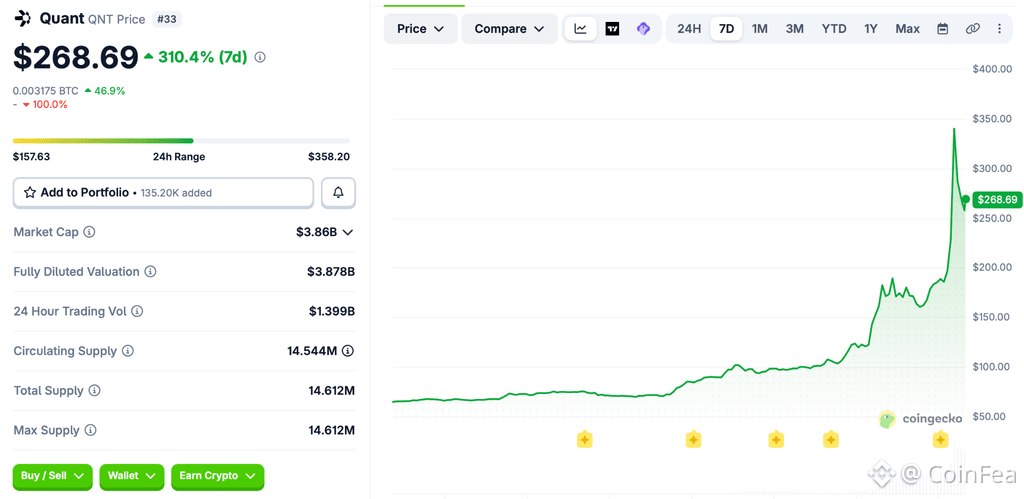
The token gained more than 300% during the period. The sharp rally followed two banking announcements released on September 24.
Quant secures tokenized deposit roles in US and UK banking
The Clearing House selected Quant to support its new tokenized deposit network in the United States. The organization belongs to 25 major US banks, including JPMorgan Chase, Bank of America, and Citi.
Its payment networks process more than $2 trillion each day. According to the announcement, the tokenized deposit network should launch during the first half of 2027.
Big news: Quant is partnering with @TCHtweets to bring on-chain, #programmablemoney to the US. We will provide the interoperability layer that lets #tokeniseddeposits move freely within the regulated banking system. This builds on our work in the UK, Europe and beyond. Read… pic.twitter.com/ZdHOd0txRP
— Quant (@quantnetwork) September 24, 2026
The Clearing House plays a major role in US dollar payments. Therefore, its move into tokenized deposits could provide banks with another route for transferring regulated money on blockchain infrastructure.
Quant also supported a separate banking project in the United Kingdom.
Seven UK banks completed interbank transfers involving tokenized pound deposits through a Quant-built platform. Participants included Barclays, HSBC, Lloyds, NatWest and Santander.
The transactions formed part of a live pilot involving some of Britain’s largest financial institutions. Consequently, Quant gained exposure to major tokenized deposit initiatives on both sides of the Atlantic.
However, the announcements involved Quant as a company rather than QNT directly. The firms have not explained how much commercial activity will require the QNT token.
That distinction leaves uncertainty around how banking adoption could translate into direct token demand.
QNT price faces resistance as daily RSI reaches 86
QNT opened near $286 before climbing toward $320 during the latest session. The token then retreated toward $258, representing an intraday decline of roughly 10%.
Earlier in the rally, QNT reached nearly $370 before reversing. That move places the $320 to $370 region among the key levels traders may monitor.
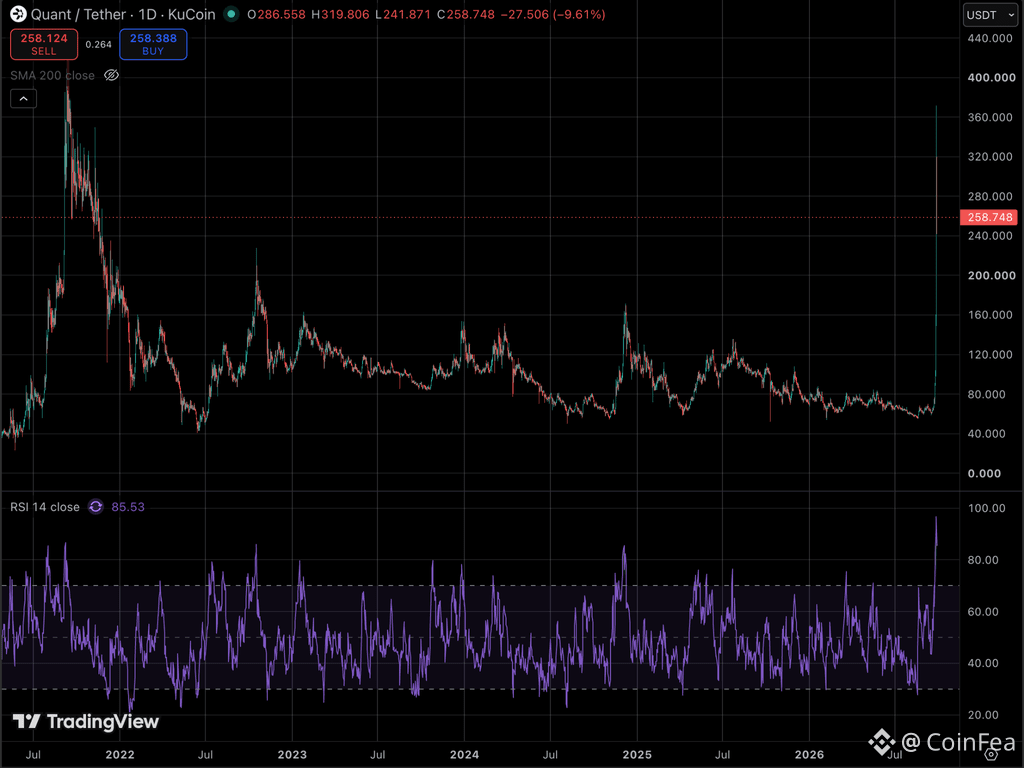
The area also carries historical significance. QNT traded between roughly $250 and $300 for several months following its 2021 peak before declining during 2022.
The same range again restricted the latest advance. Above that region, the 2021 peak between approximately $400 and $430 remains another major resistance area.
On the downside, the 2022 high around $210 to $225 represents the nearest support zone. The December 2024 high near $160 to $170 provides another level below it.
Further weakness could expose the $100 region because QNT moved through much of that range rapidly during the latest rally.
Meanwhile, the daily relative strength index reached roughly 86. That marks its highest reading on the five-year view.
The elevated RSI and long upper price wick indicate that upward momentum has weakened after the rapid advance. QNT may therefore face increased volatility as traders assess whether banking adoption can support the token’s latest valuation.
The post Quant lands major US and UK bank deals as QNT surges 300% first appeared on Coinfea.